I went to a quiet suburban wedding recently. During the vows, a man two rows ahead of me scrolled through his phone. Not furtively. Openly, thumb moving, face lit blue. His own daughter was the one getting married. I kept watching him instead of the couple, which says something about me, I guess. It also says something about a book I had just finished.
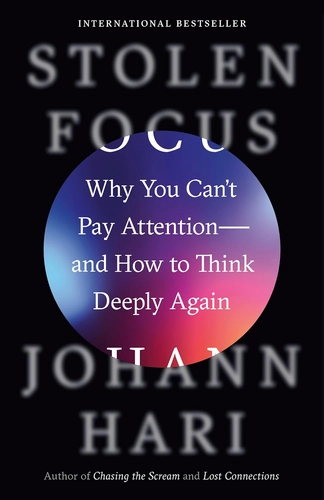
Johann Hari’s Stolen Focus asks a question that sounds almost naive until you sit with it. If our attention is collapsing, and it clearly is, who exactly is taking it? Is the answer our own weakness, or something that was done to us? It is not a productivity manual. It is a quiet accusation.
A Man Who Locked Himself on a Boat
Hari opens with his own humiliation. He could not read a book anymore. He tried every trick, every app, every digital detox, and still felt his mind sliding off the page like water off glass. So he did something slightly absurd. He spent months offline, mostly alone, on a boat, and kept a diary of what came back to him.
What came back first was boredom. Then, slowly, something stranger, a kind of mental drifting that felt like wasted time until he realized it was where his best thinking lived. His brain had not been broken. It had been trained, patiently, by tools designed to train it.
The book follows him across the world, to a Silicon Valley defector who admits he helped build the machinery, to a Rio favela where a rumor spread faster than truth could travel, to a New Zealand office that tried something almost quaint. Hari is a good companion, self-deprecating and a little dramatic. You trust him because he keeps admitting he was wrong. I rolled my eyes once or twice at how tidy his personal arc becomes. Real life rarely resolves that cleanly.
But the conflict underneath never fully resolves, and that is the point. He wants to believe individual effort can save us. The evidence he gathers keeps telling him otherwise. By the middle of the book, that tension starts to feel like the actual subject.
The Invoice You Never See
The central claim is this. Twelve forces, from polluted air to sleep loss to the collapse of childhood play, have combined to erode our attention, and the loudest of them, social media, was engineered on purpose by people who studied how to hook us. His most useful concept is the switch cost. Every time you flick between tasks, your mind pays a tax, and the tax compounds. He cites research suggesting the drop in cognitive performance from heavy multitasking rivals the impairment of a sleepless night.
That image sticks. The stolen hour, the stolen focus, the invisible invoice.
His second key idea is flow, borrowed from the psychologist who spent his life studying it. Flow is the opposite of the fragmented mind, the state where time thins out and work stops feeling like work. Hari argues we should chase flow instead of punishing ourselves for distraction.
The book has real weaknesses. Hari is a synthesizer, not a scientist, and he compresses complicated research into clean anecdotes. Some reviewers have called him out for that, fairly. A few chapters grow repetitive, and his solutions section is thinner than his diagnosis. Still, the diagnosis is what I keep returning to.
This is for anyone who has felt their mind fraying and blamed themselves. It is also for parents watching their kids disappear into screens, and for anyone who suspects something larger is at work.
Who Pays for Your Lost Hour
The deeper argument creeps up on you. Attention is not just a personal resource. It is an economy, and someone is collecting the interest. The book’s darkest passage describes a room of people in virtual reality headsets, everyone hypnotized except the man standing at the front. Hari uses it as a metaphor for a coming divide, a majority whose focus is harvested and a small class who understand exactly what focus is worth.
I keep thinking about that wedding. That man was not weak. He was captured. The machinery knew his vulnerabilities better than he did, and it had years to practice.
What do we do with that? Hari offers small things, daylight, walks, boredom, sleep. He admits they are not enough alone. The honest answer is that no single person fixes this. The book leaves you with a question rather than a solution, which is why it stays with me.
Maybe that is what attention really is. Not a muscle we forgot to train, but a commons we let someone fence off while we were looking at our phones. The question is whether we notice before the fence is finished.

