Rocky starts somewhere small and ends up somewhere enormous. By the time you catch up, she has already worried her way through three catastrophic scenarios and made you laugh in the middle of all of them.
The novel follows Rocky two years after Sandwich. Her mother has died. Her ninety-two-year-old father, Mort, now lives in the in-law apartment. Her son Jamie has a consulting job in New York. Her daughter Willa is home after college, anxious and sharp and very funny. And Rocky has a rash that spreads and will not go away, which sends her through months of specialists and bloodwork and quiet dread.
Can a person love fiercely and still live without certainty? Rocky does not conquer fear. She keeps loving anyway. And Newman refuses to pretend that is easy.
What Rocky Carries Around
The book has a second thread. A young man dies when his car is struck by a train near town, and Rocky cannot stop thinking about him. The man knew Jamie in high school. That thin connection is enough to pull her into a fixation on the accident, on the dead man’s mother, on whether it was a faulty crossing signal or something else. She checks Facebook at night. She reads comments. She builds theories.
Rocky loves by preparing for disaster. She googles symptoms at 2 a.m. She imagines her children’s deaths in detail. She does this because she is trying to be ready. And being ready is impossible.
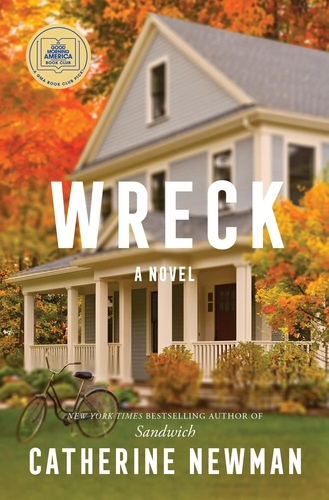
For the first forty pages, Rocky’s voice felt like too much. The asides, the tangents, the jokes landing while something terrible is happening. Then I realized the voice is the point. Her mind works this way because her love works this way.
The most unsettling scene for me was not the accident or the diagnosis. It was Rocky sitting with her father while he forgot a word, and she felt the familiar spiral start, and she did not stop it. She let the fear in. Then she made him lunch.
The Rash That Means More Than a Rash
The rash is Newman’s central image, and she uses it well. It starts small. It spreads. No doctor can name it. It is the physical form of the book’s argument: your body can betray you without giving you a name for the betrayal, and you still have to get up and make dinner.
The accident is the other image. A train on a track. A car on a road. Two paths that should have stayed separate. Newman returns to that crossing again and again, and each time it means something slightly different: randomness, negligence, the fragile border between a normal Tuesday and the end of a family’s life.
What struck me most was how Newman handles the question of fault. The authorities say suicide. The town whispers about the signal. Rocky leans toward the railroad’s negligence, and I did too. Then she wonders if she only believes that because believing in a broken system is easier than believing in a young man’s despair. That moment felt honest in a way I was not expecting.
Newman does not resolve the ambiguity. She lets it sit, and the sitting is what changes Rocky.
The Ambiguity That Stays
Newman is very good at the texture of family life: food, coffee, the way a daughter says “Mom” when she means “please stop.” She is less good at endings. Some of the late chapters feel rushed, and a few characters, Nick especially, stay thin. He is steady and kind. He is also mostly a surface for Rocky to bounce off.
The book is not for readers who need a clear diagnosis or a villain. It is for people who have sat in a waiting room and tried to read a magazine. It is for anyone who has loved someone who drives on highways at night. It is not for readers who want their anxiety soothed. Newman offers company, not comfort.
What I gained from Wreck is a smaller, stranger thing than I expected. I stopped trying to figure out whether Rocky was right to obsess. I started noticing how often I do the same math in my own head: if I worry enough, maybe nothing bad happens. It doesn’t work. It never worked. But I keep doing it.
The title is a verb and a noun at once. Things wreck. People are wrecks. And somehow the people in this novel keep showing up for each other, badly and on time.
This book won’t teach you how to stop being afraid. But it will sit with you in the fear, and there is a kind of company in that I did not know I needed.

