When I was three months into motherhood, I owned six parenting books. I had read maybe forty pages of one. Most of them sat in a stack by the rocking chair, spines uncracked, quietly judging me while I tried to figure out why my daughter screamed every time I put her down.
That is the thing nobody tells you about becoming a new mom. You are handed a list of the best parenting books for new moms before you even leave the hospital, and then you have zero hours to read them.
Quick answer: Which parenting book actually helps a new mom?
Start with one that answers quick questions, one you can use with one hand while nursing, and one that helps you understand yourself, not just your baby.
Here are three books that earned their place on my shelf. One is a reference you will actually use. One is built for parents with ninety seconds and one free hand. One changed how I parent.
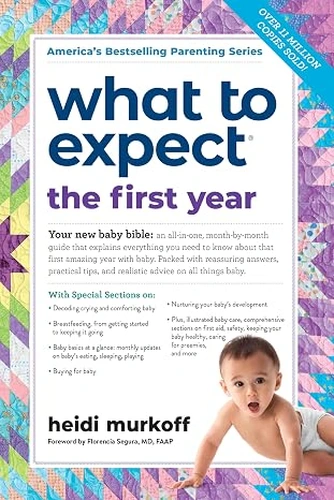
What to Expect the First Year
By Heidi Murkoff
This is the encyclopedia. And I mean that in a good way.
Nearly twelve million copies in print. Month-by-month so you do not have to read it all at once. When my son had a weird patch of dry skin at five weeks, I found the answer in four minutes.
What you get:
- Month-by-month guidance for the first year
- Answers to specific questions about feeding, sleep, and development
- A reference you can flip to when something worries you
Best for: Any new mom who wants a reliable reference she can grab in a panic.
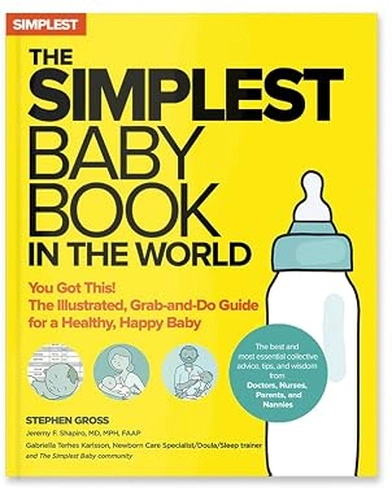
The Simplest Baby Book in the World
By S.M. Gross
This one is built for the parent who has ninety seconds and one free hand.
Over 700 illustrations. Grab-and-do format. Checklists at the start of every chapter. I kept it on the kitchen counter for a year.
What you get:
- Visual, step-by-step guidance for everything baby-related
- Checklists that tell you what to do next
- A format that works when you are exhausted and cannot read paragraphs
Best for: Any new mom who does not have time to read a traditional book.
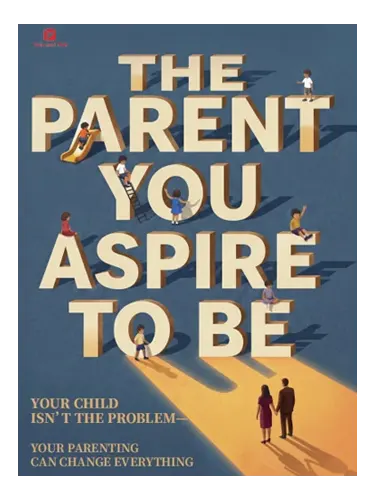
The Parent You Aspire to Be
By Miles Carter
This is the one that changed how I parent.
The first time I read it, I was defensive. Carter opens with a line that stung. You swore you would break the cycle for your kids, and you still find yourself yelling, shutting down, repeating the very things you promised to change.
I closed the book. I was not ready.
The second time, six months later, I read it slowly. What I noticed was that Carter does not start with the child. He starts with the parent. Stress, control, anxiety, the emotional reactions that show up before we have time to think.
The third time, I finally got it. The book is not about fixing your child. It is about noticing what happens inside you when your child does something hard. That is where the work is.
What you get:
- How to manage your own emotions first
- Why children lie, melt down, and fight screen time, and what those behaviors are really saying
- How to repair after you lose your temper
- How to set gentle but firm boundaries
One key idea: Repair after rupture. You will lose your temper. You will say the wrong thing. What matters is what happens next. You come back. You say, “I was frustrated earlier. That was mine, not yours.” You stay close.
Best for: Any mom who is lying awake at night wondering whether she is becoming her mother, and whether that is a good or a terrible thing.
The Three-Step Pause
Carter offers several frameworks. The one I kept is what I call the Three-Step Pause.
| Step | What to say | Why it works |
|---|---|---|
| Acknowledge | “You are really upset that we have to leave the park.” | No fixing. Just naming it. |
| Guide | “We are walking to the car now. You can hold my hand or walk beside me.” | A boundary with two choices inside it. |
| Reflect | “That was hard earlier. You did it anyway.” | The part most of us skip. Also the part that teaches. |
I have used this in grocery stores, at birthday parties, in the parking lot of a pediatrician’s office. It does not always work. Some days nothing works. But it gives me something to do besides yell.
A Small Story About Spilled Milk
Last winter my daughter, then four, spilled an entire cup of milk across the table. My first instinct was the sharp breath, the tightening in my chest. I knew exactly what was coming.
Then I remembered Carter’s spilled milk contrast. Two accidents, two reactions. The child absorbs the pattern, not the rule.
I said, “Oops. That happens. Let’s get a towel.”
She looked at me like I had grown a second head. Then she got the towel.
Two weeks later, she spilled again. And she said, “Oops. That happens.” And she got the towel herself.
That is what I mean by the book changing me. Not through theory. Through one small moment that repeated.
Which Book Should You Start With?
| If you want… | Start with… |
|---|---|
| Answers to specific questions | What to Expect the First Year |
| Something you can use with one hand | The Simplest Baby Book in the World |
| To understand yourself as a parent | The Parent You Aspire to Be |
You do not need all three. Pick the one that matches where you are right now.
Final Thought
The stack of books by my rocking chair is smaller now. Three titles, all with cracked spines and coffee rings.
My daughter, who is now six, pulled one off the shelf last week and asked what it was about. I told her it was a book about how to be a good mom.
She thought about it for a second. “You already are one,” she said.
I do not know if that is true. But I am keeping the books anyway.
Start with one book. Try one technique. See what happens.
References
Murkoff, Heidi. What to Expect the First Year. Workman Publishing.
Gross, S.M. The Simplest Baby Book in the World.
Carter, Miles. The Parent You Aspire to Be.

