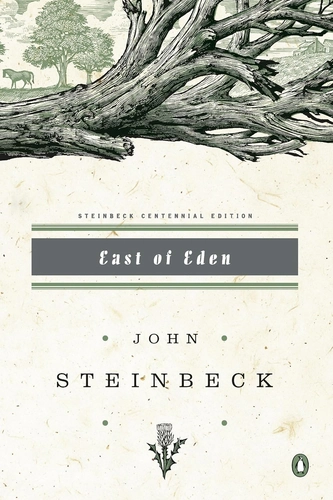
John Steinbeck called this book “the first book,” the one all his earlier work was only rehearsal for. That claim sounds like vanity until you finish it. Then it sounds like a warning.
The question East of Eden keeps pressing into your ribs is not whether the Trasks will repeat their ancestors’ mistakes. It is whether any of us can stop repeating our own.
Two Brothers, One Inheritance, and a Word Nobody Can Translate
The novel opens in Connecticut, then moves to the Salinas Valley in California, and it follows two families across three generations. Adam Trask grows up under a father who prefers his half-brother Charles, and the wound of that preference never closes. Adam marries Cathy Ames, a woman whose capacity for harm is established early and never really explained away. She gives birth to twin boys, Cal and Aron, and then she leaves. Adam, gutted, retreats into a kind of waking absence while a Chinese servant named Lee raises his sons.
Cal is the one I could not stop watching.
He is dark where his brother is golden, suspicious where Aron is trusting, and convinced from childhood that something rotten was passed to him through his mother’s blood. He spies on his father. He resents the way people brighten when Aron walks into a room. Steinbeck gives him a scene where he follows his mother to a house in Salinas and stands outside, and the dread in those pages is almost physical. I put the book down twice.
What makes Cal unbearable to read, in the best sense, is that he is not a bad person performing badness. He is a boy trying to figure out whether he is allowed to be good.
That question is the engine of the whole book, and it does not resolve the way you expect.
The Hebrew Word That Breaks the Chain
The core of this novel sits in a conversation about one word.
Lee, the servant, has spent years consulting Chinese scholars and a rabbi about a single Hebrew term in the Cain and Abel story. English translations, he explains, render it as “thou shalt” or “do thou,” which turns the line into a command or a promise. The Hebrew is closer to “thou mayest.” You may master sin. Which also means you may not.
That distinction, small as a thumbprint, reorganizes everything.
If the word is a command, then Cain had no real choice and neither do the Trasks. If it is permission, then the entire weight of what happens next lands on the person doing the choosing. Steinbeck builds generations of jealousy and violence and then quietly hands the reader a door. Not a guarantee that anyone walks through it. Just the door.
The Salinas Valley carries the same argument in its landscape. Steinbeck describes the river and the hills and the changing seasons with the patience of someone who genuinely loves dirt. The valley is beautiful and indifferent. People arrive, work it, fail at it, die in it. Nothing in the land decides who they become.
Cathy is the test case that complicates everything. She reads as a monster, and some readers find her too flat, too purely malignant to belong in a book this nuanced. I felt that pull too. But she also functions as the limit of the argument. If even she retains the freedom to choose, then the word applies to everyone. If she does not, then Steinbeck has smuggled in a born-evil exception and the whole structure wobbles.
I still have not settled that question. Four months later.
The prose is plain in the way a hammer is plain. Steinbeck can spend three pages on a family’s dinner table and make you feel like you have known these people your whole life, then drop a single sentence that lands like a dropped plate.
This book is for you if you have ever looked at your own family and wondered which parts of yourself you inherited and which parts you agreed to. It is for readers who want a story that argues with them.
It is not for you if you need a tight plot, or if cruelty on the page sits badly with you, because there is a lot of it, and it is not decorative.
What I took away: the past explains you. It does not sentence you. That sounds simple until you try to live it.
This novel will not fix your relationship with your family. It will not tell you that everything works out. But in the moments when you catch yourself becoming someone you did not choose to be, it will remind you that you are standing at a door that is still open.
Timshel. Thou mayest.

