I still remember the Tuesday I yelled at my partner because he dropped a spoon. Not a plate. Not a glass. A spoon. It clattered on the tile and something inside me just tipped over. He looked at me like I had grown a second head.
That night I lay awake thinking about how stress moves through a house. Not in the abstract way you read about. In the specific way where your own voice comes out of your mouth and you don’t recognize it.
If you’re reading this, you probably had a Tuesday like that too. Maybe it was this week.
Why Is the Hour After Work the Hardest?
Here’s what I’ve noticed in my own home, and in the homes of just about everyone I talk to.
Stress doesn’t stay where it starts. A tense meeting at 3 p.m. doesn’t politely pack up and leave when you walk through your front door. It rides home with you. It sits in your shoulders. It shortens your fuse to about the length of a matchstick.
Then someone does something completely ordinary. Spills water. Whines about dinner. Asks a question you’ve answered twice. And you react like it’s a crisis.
The strange part is that the reaction rarely matches the moment. You’re not actually furious about the spoon. You’re depleted. There’s a difference, and the people around you can feel it even if they can’t name it.
Researchers who study this pattern keep finding the same thing. When you’re running on empty, small daily frictions land harder. Some writers call it cumulative stress. It builds quietly until one tiny thing tips it over.
So the spoon was never the problem. The spoon was just the last straw on a pile you’d been carrying since 8 a.m.
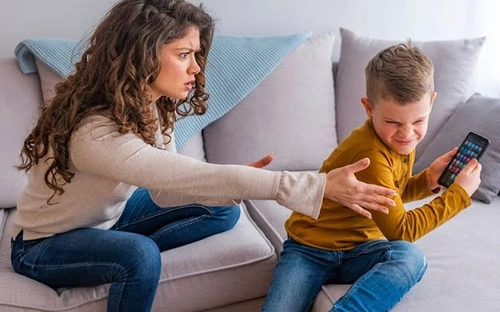
What the People Around You Actually See
My nephew, who is six, once told me, “Your face gets sharp before you shout.”
I asked him what he meant. He said my eyebrows go down and my mouth goes flat. He can read the storm coming about ten seconds before it arrives.
That stayed with me. The people who live with us aren’t just on the receiving end of our stress. They’re watching for it. They scan our faces the way sailors scan the sky. And when they see the storm building, they do one of two things. They go very quiet and small, or they get louder, which is really just a different kind of scared.
This is the part nobody warns you about. It’s not only about what you say. It’s about what the people around you learn to expect from your face.
Why Do They Melt Down Right When You Have Nothing Left?
There’s a small mercy hidden in this, and I want you to hear it.
People often save their biggest feelings for the person they feel safest with. The coworker gets the polite version. You get the tears, the clinging, the meltdown over the wrong cup.
It feels like a punishment. It’s closer to a compliment, though a very tiring one.
So when you walk in the door and someone immediately falls apart, try this reframe for a second. They were holding it together all day, and you’re the person they can finally let go with. That doesn’t make the screaming pleasant. It just makes it make a little more sense.
The Five-Minute Bridge
We started something in our house that I didn’t plan carefully. It just grew.
I call it the Five-Minute Bridge. The idea is simple. Before I become “person on duty,” I take five minutes to become a person again.
Here’s what it looks like. I walk in. I say hello. I get the hugs. I hear about the day. Then I say the same sentence every time. “I need five minutes to put my work face away. Then I’m all yours.”
Then I go to my room. I don’t check my phone. I change my clothes. I wash my face. Sometimes I just sit on the edge of the bed and breathe like a person who isn’t being chased.
Five minutes. That’s it.
The first week, my partner stood outside the door asking if I was done yet. That’s fair. By the second week, he started doing his own version. By the third week, we both had our five minutes and the evenings felt different.
I’m not going to pretend this fixed everything. It didn’t. But it moved the yelling from “most evenings” to “some evenings,” and some evenings is a very different life.
Why Does Five Minutes Actually Help?
The five minutes don’t remove the stress. They give it somewhere to land that isn’t someone else’s face.
Think of it like changing shoes. You wouldn’t walk into your house with muddy boots and then act surprised at the footprints. Work stress is muddy boots. The Five-Minute Bridge is the doormat.

What If You Live Alone?
Then you build the bridge for yourself.
I know someone who does “quiet snack time” the moment she gets home. She sits. She eats something small. She doesn’t talk much. It’s not a break exactly, but it’s a landing.
The shape of the ritual matters less than the fact that it exists. People thrive on predictable transitions. So do adults, honestly. We just forget to give ourselves one.
One Thing I Finally Understood
After the spoon night, I apologized. I said, “I was tired and I shouted, and that wasn’t about you.”
He nodded very seriously and said, “Okay.” Then he asked for a cracker.
People are remarkably forgiving. That’s a gift and also a warning, because we shouldn’t lean on it forever.
What I understand now is this. How stress moves through a house isn’t really about the stress itself. It’s about whether there’s a gap between the stress and the reaction. A small gap. Five minutes wide.
That gap is where the people you love get to meet the person you actually are, instead of the one your Tuesday turned you into.
References
- Payne, Kim John. Simplicity Parenting. Ballantine Books.
- American Academy of Pediatrics. “Parenting Stress and How to Manage It.” HealthyChildren.org.
- Siegel, Daniel J., and Tina Payne Bryson. The Whole-Brain Child. Bantam.
One Last Thing
The spoon is still on my kitchen floor somewhere, in my memory. Nobody else remembers it. I do. That’s the whole reason I keep taking those five minutes.

