I sat in a parking lot last month, engine off, doing math on my phone. My cousin had just told me she got a raise, and her first sentence was not “I’m saving more.” It was “I can finally afford the car I wanted.” I said something encouraging. Then I sat there and counted how many times I had done the exact same thing.
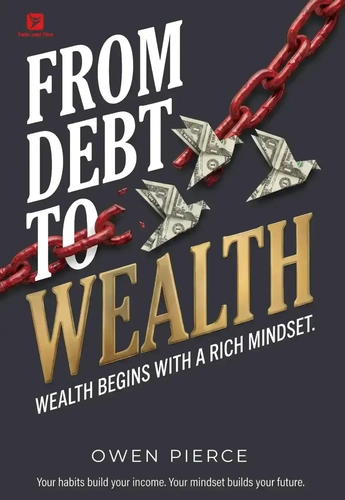
That moment is why I picked up From Debt to Wealth. I did not want another book telling me to skip coffee. I wanted to know why smart, hardworking people keep circling the same drain. And the book has a blunt answer, one it repeats in different keys across five sections: wealth is not a reward for effort. It is a reward for seeing what other people miss.
Which raises the question the whole book keeps circling. If hard work alone does not build wealth, what actually does?
The Man Who Keeps Selling His Hours
The book opens with a portrait that stung a little. A skilled professional, good at the job, paid well, respected. Every year the income climbs. Every year the account balance does not. The raise gets absorbed by a bigger apartment, a newer car, a nicer watch. Nothing dramatic happens. That is the point.
The author calls this the employee mindset, and the phrase is sharper than it sounds. It means you are the product. Your time is the inventory. When you stop showing up, the revenue stops. The protagonist of this pattern is not lazy or foolish. He is disciplined at the wrong game.
What the employee mindset looks like:
| What It Feels Like | What It Actually Is |
|---|---|
| Steady income | Selling hours you can’t get back |
| Job security | A ceiling dressed as a floor |
| A raise | More money for the same trap |
| Hard work | Effort pointed in the wrong direction |
Then come the counter-figures. The jam seller who succeeds because she reads the market, not because her jam is special. The four daughters with the coffee business, where the one who uses capital and trust beats the one who simply works hardest. Rockefeller, described without flattery, as someone whose selfishness was structural rather than moral. I found myself arguing with that chapter, then quietly agreeing with parts of it.
I will not tell you how the arc resolves. What I will say is that the book refuses the easy ending where the salary worker suddenly becomes an investor and everything blooms. The tension holds until the final third, and it holds because the author never pretends the transition is comfortable.
Assets Feed You, Liabilities Eat You
Here is the sentence the book keeps returning to, and it is almost too simple to feel profound: assets feed you, liabilities eat you.
| Asset | Liability |
|---|---|
| Rental property that pays its own mortgage | Car you drive to look successful |
| Business that runs without you | Subscriptions you forgot about |
| Investment that compounds | Lifestyle that expands with income |
| Something that pays you while you sleep | Something that costs you while you work |
The imagery stays domestic and unglamorous. Coffee. Jam. A fisherman on a pier negotiating with a businessman about how many days a week are actually worth working. The author does not reach for yachts. That restraint is the craft. Luxury in this book is described as a display of money you do not have. Real wealth, the kind nobody photographs, is quiet.
The idea that organizes everything is the information gap. Money moves toward people who understand something earlier, or deeper, than the crowd. That is why the author treats wealth as cognition rather than labor.
This is where I paused. The distinction is clean on paper. In a real life, with real interest rates and a real job that could vanish, the line blurs. The book acknowledges luck and gray areas, which I appreciated, though it does not spend much time on people for whom the gray area is the whole picture. Someone living paycheck to paycheck with a medical bill does not need a mindset shift. They need cash.
Still, the pattern it describes is real, and I recognized it in my own parking lot arithmetic. We do not usually fail at money because we cannot do math. We fail because we keep treating income as the finish line.
What Stays With You
The book is at its best on psychology. Fear, patience, resilience, and self-interest are treated as financial skills, not personality traits. Ford’s first business failing is framed as tuition. Getty’s calculated risks are framed as the alternative to a lifetime of regret. Poverty itself gets a strange, honest treatment, as an advantage that removes fear and creates speed.
This book is for you if:
- You earn decently and wonder where it all went
- You are tired of budgeting advice that ignores behavior
- You want to understand why income alone isn’t enough
- You are ready to rethink what you’ve been taught about money
This book is not for you if:
- You want a guaranteed formula
- You need step-by-step investment instructions
- You are looking for a quick fix
It will frustrate readers who want a guaranteed formula, because it offers principles and lets you do the uncomfortable translation into your own life.
What I took away is less a plan than a question I now ask before most purchases. Does this feed me or eat me. It sounds dramatic. It has already changed two decisions this month.
And the fisherman stays with me, the one who wanted fewer days on the water, not more. Maybe that is what wealth actually is. Not the number in the account, but the number of mornings that belong to you.

