Before an important meeting, David checks his notes, reviews his calendar, and rehearses what he plans to say. Those are reasonable ways to prepare, but he keeps going after everything is ready. He imagines difficult questions, worries about how his manager might interpret his answers, and reviews an old mistake that has nothing to do with the upcoming meeting. By the time he arrives at work, he is exhausted before the meeting has even started.
When anxiety becomes a habit, preparation and worry can begin to look almost identical. Both involve thinking ahead, considering possibilities, and trying to prevent problems. The difference is that preparation eventually produces a useful action, while anxiety often keeps asking for more analysis even when nothing new can be done.
Learning how to manage anxiety starts with understanding that distinction. You do not have to stop caring about what happens, and you cannot control every future outcome. But you can learn to recognize when worry is helping you prepare and when it is simply keeping your mind occupied.

Start With the Part You Can Influence
When you feel anxious about something, your attention may immediately jump to everything that could go wrong. A difficult conversation becomes a chain of possible arguments, a deadline becomes a prediction of failure, and a small uncertainty becomes a question you cannot stop trying to answer.
Bring the situation back to something more specific. If you are worried about a meeting, identify what preparation would actually help. If you are concerned about a relationship, consider whether there is something you need to communicate. If you are waiting for information that has not arrived, decide what you can reasonably do while you wait.
This does not make uncertainty disappear, but it gives your attention a practical direction. Once the useful action has been taken, you can remind yourself that thinking about the same outcome again is not automatically making you better prepared.
Recognize the Difference Between a Concern and a Mental Loop
A concern usually has some connection to a question you can address. A mental loop keeps returning to the same question without producing a new answer.
For example, you may need to decide how to handle a mistake at work. It makes sense to review what happened, determine whether you need to correct anything, and decide what to do differently next time. But if you keep replaying the mistake for hours after you have dealt with it, the thinking may no longer be useful.
Ask yourself whether you have learned anything new from the latest round of analysis. If you have, use that information. If you are simply revisiting what you already know, try returning your attention to the task in front of you rather than continuing to search for certainty.

Give Worry a Time and a Place
For some people, attempting to suppress anxious thoughts makes them more persistent. They tell themselves not to think about a problem, then become frustrated when it keeps returning.
An alternative is to set aside a short, deliberate period to write down what is worrying you. Identify the concern, what you know about it, and whether any action is needed. If a practical step is available, make a plan. If the situation cannot be resolved yet, acknowledge that you may need to wait for more information.
When the same worry appears later, remind yourself that you have already considered it and can return to it at the planned time if necessary. This will not work perfectly every time, but it can help reduce the feeling that every anxious thought requires immediate attention.
Look at the Habits That Keep Anxiety Going
Anxiety is not always maintained by the original concern alone. The way you respond to that concern can influence how often it returns.
Repeatedly checking messages may temporarily reassure you, but it can also make you more attentive to every new delay. Avoiding an activity may reduce fear in the moment, while making the activity feel even more intimidating the next time. Harsh self-criticism may feel like a way to prevent mistakes, even though it leaves you more worried about getting something wrong.
These habits are worth examining without blaming yourself for having them. They often develop because you are trying to feel safer or more prepared. Understanding their short-term benefits and longer-term costs can help you decide which responses are worth changing.
Where Break the Anxiety Circle Fits In
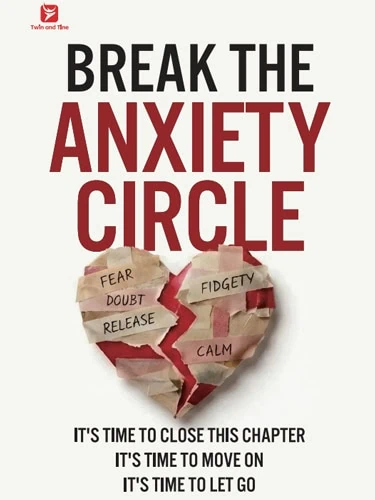
Break the Anxiety Circle by Miles Carter focuses on the connection between anxiety, overthinking, self-doubt, and repetitive mental habits. Rather than treating every anxious episode as a completely separate problem, the book explores how one worry can lead to another and why the mind may continue searching for answers long after the original concern has been addressed.
Its topics include anxiety loops, fear of judgment, decision-making, negative self-talk, people-pleasing, boundaries, and emotional regulation. These are practical areas to examine when anxiety shows up not only as fear, but also as repeated second-guessing, difficulty letting go of mistakes, or constant concern about what other people think.
The book’s focus is on recognizing patterns and understanding what keeps them active. This can be particularly useful for someone who already knows that they overthink but struggles to understand why one worry so often develops into several more.

Break the Anxiety Circle
Miles CarterA mental reset for people trapped in the overthinking loop. Understand why your mind won’t stop racing — and how to break free from anxiety, people-pleasing, and emotional exhaustion.
What You Can Gain From Reading Break the Anxiety Circle
Reading Break the Anxiety Circle can help you look at anxiety as a pattern you can learn to recognize, rather than a series of unrelated worries that require a completely new solution each time.
You can explore how to identify when useful reflection has turned into repetitive mental analysis, understand why fear of judgment can influence your choices, and recognize the connection between people-pleasing and self-doubt. The book also addresses boundaries and self-worth, which can matter when your anxiety is closely tied to the desire to avoid criticism or keep everyone around you satisfied.
In everyday life, these ideas may be relevant when you find yourself replaying a conversation after work, delaying a decision because you want complete certainty, or repeatedly looking for reassurance about something you have already discussed. Instead of trying to force every thought away, you can work on noticing what the thought is doing and choosing a more useful response.
Self-help reading can support that process, but anxiety affects people in different ways. If it is persistent, severe, or interfering significantly with sleep, relationships, or daily responsibilities, consider seeking guidance from a qualified mental health professional.

Managing Anxiety Does Not Mean Controlling Every Outcome
It is easy to believe that if you think through every possibility, you will eventually feel prepared enough to relax. In reality, life rarely provides that level of certainty, and another question can usually be found if you keep looking.
The more sustainable goal is to prepare for what you can influence and become more comfortable with what remains unknown. You can make a thoughtful decision without knowing every consequence, address a mistake without punishing yourself indefinitely, and care about a relationship without monitoring every small change for signs of trouble.
That is the direction Break the Anxiety Circle encourages readers to explore: understanding the patterns behind worry and learning to respond in ways that leave more room for everyday life.
If you found this helpful, these books go deeper into the same themes.



Break the Anxiety Circle
$19.90

From Debt to Wealth
$19.90

