Why I Swapped Books About Making Money for Books About Not Losing It
Three years ago I did something embarrassing. I opened my brokerage account at 11pm, bought four stocks I had read about that same afternoon, and went to bed feeling like a genius. Two weeks later I was down 18%. My wife asked what happened. I said the market was volatile. She said, “You bought a company because a stranger on the internet liked it.”
She was right. That night I started looking for a low risk investment strategies book, something that would tell me how to stop losing money instead of how to get rich by Friday.
That search led me to three books. None of them promised fast money. One of them, honestly, is about the opposite of low risk, and reading it is exactly why I now understand what low risk actually means.
Quick answer: Which low risk investment books actually help?
Start with one that shows you how much discipline the risky path requires, one that teaches you the boring index fund approach, and one you can keep on your desk as a reference for every question that comes up.
Here are three books that changed how I save. One scared me straight. One grounded me. One answers my questions at the kitchen table.
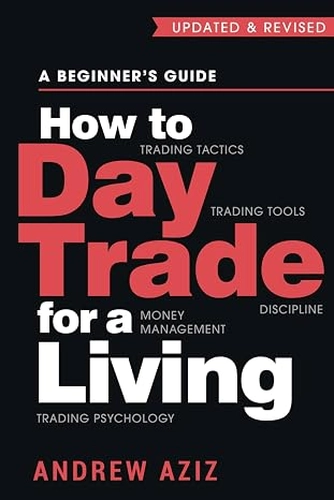
How to Day Trade for a Living
By Andrew Aziz
Strange choice for someone scared of risk, right?
Here is the thing. The author says something early on that stopped me. Simply reading a book will not make you a profitable trader. Profit comes from practice, tools, and ongoing education. He also writes that day trading is serious work, not a hobby and not gambling.
That sentence did more for me than any safe investing article. I finally understood that people who trade for a living wake up early, run, eat breakfast, and sit down alert and prepared before the New York open. They treat it like a job. I was treating it like a lottery ticket.
What you get:
- A realistic look at what day trading actually demands
- Why discipline and routine matter more than tips
- How much time and energy the high-risk path requires
- A clearer sense of whether you have what it takes
One key idea: Simply reading a book will not make you a profitable trader. Profit comes from practice, tools, and ongoing education.
What I did with it: Did I start day trading after reading it? No. Did I stop buying random stocks at midnight? Yes. Sometimes the most useful risk lesson is watching how much discipline the risky path actually requires. I knew I did not have that discipline. So I stopped pretending.
Best for: Anyone who needs to understand why the fast path is not for them.
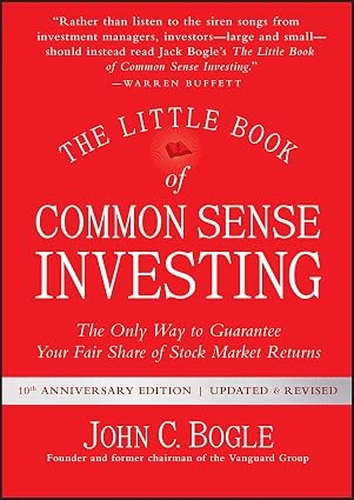
The Little Book of Common Sense Investing
By John C. Bogle
This one changed everything.
What makes it different: Bogle’s whole argument fits in one idea. Buy a low-cost fund that tracks a broad market index, hold it, and keep your costs tiny. That is it. He calls index funds the simplest and most effective long-term strategy, and he shows how compounding returns work for you while compounding costs work against you.
What you get:
- The case for low-cost index funds
- Why most investors lose by trading too much
- How costs quietly eat your returns
- A strategy that asks for patience, not intelligence
One key idea: Too many investors trade frantically and turn a winner’s game into a loser’s game.
What I did with it: I remember reading that part and looking at my phone. Eleven trades that month. Eleven. I was exhausted from doing nothing productive. I stopped checking my account every day. Maybe twice a month now.
Best for: Anyone who wants a strategy that lets them sleep at night.
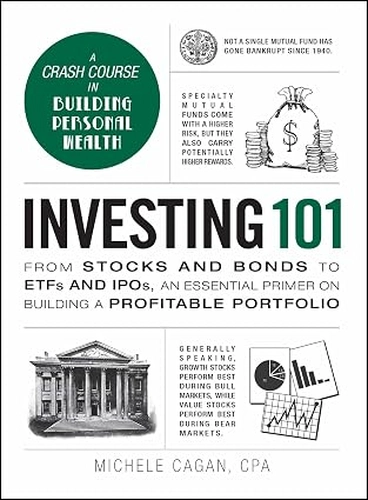
Investing 101
By Michele Cagan
This one sits on my desk, not my shelf.
What makes it different: Cagan writes it like a person, not a textbook. When my wife asks what an ETF is, or when I forget the difference between a bond and a fund, I flip to the page.
What you get:
- Clear explanations of stocks, bonds, ETFs, and IPOs
- How to build a portfolio step by step
- A chapter on risk tolerance in plain language
- A reference you can keep nearby for years
One key idea: Understanding risk tolerance in plain language helps you figure out how much of your savings should even be in the market.
What I did with it: I keep it on my desk. It is the book I reach for when I have a question and do not want to wade through jargon.
Best for: Anyone who wants a reference they can flip through whenever a question comes up.
The Three-Book Method
I ended up calling my approach the Three-Book Method. It is not clever, but it works for me.
| Book | What it does | Why it matters |
|---|---|---|
| The warning | Shows you what the risky path demands | You ask honestly if you have what it takes. I did not. |
| The foundation | Teaches the boring index fund approach | This became my actual strategy, not a theory |
| The dictionary | Answers every question that comes up | Sits on my desk, ready when I need it |
Three books. One to scare me, one to ground me, one to answer questions at the kitchen table.
Why Reading About the Risky Path Made Me Safer
I did not start day trading after reading Aziz. But I stopped pretending I could. That is the part nobody tells you. Reading about the high-risk world is not about learning to do it. It is about learning why you should not.
The discipline those traders have, the early mornings, the routine, the years of practice. I do not want that life. I want a boring account that grows slowly while I am making breakfast. That is what these three books gave me.
Final Thought
I still remember that 11pm trade. The knot in my stomach when I opened the app two weeks later. What I wanted back then was not a strategy. It was a way to stop feeling stupid with money. These three books gave me something quieter than confidence. They gave me a routine, a slow Saturday habit of reading instead of clicking, and a wife who no longer asks what happened.
The money grows slower than my old fantasy did. It also does not vanish on a Tuesday morning while I am making breakfast.
Start with one book. Try one technique. See what happens.
References
Aziz, Andrew. How to Day Trade for a Living: A Beginner’s Guide to Trading Tools and Tactics, Money Management, Discipline and Trading Psychology.
Bogle, John C. The Little Book of Common Sense Investing: The Only Way to Guarantee Your Fair Share of Stock Market Returns.
Cagan, Michele. Investing 101: From Stocks and Bonds to ETFs and IPOs, an Essential Primer on Building a Profitable Portfolio.

