Anxiety spirals rarely give advance warning. A vague email from a manager, a subtle tone shift in a conversation, or a minor physical sensation can instantly trigger a cascade of worst-case predictions. Within minutes, your mind constructs a narrative of impending failure or conflict.
The most exhausting aspect of a mental spiral isn’t the original trigger; it is the secondary panic generated by trying to think your way out of it.
When an anxious thought occurs, the brain interprets the resulting emotional distress as proof that a real threat exists. This creates a self-reinforcing loop: the more you attempt to analyze the worry to gain certainty, the more urgent the threat feels to your nervous system.

3 Actionable Steps to Interrupt a Thought Spiral
To break this pattern, you must move beyond raw willpower. Forcing yourself to “stop thinking” or arguing with an anxious thought only keeps your attention locked on the threat. Effective pattern disruption requires changing how you respond to the initial spark:
- 1. Label the Loop in Real TimeThe moment you feel your mind racing with “what-if” scenarios, mentally name the process: “My brain is launching an anxiety spiral right now.” Recognizing the habit loop creates a necessary cognitive buffer between the thought and your emotional reaction.
- 2. Refuse to Argue with the ThoughtAnxious thoughts thrive on mental debate. Instead of trying to prove the worst-case scenario wrong, treat the thought as neurological noise. Acknowledge its presence without engaging in problem-solving or searching for 100% reassurance.
- 3. Shift to Somatic Down-RegulationAnxiety triggers a physical stress response that keeps your cognitive brain hijacked. Use physical anchors—such as placing both feet flat on the floor, lengthening your exhale, or changing your physical posture—to signal safety directly to your nervous system.
A Deeper Framework for Long-Term Mental Clarity
While immediate grounding techniques help clear acute panic, preventing recurring spirals requires a structural understanding of how hyper-vigilance operates in daily life.
In Break the Anxiety Circle, Miles Carter approaches anxiety spirals not as emotional weaknesses, but as predictable habit loops driven by hyper-vigilance. The book examines why traditional coping strategies—such as arguing with negative thoughts or forcing positive affirmations—often fail during acute anxiety, as they continue to give the threat your full cognitive attention.
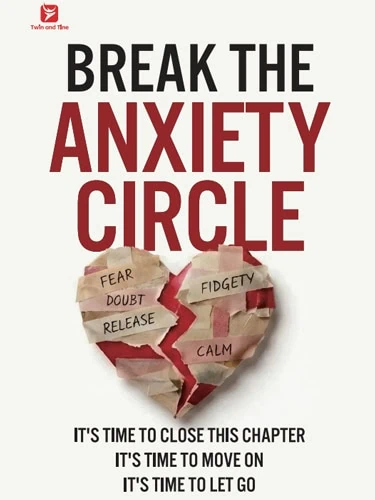
Carter outlines a systematic approach focused on pattern disruption. Instead of attempting to control the initial anxious impulse, the book provides structured frameworks to alter your reaction to the thought, preventing a passing doubt from expanding into a prolonged mental crisis.
Key Frameworks Explored in the Book
- The Four-Stage Loop PatternDeconstructs how uncertainty escalates into hyper-analysis, pinpointing the exact moments where cognitive intervention is most effective.
- Cognitive Pattern InterruptionDelivers structured techniques to step back from catastrophic “what-if” scenarios without engaging in lengthy mental debates.
- Uncertainty Tolerance ProtocolsOffers clear strategies to reduce the compulsive need for immediate reassurance, helping the nervous system recalibrate over time.

Break the Anxiety Circle
Miles CarterA mental reset for people trapped in the overthinking loop. Understand why your mind won’t stop racing — and how to break free from anxiety, people-pleasing, and emotional exhaustion.
A Pragmatic Tool for Mental Clarity
Break the Anxiety Circle by Miles Carter offers a clear, analytical perspective for anyone looking to understand their internal stress responses. By focusing on practical mechanics rather than superficial relief, it serves as a grounded guide for establishing long-term mental composure and stepping out of recurring thought spirals.

