Before reading Christin Hannah’s “The Nightingale,” I could roughly guess what the book might be about. I thought it might be a story about war, suffering, and two French sisters who fought bravely against the Nazis. And indeed, all those elements were present in the book. But what really struck me was something else. After reading the book, I asked myself for the first time: “In how many different ways can courage be expressed?”
Vianne and Isabelle couldn’t be more different. Isabelle is young, impulsive, fearless. Operating under the codename “Nightingale,” she led 117 downed Allied pilots across the Pyrenees to safety. She is radiant, the stuff of legend. Vianne chose a different path. Her husband went off to fight, leaving her alone in a small town to protect their daughter. A German officer moved into her house. The Gestapo — Von Richter — treated her like a plaything. She didn’t resist. She didn’t run. She just endured, day after day, doing whatever it took to keep herself and her child alive without being destroyed. And then, later in the book, Vianne did something that shocked me even more than Isabelle’s heroics: she took in the child of her Jewish neighbor and, in complete silence, saved nineteen Jewish children.
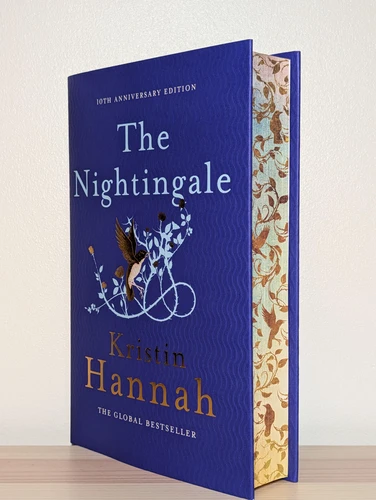
There’s a line in the novel that I read over and over:
“In love we find out who we want to be; in war we find out who we are.”
In the fire of war, Isabelle discovered her kind of courage — the kind that charges outward, fights, and dies if necessary. But Vianne discovered another kind: the courage to live, to not fall apart, to protect whoever she could, no matter what it cost her. To borrow a sentence from the book:
“To resist and die bravely is one kind of courage. To endure, to persevere, to live — that is another.”
By the end, Isabelle’s name is remembered, written into books, passed down as a legend. Vianne, meanwhile, lived on in silence. After the war, she went back to being a mother and a grandmother, as if nothing had ever happened. Late in the novel, the elderly Vianne looks back and says: “Men tell stories. Women get on with it. For us it was a shadow war. There were no parades for us, no medals, no history books. We did what we had to do during the war, and when it was over, we picked up the pieces and started our lives again.”
Reading those words, I couldn’t help thinking about my own life. Not war — nothing dramatic, nothing worth calling sacrifice. But my mother, for years and years, did something that no one ever thanked her for. She never ran off to do anything bold. She never made any big, visible decisions. She just put three meals on the table every day for my siblings and me, washed our school uniforms, folded them neatly, didn’t make any noteworthy decisions, but simply served her family meals on time every day and washed and folded her school uniform. I never thanked her for these things. In the days following reading “The Nightingale,” I kept thinking about Vianne, and about her.
Of course, The Nightingale is about war. But it’s also about a kind of courage that rarely gets praised — the courage of the person in the background who silently endures everything and still gets up the next morning to make breakfast. In extreme circumstances, simply not being crushed is its own kind of strength. Vianne taught me to see the weight in the word “survive.” It isn’t a passive outcome. It’s a choice, made over and over, day after day.
