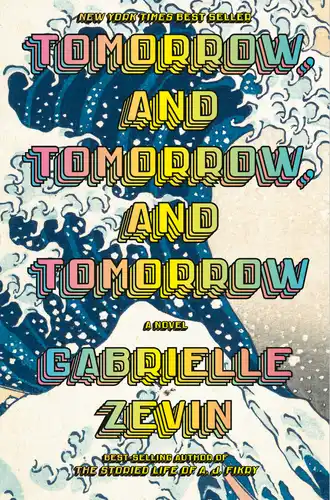
It’s 2:00 AM. I sat in front of the computer and opened an old game that had been sealed for a long time over and over again. The pixelated picture is rough and the background music is monotonous and boring, but I still linger on the familiar screen. At that moment, I suddenly realized that some things we gave up many years ago would always come back to us at the most unexpected time. These days I rarely play games, but after reading the book Tomorrow, Tomorrow, and Tomorrow, I still remember that feeling: the moment the screen lights up, reality seems to be isolated and people can finally take a breath.
Gabrielle Zevin writes about games, but it’s not just about games. The novel starts with Sam and Sadie as teenagers. They know each other through games, then go on to make games together, start a studio, become famous, and slowly drift apart. On the surface, it sounds like a story about creators. But what really stayed with me were the small, messy emotions. Sam has been suffering from illness for a long time, so he is used to closing himself off; Sadie is smart and sensitive, but no one really understands him. ‘They jointly created games such as Ichigo and Mapletown. In the process, they constantly exposed the most vulnerable parts of themselves.
There’s a line in the book that I love:
“What is a game? An opportunity to focus our energy, with relentless optimism, at something we’re good at.”
I paused when I read it. Later I thought, maybe that’s why a lot of people love games—not just to win. In real life, so much is out of our control. You get misunderstood, you fail, you mess up relationships. But in a game, at least there are rules. At least there’s the possibility of a “do over.” Sam and Sadie are the same. They keep making games, like they’re trying to build themselves another world.
At first I thought the book was going to be about friendship or love. But as I read on, I realized what makes it so powerful is how honestly it captures that long term sense of misalignment between people. Sam and Sadie clearly care about each other, yet at the most critical moments, they fall silent. Sometimes I got so frustrated reading it—I just wanted to yell, “Just say something!” But then I thought, that awkwardness is actually so real. Isn’t that how a lot of real relationships are? It’s not that you don’t care. It’s that you don’t know how to start talking, or you’ve already missed the right moment.
In college, I had a really close friend too. We used to talk almost every day. Then at some point, I don’t know when, our messages started coming every few days. Eventually even a simple “How’ve you been?” began to feel forced. No fight, no falling out—you couldn’t even say who was wrong. But the friendship just slowly stopped. Reading this book, I kept thinking about that feeling. Some relationships don’t end with a clear moment. They just gradually go quiet.
The most uncomfortable part of the novel is about the setting of Ichigo. Players need to take care of a small creature that will age and die, and you can’t really stop it from leaving. You can only spend a limited time with it. When I saw this, I remembered that I used to have a hamster when I was a child. After it died, I didn’t dare to throw away the cabin in the cage for a long time. I always felt that as long as those things were still there, it would not really disappear. In fact, the same thing is discussed repeatedly in Tomorrow, Tomorrow, and Tomorrow: people know that many things will be lost in the end, but they will still find ways to get close to each other. Maybe because it is short, those companionships are particularly important.
The most special thing about this book is that it doesn’t write the relationship very “completely”. Sam and Sadie are neither lovers in the traditional sense nor just friends. They are like a part of each other’s lives that can never be completely separated. Sometimes they understand each other, and sometimes they hurt each other. ‘The novel isn’t in a hurry to explain the characters’ actions,nor does it deliberately create dramatic conflicts, but spends a lot of time describing that silence, misunderstandings, and long-accumulated emotions. To some extent, it is closer to the real relationship itself.
That said, it’s not the kind of book everyone will breeze through. The first part has quite a bit about game development and starting a studio. If you’re not familiar with games, you might find the pace a bit slow. And the whole book stays pretty heavy. The repeated misunderstandings between the characters can actually get exhausting to read. But in a way, that’s exactly why they feel real. Real people don’t suddenly make up after one conversation. They don’t suddenly become mature. Most of the time, they just keep moving forward with the problems they already have.
Later, I always felt that the most difficult part of Tomorrow, Tomorrow, and Tomorrow is not the fierce conflicts, but the long-term misalignment between people. In many cases, people don’t care about each other, but don’t know how to express it. The repeated games in the novel seem to remind people that reality is not like a game, and there is no chance to really start over.
But even so, people still find ways to keep living, to reach out to others. Maybe that’s why, long after finishing it, I still think about this book now and then. Not because it tells some grand, epic story. But because it captures the hardest part of so many relationships. They are the people you haven’t completely lost, but can never truly go back to go back to. The moments when you want to reconnect but don’t know how. Years later, you might not remember exactly what happened. But you remember that someone once walked a long road with you.
