The first time I heard about tuberculosis, I was a kid watching a commercial for a charity. Black and white footage of a sanatorium. A woman coughing into a handkerchief. The narrator said something about “a disease of the past.” I filed it away with polio and scarlet fever. Something that used to kill people, but not anymore. I was wrong.
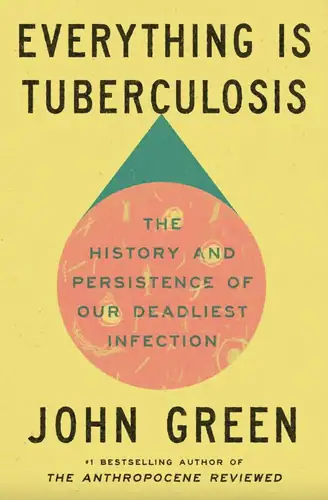
John Green’s Everything Is Tuberculosis is not a book I expected to need. I knew him as the author of weepy YA novels and the guy who co created Crash Course. A nonfiction book about an infectious disease did not sound like a page turner. Then I read a sentence from the book in an interview. Green said, “We have known how to cure tuberculosis since the 1950s, and yet more than a million people still die from it every year.” That sentence sat in my head for days. I bought the book the next morning.
Henry, seventeen, spindly legs, a big smile
The book has two parts. One is a history of tuberculosis, how it shaped cities, fashion, literature, even the layout of hospital wards. The other is the story of Henry Reider, a teenager Green met in 2019 while visiting a TB hospital in Sierra Leone with Partners in Health. Henry was seventeen, with spindly legs and a big, goofy smile. He had drug resistant TB. He had been sick for years. He was still alive, but barely.
Green does not hide his own reaction. He writes about meeting Henry and feeling something shift. He had come to Sierra Leone as a writer and a curious traveler. He left as an advocate. The book is the result of that shift.
I have never met anyone with TB. But I have met people who were sick in a system that did not care enough. A friend of mine spent months trying to get a diagnosis for a rare autoimmune condition. She saw specialist after specialist, spent thousands of dollars, and was told more than once that it was probably “just anxiety.” When she finally got the right treatment, it took a week to work. She cried. Not from relief. From anger about all the time that had been wasted.
Henry’s story is like that, only multiplied by poverty and distance. He lived in a country where the health system was underfunded and overwhelmed. His treatment for drug resistant TB took eighteen months of daily injections that left him in pain. But the real problem was not the medicine. It was getting the medicine at all. Supply chains broke. Clinics ran out of drugs. Patients disappeared because they could not afford the bus fare to the hospital.
“I care about TB because I care about Henry,” Green writes. He does not pretend that statistics alone can move people. He tries a different approach: a face, a name, a boy who wanted to finish school and become an electrician.
When TB was romantic and when it became invisible
The first half of the book is a whirlwind tour of TB’s impact on human history. Green argues, convincingly, that tuberculosis has shaped the world in ways most of us never notice. The cowboy hat was invented because a man with TB needed sun and fresh air and did not want to wear a top hat in the desert. Women’s skirts got shorter because the fashion industry latched onto the “consumptive look” of pale, slender patients. Sanatoriums, built to isolate the sick, became the template for modern hospitals.
I had never thought about any of this. I had also never thought about why TB became a “disease of poets” in the nineteenth century and a “disease of poverty” today. Green traces the shift. When rich people got TB, it was romanticized. When poor people got TB, it was ignored. That pattern, he argues, has never really gone away. The tuberculosis that kills a million people a year is not a biological inevitability. It is a political choice.
A doctor’s line that stopped me cold
There is a chapter where Green describes the economics of TB treatment. Drug resistant TB requires a cocktail of medications that cost several thousand dollars per patient. That is expensive for an individual, but cheap for a government. The global health community has known this for decades. And yet, year after year, funding for TB programs falls short. Green quotes a doctor who tells him, “If tuberculosis were a disease of wealthy white people in Manhattan, we would have solved it already.”
I put the book down after that line. Not because I was shocked. Because I knew it was true. I had seen the same pattern play out in other contexts. The way certain diseases get funding because they affect certain people. The way pharmaceutical companies invest in treatments that will turn a profit, not in cures that will save lives in places where no one can pay.
Green does not shout about this. He lays out the facts and lets you feel the outrage yourself.
What Henry is doing now
The book returns to Henry throughout. We learn that he survived. We learn that he is now in college, studying to become a health advocate himself. We learn that Green has kept in touch with him, visited him again, and helped raise money for the hospital where they met. That is not just a feel good coda. It is the point. Green is not writing a book about a problem he discovered and then dropped. He is writing about a problem he has stayed inside.
I thought about the causes I have cared about. The ones I donated to once and then forgot. The petitions I signed and never followed up on. Green does not scold me for that. He just shows me a different way. Not the way of guilt. The way of friendship.
I finished this book on a plane, looking out the window at nothing in particular. I felt heavy but not hopeless. Green is angry, but his anger is not paralyzing. He makes you want to do something, even if that something is just learning more, telling someone else, or sending a few dollars to an organization he trusts.
I do not have Henry’s phone number. I cannot visit a hospital in Sierra Leone. But I can remember that tuberculosis is not a disease of the past. It is a disease of right now, killing people who could be saved if the world decided they mattered.
“There’s no excuse for people dying of tuberculosis in 2025,” Green says in interviews. He put that same sentence in the book. It is the closest thing to a thesis he offers. The rest is evidence.
This is not a fun book. It is not even a comfortable book. But it is an important one, written by someone who knows how to hold your attention without manipulating you. If you have ever donated to a charity and then forgotten about it, read this. If you have ever looked at a statistic about global poverty and felt numb, read this. If you just want to meet a boy named Henry with spindly legs and a goofy smile, read this.
