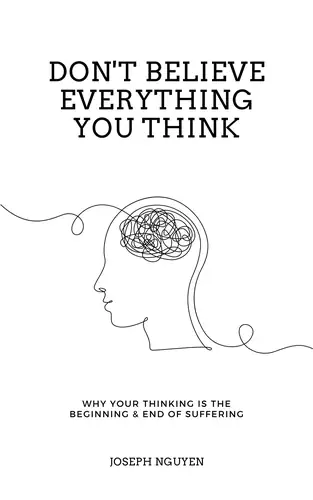
I finished this book in one sitting. That’s not a compliment. That’s a warning. At 100 pages with giant font and paragraph breaks every few sentences, Nguyen’s international bestseller reads less like a book and more like a blog post that got lost on its way to TikTok. But 31 languages, over 110,000 copies sold, and a spot on the New York Times bestseller list suggest I’m missing something. So I read it again. Slower this time.
Here’s what I found.
A Thesis That Fits on a Bookmark
Nguyen’s thesis is simple enough to fit on a bookmark. Thinking is the root cause of all psychological and emotional suffering. Not pain (pain is inevitable). But suffering, the extra layer of anguish we add on top, is optional and entirely self inflicted through thinking.
The distinction Nguyen draws between “thoughts” (neutral mental events) and “thinking” (active engagement with those thoughts) is the book’s single most useful insight. Thoughts appear spontaneously. Thinking is what we do with them: analyzing, worrying, rehearsing, ruminating. According to Nguyen, the moment you stop thinking and simply observe your thoughts without attachment, suffering dissolves. Just like that.
“All you have to do is remember that thinking is the root cause of how we’re feeling,” he writes. “Once this is brought into your awareness, don’t fight the thinking.” He cites Thich Nhat Hanh: “People have a hard time letting go of their suffering. Out of a fear of the unknown, they prefer suffering that is familiar.”
The book promises freedom from anxiety, self doubt, and self sabotage “without needing to rely on motivation or willpower.” It claims you can learn to become unaffected by negative thoughts and feelings, and “instantly create a new experience of life if you don’t like the one you’re in right now.”
That’s a hell of a promise.
To be fair, Nguyen’s core message (you are not your thoughts) is genuinely valuable. If you’ve never encountered this idea before, reading it here might feel like a revelation. If you’re a chronic overthinker who’s never heard of meditation or cognitive behavioral therapy, this book could genuinely help you take the first step toward mental quiet.
But.
Between Simple and Simplistic
Here’s where things get uncomfortable. Nguyen spells out a simple thesis: thinking is the root of our suffering. To avoid suffering, don’t think. The problem is not that this thesis is simple; it’s that it is simplistic.
The book offers almost no scientific backing. One critical review notes that the content “doesn’t seem to be backed by research; it’s all the author’s own anecdotes and experience.” A therapist writing about the book puts it more bluntly: “I reject Nguyen’s assertion that the root cause of all psychological and emotional suffering is simply believing our thoughts. It minimizes and dismisses the complexity of mental health conditions.”
She continues: “Many clients face deeply ingrained patterns shaped by trauma, neurobiology, or environmental stressors, factors that are not easily addressed by ‘not believing’ their thoughts alone. I worry that readers may feel blamed if they cannot think their way out of suffering, as if they are simply not trying hard enough.”
That’s the real danger here. Telling someone with clinical depression or PTSD that their suffering is optional, that they just need to stop thinking, is not just unhelpful. It’s harmful.
Then there’s the “Universal Mind” stuff. One reviewer describes hitting a wall when “the Universal Mind made an appearance” — all the talk of the “Source” and connecting with something beyond yourself. As they put it: “If this sort of nonsense resonates with you, then by all means, have at it. But if you are looking for more depth, insight, and ways to shift the paradigms of thinking you’ve had all your life, look elsewhere.”
The book is repetitive to the point of tedium. One reviewer on StoryGraph calls it “very repetitive and reductive,” adding that Nguyen “acts like he figured out something new about psychology or spiritual practice, when in reality it just took him way too long to figure out the original intent of all the spiritual practices he claimed weren’t working.”
To Read or to Run
If you’ve never meditated, never heard of CBT, and tend to overthink everything, this book might be a helpful first step. It’s short enough to not feel like homework and simple enough to actually finish. The core insight, that you don’t have to believe every thought that pops into your head, is genuinely liberating.
But if you’re looking for evidence based strategies, practical exercises, or anything beyond a single idea repeated for 100 pages, skip this. Read The Happiness Trap by Russ Harris instead. Or Feeling Good by David Burns. Or literally anything by Thich Nhat Hanh, who Nguyen quotes but doesn’t come close to matching in depth or wisdom.
And if you’re struggling with trauma, depression, or anxiety that interferes with daily life, please don’t read this book as a substitute for professional help. It’s not. A therapist writing about this book cautions readers “not to view this book as a substitute for evidence based treatment or professional guidance.”
Nguyen’s book is a 100 page pamphlet stretched into a hardcover. It’s fine as a primer for someone who’s never questioned their thoughts before. It’s dangerously oversimplified for anyone else.
The book has sold millions. It has helped some people. But so has snake oil. And at least snake oil doesn’t pretend to be science.
Two and a half stars. Read it in an afternoon, take the one useful idea (you are not your thoughts), and put it on a shelf. Then go read something with footnotes.
