Let me start with a confession: I used to think I was too smart for persuasion tactics. I’d read an article about “reciprocity” and roll my eyes. Oh please, no one’s tricking me with a free pen.
Then I bought a $60 extended warranty on a toaster.
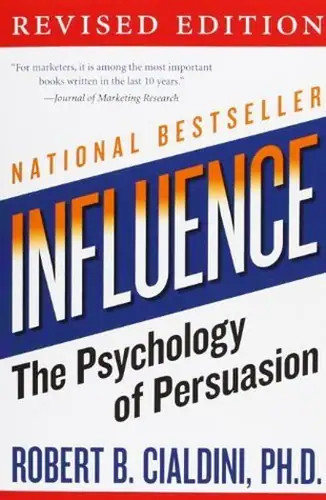
That’s the thing about Robert Cialdini’s Influence. It doesn’t just teach you psychology. It embarrasses you. You recognize yourself on every page — not as a villain, but as the sucker. And that uncomfortable recognition is exactly why this book has sold over 5 million copies and remains required reading for anyone in sales, marketing, or just trying to survive modern life.
What it does brilliantly (and what it doesn’t)
Let’s be clear: Influence is not a practical “how to persuade anyone” playbook. If you want scripts and one-liners, look elsewhere. What Cialdini offers is something rarer: a framework for seeing the hidden structure behind every yes.
The six (now seven) principles — reciprocity, scarcity, authority, consistency, liking, social proof, and unity — are not just clever observations. Cialdini spent years going undercover as a used-car salesman, telemarketer, and even a cult member to understand how these forces actually operate in the wild. That immersive research is what sets this book apart from every pop-psychology knockoff.
The writing is engaging, full of stories you won’t forget. The famed “Petrified Forest” study (where a sign saying “many visitors have stolen wood” increased theft) is the kind of counterintuitive finding that sticks in your brain forever. So is the story of the Hare Krishnas who learned that giving a flower — even unsolicited — triggered an automatic sense of debt.
The new 2021 edition adds the principle of “unity” — shared identity — which Cialdini argues is even more powerful than simple liking. That update feels necessary and timely in an era of tribal politics and brand communities.
The problem: it’s not really a book you “apply”
Here’s my honest critique. Most readers finish Influence feeling brilliant and enlightened — then promptly fall for the exact same tricks two weeks later. Why? Because awareness alone isn’t skill. The book gives you almost no practice, no exercises, no real-world application. It’s like reading about swimming and expecting to survive a riptide.
Cialdini does include a “defense” section for each principle. But it’s mostly one-line advice: “Ask yourself, ‘Would I want this if there was no scarcity?’” That’s helpful, but it’s not training.
Also, the book is dense. The 2021 edition runs over 500 pages, and some chapters meander through studies that could have been summarized in half the space. If you’re looking for a quick, actionable read, this isn’t it.
Who this book is really for
Influence is best read as a lens, not a tool. You read it once, and then for the rest of your life, you’ll notice reciprocity traps in supermarket samples, authority appeals in pharmaceutical ads, and social proof in Amazon’s “customers who bought this also bought…” You’ll become a better observer of human behavior — and a slightly harder target.
For salespeople and marketers, it’s essential. You can’t ethically design a persuasive campaign until you understand why people say yes. For everyone else, it’s a fascinating, sometimes uncomfortable, look in the mirror.
The bottom line
I’ve read Influence twice, and I still fell for a “limited-time offer” last month. The book won’t make you immune. But it will make you wince when you realize what just happened. And that wince — that moment of clarity — is worth the price of admission.
Four stars. Read it once. Then put it on your shelf and pick up a workbook if you actually want to change your behavior.
