“Because I said so” rarely ends a power struggle with a strong-willed child. You ask your child to get dressed, start homework, or turn off a video, and they immediately challenge the request. The more firmly you insist, the more determined they seem to become. Before long, an everyday task has turned into a contest over who gets the final word.
Strong-willed children are not necessarily trying to make family life difficult. They may have strong preferences, react intensely to frustration, or want more control over decisions that affect them. They still need limits, but they may respond better when parents combine clear expectations with opportunities for independence.
The following five books offer practical ideas for reducing recurring conflicts, improving communication, and helping children develop responsibility without turning every disagreement into a battle.
1. Raising Your Spirited Child by Mary Sheedy Kurcinka

Some children react strongly to changes, become deeply absorbed in what they are doing, or struggle to shift from one activity to another. A parent may interpret the reaction as stubbornness, while the child experiences the transition as frustrating or overwhelming.
Raising Your Spirited Child helps parents understand children with intense temperaments and recognize patterns that can make daily routines more difficult. Mary Sheedy Kurcinka explores traits such as intensity, persistence, sensitivity, and adaptability, offering ways to work with a child’s temperament rather than treating every difficult reaction as deliberate misbehavior.
For example, a child who resists leaving the playground may need a predictable transition rather than repeated warnings delivered with increasing frustration. A parent might give a clear time reminder, explain the next step, and offer a small choice: “We are leaving in five minutes. Would you like one last turn on the slide or the swings?”
The book encourages parents to notice which situations trigger conflict and adjust their approach accordingly. It can be particularly useful when a child’s strong reactions appear across many parts of daily life.
2. The Parent You Aspire to Be by Miles Carter

With a strong-willed child, even simple requests can turn into negotiations. A parent asks for homework to begin, the child argues about the timing, and the conversation shifts from the task itself to accusations about fairness, respect, or control. Parents may end up repeating the same instruction without getting closer to a solution.
The Parent You Aspire to Be by Miles Carter focuses on practical strategies for behavior correction, emotional management, and parent-child communication. It addresses challenges such as procrastination, refusal to study, lying, rude speech, emotional outbursts, excessive internet use, and difficulty following boundaries.
The book emphasizes replacing ineffective reactions with clearer language and practical steps. For a strong-willed child, that can mean reducing lengthy arguments, stating the expectation directly, and giving the child a reasonable way to take responsibility without allowing the original task to disappear.

The Parent You Aspire to Be
Miles CarterPractical guidance for tantrums, backtalk, lying, screen addiction, emotional outbursts, and everyday parenting struggles.
For example, instead of saying, “You never do what you’re told,” a parent could say, “Homework needs to be finished before gaming. You can start with math or reading, but it needs to begin now.” The child has some control over how to start, while the boundary remains unchanged.
This approach is useful for parents who want specific ways to handle recurring behavior rather than relying on threats, repeated reminders, or lectures. It also encourages parents to pay attention to their own emotional reactions, which can either calm a power struggle or intensify it.
3. Your Defiant Child by Russell A. Barkley and Christine M. Benton
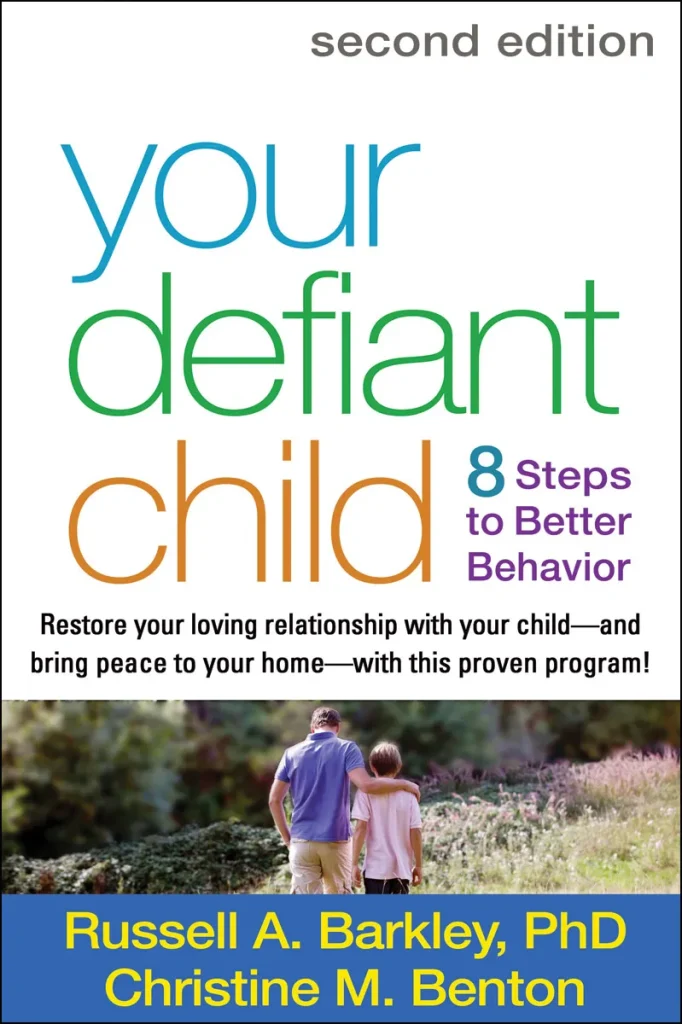
When a child repeatedly refuses instructions, argues about ordinary expectations, or reacts angrily to limits, parents may feel that every interaction requires more effort than it should. Repeating a request can turn into a debate, while punishment may stop the behavior briefly without improving cooperation over time.
Your Defiant Child offers a structured approach to helping parents manage oppositional behavior. Russell A. Barkley and Christine M. Benton focus on practical behavior-management strategies, including clear instructions, consistent consequences, and ways to encourage cooperation through predictable expectations.
The book encourages parents to pay attention to patterns rather than treating each incident as an isolated problem. If a child repeatedly ignores a request, for instance, it can help to examine whether the instruction is specific, whether the consequence is predictable, and whether the parent-child interaction has become a cycle of repeated commands and resistance.
This book is especially relevant when defiance is persistent and creates significant conflict at home. Its structured approach may also be useful for parents who want a clearer plan for responding consistently rather than improvising a new consequence every time.
4. How to Talk So Kids Will Listen & Listen So Kids Will Talk by Adele Faber and Elaine Mazlish
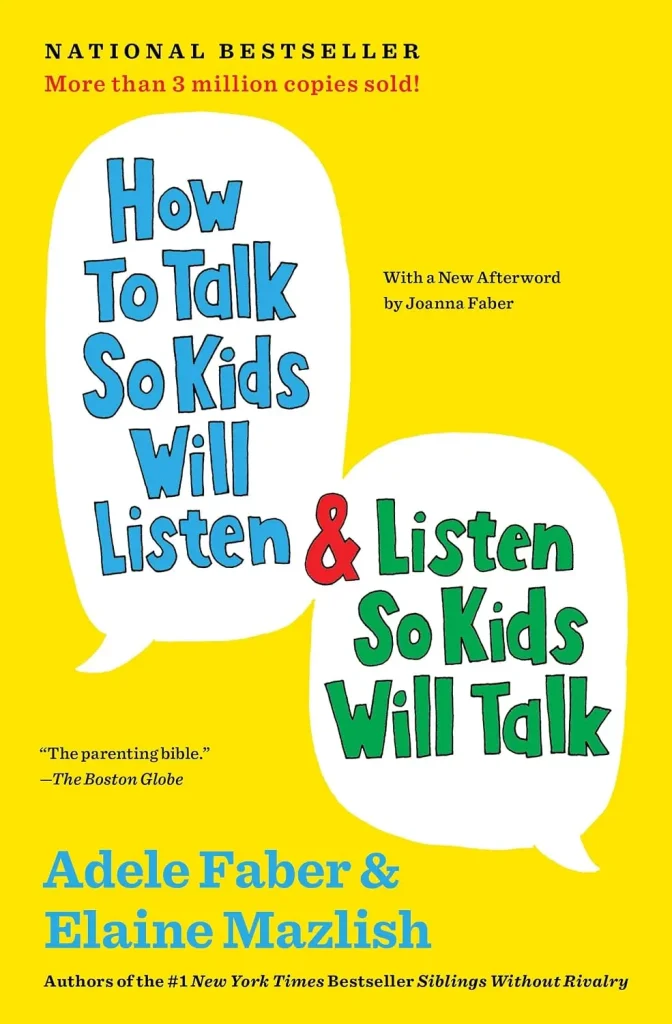
A strong-willed child may challenge a request because they disagree with it, but the way a parent phrases the request can also affect the response. Statements such as “You’re always arguing” or “Why can’t you just listen?” can make a child feel attacked and shift the conversation away from the behavior that needs to change.
How to Talk So Kids Will Listen & Listen So Kids Will Talk offers practical techniques for acknowledging feelings, describing problems without insults, and inviting children to participate in solutions. It helps parents communicate expectations without making the interaction unnecessarily adversarial.
Suppose your child refuses to put away sports equipment after practice. Instead of labeling them irresponsible, you could say, “The equipment is still in the hallway, and people need to get through. Please put it in the storage area before you start your next activity.” The instruction is direct, specific, and focused on the problem.
The book is helpful for parents who want to reduce verbal battles while still expecting children to contribute, cooperate, and respect family rules.
5. Setting Limits with Your Strong-Willed Child by Robert J. MacKenzie

Some children respond to a limit by testing whether it will actually be enforced. A parent says that gaming must stop at a certain time, but after a few complaints, allows another round. The next evening, the child argues even longer because the boundary has become negotiable.
Setting Limits with Your Strong-Willed Child focuses on establishing clear expectations and following through consistently. Robert J. MacKenzie explains how vague rules, repeated warnings, and emotionally charged reactions can contribute to ongoing conflicts.
The book encourages parents to communicate limits in concrete terms and make consequences predictable. Instead of arguing for ten minutes about whether screen time should end, a parent can explain the rule in advance, give a reminder before the transition, and follow through without restarting the debate.
The approach is not about controlling every aspect of a child’s life. It is about distinguishing between choices children can make and responsibilities that remain in place. That distinction can help parents reduce unnecessary negotiations while giving children appropriate independence.
How to Handle Power Struggles with Strong-Willed Children
The aim is not to make a strong-willed child stop having opinions. It is to help them express those opinions appropriately while learning that some responsibilities are not optional.
When a disagreement begins, try these approaches:
- Choose your non-negotiables. Keep safety, respectful behavior, and essential responsibilities clear. Allow flexibility in smaller matters, such as which suitable outfit to wear or which task to complete first.
- Give fewer, clearer instructions. Long explanations can create more opportunities for arguments. State what needs to happen, when it needs to happen, and what comes next.
- Offer limited choices. “Do you want to start homework at the kitchen table or your desk?” gives a child some control without changing the expectation that homework must be done.
- Avoid turning refusal into a contest. Repeating commands louder and louder rarely makes the original request clearer. Stay focused on the task rather than trying to prove who is in charge.
- Follow through consistently. If a rule changes whenever a child argues long enough, arguing becomes part of the routine. Keep consequences reasonable and predictable.
It is also worth looking for patterns behind the resistance. A child who argues mainly during transitions may need more preparation, while one who refuses tasks that feel difficult may need help breaking them into manageable steps. Understanding the trigger does not mean excusing the behavior; it helps you choose a response that addresses the actual problem.
Raising a Strong-Willed Child Without Constant Conflict
Strong-willed children may challenge limits, but their determination can also become a strength when they learn how to use it constructively. The goal is to help them develop flexibility, responsibility, and respect for others without expecting them to abandon their individuality.
These books offer several ways to approach that process, from understanding temperament to establishing consistent limits and improving family communication. Start with the issue that causes the most repeated conflict in your home, and focus on making your response clearer and more predictable. Progress may take time, but fewer arguments and better cooperation can begin with small changes in everyday interactions.
Did this article help you see things differently? Our books turn helpful ideas into practical tools you can return to anytime.



Break the Anxiety Circle
$19.90

From Debt to Wealth
$19.90


