I Can’t Stop Thinking About Work at Night — Even When I’m Home
I remember one night, tucking my daughter into bed after a 12-hour day at the office.
I was humming “Twinkle Twinkle Little Star,” but my mind was still at my desk—37 unread emails, a missed deadline, a supplier who hadn’t replied.
I couldn’t stop thinking about work anxiety.
What scared me most wasn’t the thoughts themselves, but this:
My brain never seemed to know the workday had ended.

Why You Can’t Stop Thinking About Work Anxiety at Night
For a long time, I thought I just needed to relax better.
But no matter what I did—walking, reading, watching shows—the thoughts always came back.
Because the real problem wasn’t stress.
It was the missing “work is finished” signal.
Your brain behaves like a system running without a proper shutdown.
When your job carries high responsibility or unclear boundaries, your mind stays in problem-solving mode long after work ends.
Why Distraction Doesn’t Work (And Never Will)
Most people try to escape work thoughts with distraction.
But distraction only pauses awareness—it doesn’t close the loop.
This is why:
- You feel fine while watching TV
- But the moment it ends, thoughts return
- Especially at night when everything is quiet
A better way to understand it is simple:
Your brain is not refusing to relax. It is still trying to finish unfinished work.
The 5-Minute Shutdown Ritual That Stops Work Anxiety
The turning point came when I stopped trying to “think differently” and started giving my brain a physical signal.
This is the shutdown ritual.
Its purpose is simple:
Teach your brain: work is over.
Step 1: Hard Stop
Pick a fixed time (e.g., 5:30pm). When it hits, stand up.
Step 2: Physical Transition
Change clothes immediately. This creates a clear mental shift.
Step 3: Close the Mental Loop
Say out loud:
“The workday is finished.”
Then write:
- 1 thing you completed today
- 1 thing you will leave for tomorrow
Step 4: Separate Physically
Put away your laptop and work items. Close a drawer or door.
Step 5: Signal Safety to Your Body
Drink water slowly or wash your hands.
This tells your nervous system:
The threat is over.

Why This Works (The Real Mechanism)
This isn’t mindset.
It’s conditioning.
After repetition, your brain learns:
This sequence = work is over.
Within 1–2 weeks, many people notice:
- Fewer night wake-ups
- Less mental looping
- Reduced emotional intensity
Not because work disappears—but because your brain finally gets closure.
What to Do When Work Thoughts Still Come Back
Even with a ritual, work thoughts may still appear.
The key is not to fight them.
Instead:
“That belongs to tomorrow.”
Then return to physical reality:
- feel your breath
- notice the room
- touch something physical
You are not trying to erase thoughts.
You are training your brain not to follow them.
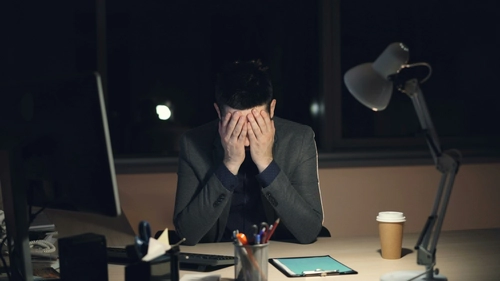
When Work Anxiety Is Actually a Bigger Problem
If your brain still feels overloaded even after switching off, it may signal:
- unsustainable workload
- unclear role boundaries
- emotional burnout
In that case, the shutdown ritual is not the full solution.
It is a bridge.
It gives you enough mental space to think clearly again.
FAQ: Can’t Stop Thinking About Work Anxiety
Why can’t I stop thinking about work at night?
Because your brain never received a clear signal that the workday is over, so it keeps processing unfinished tasks in the background.
How do I stop work anxiety before bed?
Use a consistent shutdown ritual that physically marks the end of work and signals safety to your nervous system.
Why does distraction not help work anxiety?
Because distraction only pauses awareness—it does not close unresolved mental loops.
Is constant work anxiety a sign of burnout?
It can be. Especially when it affects sleep, recovery, and emotional presence for an extended period.
One Last Thing
I still remember nights when I lay in bed replaying emails instead of resting.
Now I do something different.
I stand up.
I close the day.
And my brain, finally, understands what that means.
