I gave away a jar of homemade jam last week. A friend had admired my cherry tree, so I handed her a jar. She looked almost guilty. “Are you sure?” she asked. “You could sell these at the farmer’s market.” And I felt it too, that flicker of loss. A jar not mine anymore. A small profit not made. Later, I sat with that feeling and hated it. Why does giving feel like subtraction? This is the question Robin Wall Kimmerer dares to ask in her slim, radiant new book The Serviceberry.
What if our entire economic metaphor is wrong? What if abundance isn’t a pile of stuff, but a flow?
Character and Plot: The Serviceberry Tree as Our Teacher
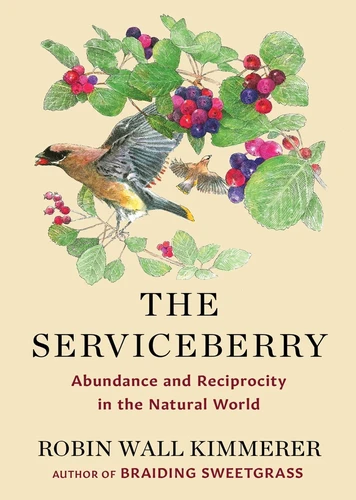
The protagonist here isn’t a person. It’s a tree. The serviceberry, Amelanchier, a small, generous shrub that fruits in early summer. Kimmerer, a botanist and enrolled member of the Citizen Potawatomi Nation, gives us a vivid portrait of this tree’s life. The serviceberry doesn’t hoard its sweetness. It produces far more fruit than it needs. Birds eat. Bears eat. People eat. The seeds are scattered. The tree gets fertilized. It thrives not despite giving away, but because of it.
The core conflict is quiet but enormous: our modern economy versus the economy of the natural world. Kimmerer calls the first a scarcity economy built on “more for me means less for you.” She calls the second a gift economy built on reciprocity. We, the readers, are the conflicted protagonist. We want to believe in generosity, but we’ve been trained to count. The plot moves from this tree outward, into forests, into Indigenous traditions, into our own kitchens.
I won’t spoil the ending, of course. But I will say this: it involves a radical shift in how you see your next meal.
Theme and Imagery: The Gift That Grows by Being Given
The core theme is this: generosity is not a loss. It is a cycle. Kimmerer’s key imagery is the circle and the flow. Water cycles through clouds, rivers, oceans. Carbon cycles through plants, animals, soil. The serviceberry’s fruit cycles through beaks, bellies, and earth. Nothing is wasted. Nothing is truly owned.
The economy of the gift is not altruistic sacrifice. It’s intelligent self-interest within a system. Kimmerer’s craft is subtle. She weaves botanical fact with Indigenous story without ever lecturing. She shows how the word “economy” comes from the Greek oikonomia, meaning “household management.” She asks: what if the household is the whole planet?
We are all embedded in cycles of giving and receiving. To pretend otherwise is to starve ourselves of connection.
The struggle of her character, the serviceberry, reveals a universal pattern. The author’s craft, her ability to see moss and mycelium as moral teachers, builds her argument gently but firmly. You feel it in your chest, not just in your head.
Elevation and Call to Action: A Different Kind of Wealth
I finished this book and looked at my kitchen differently. The jam I gave away. The tomatoes a neighbor left on my porch. The time I helped a friend move boxes. I had counted them as debts or favors. Kimmerer argues this is the poverty of our worldview. A gift, truly given, creates relationship. And relationship is the real wealth.
The book has a quiet limitation, I think. It doesn’t fully address how to survive a gift economy when you are poor, when you are exploited, when the system is rigged against you. The serviceberry can afford to be generous because it lives in a healthy ecosystem. We live in a broken one.
But Kimmerer doesn’t offer a naive solution. She offers a different lens. She shows how Indigenous economies, like the Potawatomi’s, practiced “the honorable harvest”: take only what you need, leave some for others, use everything, share.
This book is for anyone who has ever felt guilty about wanting more, or guilty about giving too much. It’s for anyone who has ever paused, hand on a jar of jam, and wondered if generosity is foolish. What you gain from reading it is permission. Permission to stop counting. Permission to trust that the flow will sustain you.
There is a moment near the end where Kimmerer writes about the Haudenosaunee Thanksgiving Address, a ceremony of gratitude for every part of creation.
“We are thankful that the berries are still here. We are thankful that the strawberries are still here. We are thankful that the serviceberries are still here. We are thankful that the blackberries are still here.”
She says it is not a prayer. It is a statement of fact.
Maybe that is the only economic principle we need. Not profit. Not growth. Gratitude.
The serviceberry does not count its gifts. It just gives. And in giving, it lives.
