When exactly did the detective solve the case? This is a question you’ll find yourself asking after reading any book in Anthony Horowitz’s Hawthorne Series. The answer is always revealed in the final chapters, yet the story repeatedly emphasizes that all the clues were planted long ago in the preceding pages.
As I sit on my balcony at home, listening to the sound of water trickling down the wall, what I can’t help but wonder isn’t the truth behind this particular case. On the first day of the investigation, just how much did Hawthorne actually figure out? More importantly, with five books already published in this series, when will we finally get a clear picture of Hawthorne?
On the surface, Close to Death presents a standard orthodox mystery.
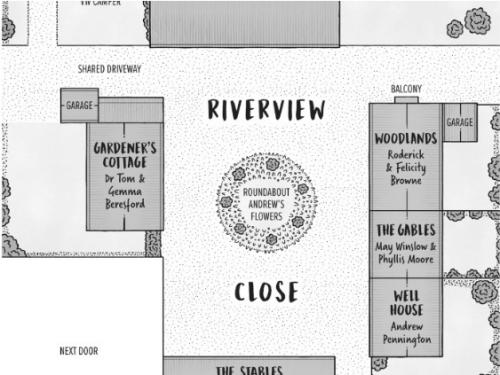
The Thames View, a luxury complex of six homes. The newly arrived millionaire, Kenworthy, has become public enemy number one—blocking the road, making noise, destroying gardens, building a pool, and brutally killing pets. Everyone wants him dead. Then he really does die, a sword piercing his throat. All the neighbors are suspects; everyone has a motive, and everyone has a secret.
A closed setting, a cast of villains—this is the formula most familiar to fans of classic detective fiction. Horowitz takes this classic formula to the extreme: the foreshadowing is so dense that every line of dialogue could be a clue, and every detail is precisely resolved by the end.
What truly makes Close to Death addictive is another puzzle—no, actually, the reason it hooked me had nothing to do with the case itself. It lies beneath the first puzzle, running like an underground river through the entire series. This puzzle is called: Hawthorne.
There is also a kind of “locked room” hidden within people’s line of sight and collective consciousness. Everyone is looking in the same direction, so no one looks at the real answer. This premise of collective blindness is more chilling than any mechanical plot device.
And this unease reached its peak halfway through the book. I began to suspect one thing: Does Hawthorne even exist?
This doubt is no metaphor. I genuinely almost looked up the facts to confirm it.
Anthony Horowitz employs an extremely cunning technique to create this effect: he writes “himself” into the novel. The narrator, “Anthony Horowitz,” is a writer who authored The House of Silk and wrote screenplays for Agatha Christie’s Poirot—all of which are true. He uses his real identity as an anchor, and upon this anchor, weaves fiction: a former detective named Hawthorne, whom he brings along on his investigations, resents as a hindrance, and never tells the whole truth to.
Reality and fiction are deliberately stitched together. The reader jumps back and forth between truth and fiction, unsure which parts “actually happened” and which were “made up by Anthony.” And the “Anthony” in the book is grappling with the same question—he constantly tries to piece together Hawthorne’s past, yet can only ever gather fragments.
This is more unsettling than Agatha Christie’s “invisible narrator.” Agatha never tells you, “I wrote this story”; her narrator is a transparent window. Horowitz, however, turns the narrator into a funhouse mirror—what you see is not just the case, but also the narrator’s own confusion, frustration, and unreliability.
There is a subtle arc of growth running through this series: the narrator Anthony’s power gradually increases.
In the earlier books, Anthony played the role of the “slow-witted Watson”—trailing behind Hawthorne, recording what he saw, always one step behind the truth. But in Close to Death, a crucial shift occurs: Hawthorne is extremely reluctant to participate in the storytelling. Anthony is forced to face a pile of fragments on his own—case files from years past, recordings, and testimonies from all sorts of people. As he unravels the layers, he discovers that everyone is hiding unusual, even rather awkward, secrets.
It turns out that Anthony’s investigative skills are far stronger than he ever imagined. Though this also leads to a whole host of troubles—a part of the story that readers find thoroughly engaging.
However, Anthony isn’t the only one investigating. He encounters a formidable point of reference: Hawthorne’s first partner, Dudley.
Dudley was also a detective, and he seems to possess even greater insight and sharpness than Hawthorne. In scenes where the two appear together, Dudley often spots the key clues before Hawthorne does—which is almost subversive for series readers. More importantly, he holds the secret to the “defining moment” of Hawthorne’s career.
Anthony captures this insight keenly. He finally realizes that to unravel the mystery of Hawthorne, one cannot start with Hawthorne himself—he’ll never speak. One must start with the people around him. Dudley is that key.
Each book in this series lifts a small corner of the veil on Hawthorne’s background. The first tells you he was a detective. The second tells you why he left (but not entirely). The third gives you a name. The fourth gives you a location. Close to Death offers the most—through Dudley, Hawthorne’s past is seen for the first time from a “witness’s” perspective.
While reading this book, I had a strong hunch: in the next installment, Horowitz might be closing in. Dudley has appeared, the secret has been hinted at, and the contours of the “crucial moment” are already taking shape. Of course, it could just be my imagination—but that’s the joy of following a mystery series: you don’t know when the author will reveal the final card, but you know he’ll do it at the most unexpected moment.
