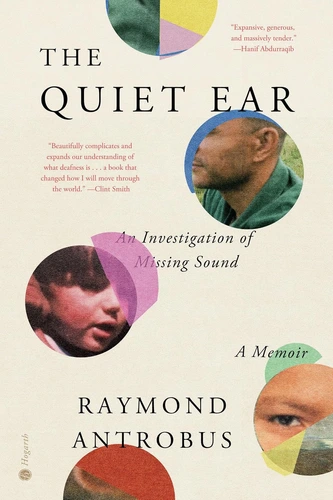
I found myself sitting in the quiet of my own kitchen the other night, the refrigerator humming, the fan turning. And I wondered, for the first time in a long time, what it would be like if that hum just stopped. If the world around me went mute. Would I hear more, or less? Raymond Antrobus’s The Quiet Ear doesn’t answer that question with a simple yes or no. It asks a deeper one instead. What happens when the thing we call “listening” has nothing to do with sound at all?
A Portrait of the Poet Who Listened Through His Bones
Antrobus is not just a poet who happens to be deaf. He is a man who learned to hear with his whole body. He writes about his childhood with a mixture of tenderness and frustration. I remember him describing how his mother would speak to him, her face close to his, so he could feel the warmth of her breath, the vibration of her voice in his chest. It wasn’t a lack. It was a different kind of fullness. The book’s core conflict emerges from this tension. He lives in a world built for hearing people, a world where silence is often seen as empty, as a problem to be fixed. But he also inhabits a rich, vibrant world of sign language, of visual poetry, of tactile connection. He is constantly translating between these two worlds, and the effort of that translation is the book’s heartbeat. I won’t spoil the turning point, but I will say it involves a performance, a stage, and a moment where he realizes that his silence is not a void but a canvas. The title for this section could be: “He Listened With His Whole Body, Not Just His Ears.”
The Invisible Language of Silence and Vibration
The central theme, I think, is not deafness itself but the nature of connection. Antrobus uses a recurring image of vibrations. He talks about how a bass line in a club can be felt through the soles of your feet. How a door slamming sends a pulse through the air. How a whisper on the neck is a different kind of sound. These are not lesser sounds. They are just different frequencies. He builds his argument through the craft of poetry, using short, broken lines that mimic the rhythm of sign language, or long, flowing sentences that capture the feeling of being enveloped by music. The book’s key concept is that “hearing” is a narrow, culturally imposed definition. Real listening, he suggests, is a form of attention. It is the willingness to receive someone else’s presence, whether through hand gestures, written words, or a shared silence. I found myself thinking about my own conversations. How many words do I actually absorb? How often do I listen to the silence between the words? This character’s struggle reveals a universal pattern. We all, in some way, are trying to be heard. We all have our own quiet ears. The title for this section could be: “His Silence Was Not an Absence, but a Different Language.”
A Book That Finally Taught Me How to Listen
I’ll be honest. I picked up this book because I thought it would be a sad story about overcoming adversity. It wasn’t. It was a book about abundance. Antrobus shows us that the world of the deaf is not a world of lack. It is a world of heightened perception, of visual beauty, of physical intimacy. The book’s one weakness, if I had to name one, is that it sometimes moves too quickly. I wanted to stay in some moments longer. But maybe that’s the point. A poem is a brief encounter, not a novel. Who is this book for? It is for anyone who has ever felt misunderstood. Anyone who has ever struggled to connect with a parent, a lover, a friend. Anyone who has ever sat in a quiet room and felt the weight of their own thoughts. What you will get from it is not a solution. You will get a new way of seeing. A new way of being present. The book crosses eras because the need to be heard is timeless. Whether you are a deaf person in 2024 or a hearing person in 1924, the longing for true connection is the same. Maybe that is what love really is. Not the noise we make, but the space we leave for each other to be quiet in. Real emotion, I discovered, does not always have a sound. Sometimes, it is just the feeling of someone sitting beside you, listening.
