I walked through London last autumn. I saw the shiny glass towers, the old pubs, the river that never stops moving. I felt something under my feet. Something heavy. I could not name it.
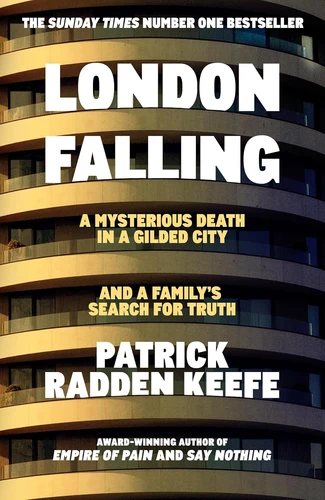
Then I read Patrick Radden Keefe’s new book, London Falling. And I realized: that heaviness is not just mine. It belongs to the city itself.
Keefe has written about empires before. In Empire of Pain, he dissected the Sackler family. In Say Nothing, he traced the Troubles in Northern Ireland. But here, he turns his gaze to a whole city. A place that contains centuries of violence, ambition, loss, and reinvention. The question at the heart of London Falling is simple, really. How does a city’s past seep into its present without anyone noticing? And what happens when that past finally rises to the surface?
The Protagonist Is Not a Person. It Is the City Itself.
Keefe does something strange. He does not give us a single hero to follow. Instead, he makes London the main character. The city breathes. It remembers. It hides things in its soil, in its architecture, in the air.
He takes us into corners most tourists never see. A forgotten tunnel under the Thames. A housing estate built on a medieval plague pit. A street where a Victorian murder still echoes in local gossip. Each chapter feels like digging through layers of sediment. You pull up one piece of history, and another clings to it.
The tension builds slowly. Keefe shows how London’s present-day problems — inequality, gentrification, a housing crisis — are not new. They are the same wounds, reopened again and again. The city has been falling, in some way, for centuries. But it keeps standing. That is the mystery. How does something so broken still hold together?
I will not tell you the ending. That would ruin the journey. But I will say this: the book does not offer easy answers. It offers a kind of recognition. A mirror held up to the reader. You might see your own city in it. You might see yourself.
The Real Theme: The Weight We Do Not Know We Carry
The core theme here is inheritance. Not the kind you get from a will. The kind you absorb without choosing. Keefe writes about a bomb shelter from World War II that was turned into a nightclub. He describes a statue that was moved three times, each time losing a piece of its meaning. He lingers on a single brick from a demolished building, now sitting in a museum. These are not random details. They are evidence of his argument.
Keefe’s craft is quiet but precise. He uses imagery of mud, of water, of stone. London is built on clay, he reminds us. The ground shifts. Buildings crack. The past seeps through the cracks. He writes about a flood that uncovered a Roman wall. He describes how the Tube tunnels sometimes smell like old bones. These images stick. They make you feel the city’s age in your own body.
The struggle in this book is universal. We all live in places that carry history. We all walk on ground that holds stories we do not know. Keefe makes you wonder: what am I walking on right now? What am I not seeing? That is the pattern. That is the truth he uncovers.
What This Book Leaves You With
London Falling is not a guidebook. It is not a history textbook. It is a meditation. Keefe argues that cities are not backdrops. They are characters. They shape us as much as we shape them. This idea has power beyond London. Think of New York. Think of Tokyo. Think of the small town you grew up in. What is buried there? What is waiting to be felt?
There is a weakness, though. The book can feel sprawling. Keefe jumps between centuries and neighborhoods. Sometimes you lose the thread. I wanted more focus on a single story. But maybe that is the point. London is too big for neat narratives. It resists being contained.
Who should read this? Anyone who has ever felt haunted by a place. Anyone who wonders why a certain street makes them uneasy. Anyone who loves a city but cannot explain why. You will not get a map of London from this book. You will get something stranger. You will get a sense of how the dead still walk among us, in the pavement, in the air, in the quiet moments when you stop and listen.
Maybe that is what a city really is. Not a collection of buildings. Not a dot on a map. A living archive. A thing that falls and falls, and still, somehow, stands.
What is your city hiding from you?
