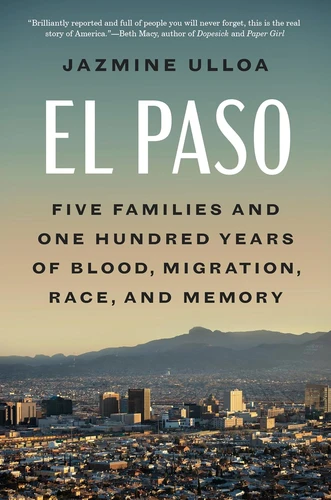
I was sitting on my porch last week, watching a neighbor argue with a delivery driver. The sun was setting, and the air smelled like dust and jasmine. I thought about how little I know of my own street. Who lived here before me? What stories are buried under the concrete? Then I picked up Jazmine Ulloa’s El Paso: Five Families and One Hundred Years of Blood, Migration, Race, and Memory. Honestly, it felt like the book had been waiting for me. Ulloa, a national correspondent for The New York Times, grew up in this border city. She writes about five families, weaving their lives into a tapestry of a century. But the question driving the book is simple: How does a place shape us, even when we think we have left it behind? What do we carry from our hometowns, and what do we refuse to see?
The People Who Stayed and the Ones Who Left
The book centers on five families. There is the family of a Mexican American rancher, a Black couple who fled the South, a Jewish family fleeing persecution, a Chinese immigrant family, and a white family with deep roots in Texas. Each family’s story is intimate. You feel the dust on the boots, the weight of a suitcase, the knot in the stomach when crossing the border. The protagonist is not one person. It is the city itself. But if I had to pick a human anchor, it would be a woman named Eva. She is the rancher’s granddaughter. She stays in El Paso while her siblings scatter to Chicago, New York, Los Angeles. Eva watches her hometown change. She sees the fences go up, the factories close, the faces of her neighbors shift. There is a moment when she walks past a mural that had been there since her childhood. Someone had painted over it. She feels a loss she cannot name. That is the core conflict. The book asks: Do we belong to a place, or does the place belong to us? Suspense builds not from action but from silence. What happens when a border is drawn through your kitchen? I will not spoil the ending. But I will say this: Eva does not leave. And that choice says everything.
Threads of Blood and Memory
The core theme is migration as a constant, not an exception. Ulloa shows that El Paso has always been a place of crossing. Indigenous people, Spanish colonizers, Mexican refugees, Black homesteaders, Chinese railroad workers, Jewish merchants. They all came, they all left marks. The key imagery in the book is the river. The Rio Grande runs through the city. It is a source of life. It is also a line of death. Ulloa describes it as a ribbon that both connects and separates. One family crosses it to escape violence. Another family builds a wall on its banks. The author’s craft is subtle. She does not tell you what to feel. She shows you a child picking up a stone from the riverbed. Later, the same stone becomes a paperweight on a desk in a distant city. That is the weight of memory. It is small, tangible, and impossible to shake off. This character’s struggle reveals a universal pattern. We all carry a river inside us. It might be a street, a language, a smell. But it is always there. The book does not pretend that migration is easy or romantic. It is bloody. It is messy. People lose their names, their languages, their children.
What This Book Asks of You
I finished the book on a Sunday morning. I sat still for a long time. I thought about my own hometown. I realized I had been lying to myself. I thought I had left it behind. But I had not. I carried its prejudices, its silences, its unspoken rules. Ulloa completes the argument by showing that memory is not a museum. It is a living thing. It changes with every retelling. The book has flaws. At times, the family stories feel rushed. I wanted more pages for the Jewish family, for the Chinese family. But maybe that is the point. History is always incomplete. Who does this book serve? It serves anyone who has ever felt torn between two places. It serves anyone who has watched a hometown disappear. It serves anyone who has wondered why they carry certain fears or hungers. What you will gain is not comfort. It is clarity. The clarity that your identity is not just yours. It is stitched together by strangers who crossed a river a hundred years ago. The final question the book leaves you with is not about El Paso. It is about you. What river runs through you? What history are you still carrying, without knowing it?
