I was standing in the kitchen, gripping the counter so hard my knuckles went white. The dishes were still in the sink. A work email had triggered something stupid and small, but my chest felt tight and my thoughts were racing. I knew, in that moment, I was about to snap at the next person who walked in. So I asked myself, almost out loud: how can I regulate my emotions when everything inside me wants to explode? That moment changed me. Not because I found a perfect answer, but because I finally stopped pretending I was fine.
Here’s the truth. You are not broken. The fact that you are even searching for how to regulate your emotions means you are already halfway there. Most people white-knuckle through life, reacting and regretting, reacting and regretting. You are asking the right question. And the answer is simpler than you think—though not always easy.
Why Do I Lose Control of My Feelings So Fast?
I used to believe I was just an “emotional person.” Like I had a bad setting. But over time I realized something else was going on. When I exploded, I wasn’t responding to the dirty dishes or the email. I was responding to a backlog. A hundred unprocessed moments stacked up over weeks, and then one tiny thing lit the fuse.
Self-regulation isn’t about never getting upset. It’s about building a gap between the feeling and the action. Harvard Health defines self-regulation as the act of controlling your behaviors, thoughts, emotions, choices, and impulses. That sounds formal. To me, it just means I get to choose my next move instead of letting my lizard brain drive the bus.
Why is it so hard to regulate emotions in daily life? Most of us were never taught. We learned to stuff feelings down or yell them out. There wasn’t a middle ground modeled for us. So when pressure builds, the body goes into survival mode. Heart races. Muscles tense. The thinking brain goes offline. If you don’t know how to ride that wave, you crash.
But here’s the thing. What if the wave is just energy? What if you could learn to surf it?
How Can I Regulate My Emotions When I’m Already Over the Edge?
The advice that finally stuck with me wasn’t some complex framework. It was a story my friend told me about her grandfather. He was a widower, and every time he got angry, he would walk to the garden and water the plants. “By the time I finish, I’ve cooled down,” he said. That image stayed with me. Not because it solved everything, but because it showed me a pause button exists. You just have to install your own.
I started with the simplest thing I could find: breathing. I hate when people tell me to breathe. It feels dismissive. But one day, mid-meltdown, I tried something different. I didn’t just breathe. I counted the seconds. In for four, hold for four, out for six. That little extra exhale tricked my nervous system. My shoulders dropped. The thoughts were still there, but they weren’t screaming at me anymore. That was my first taste of regulating my emotions in real time.
After that, I built a tiny practice. Every morning, before checking my phone, I sat for two minutes and just noticed what was happening inside. No judgment. If I was anxious, I said, “There’s anxiety.” That’s it. Mindfulness, in plain English. It’s not about clearing your mind. It’s about noticing what’s already there without drowning in it. After a few weeks, I started catching the early warning signs before the volcano erupted. My jaw would clench, and I’d think, “Oh, here we go.” And that tiny awareness became my garden hose.
The No-Snap Pause Method
I gave my personal tool a name because I needed to remember it when I was in the middle of a storm. I call it the No-Snap Pause Method. It borrows from a classic four-step approach: Stop, Breathe, Reflect, Choose. But I adapted it for real life. Here’s how it works for me:
Step 1: Stop your body. When you feel the heat rising, physically freeze for three seconds. Don’t move. Don’t speak. Just stop. That alone breaks the autopilot reaction.
Step 2: Breathe out longer than you breathe in. This tells your brain you are safe. I do one long exhale like I’m blowing through a straw.
Step 3: Reflect with one question. I ask: “What do I actually need right now?” Not what does the other person deserve. What do I need? Maybe I need to be heard. Maybe I need to leave the room. The answer is usually simpler than the story in my head.
Step 4: Choose a small, kind action. Even if it’s just unlocking my jaw or saying, “I need a minute.” That counts. I am choosing, not reacting.
I practiced this on tiny annoyances first. The slow driver. The cold coffee. I looked ridiculous, I’m sure, pausing dramatically before speaking. But slowly, it became automatic. My brain learned a new path.
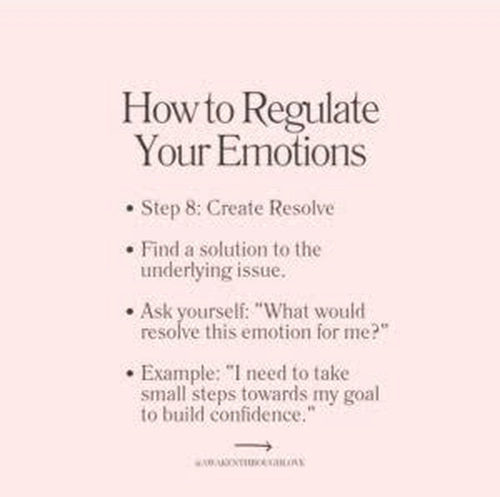
Now, how can I regulate my emotions when things are truly heavy? The same method works, but I add one more thing. I write down the distorted thoughts. “I’m a failure.” “They don’t respect me.” I look at those sentences on paper, and often they’re clearly exaggerated. Labeling them doesn’t erase the pain, but it puts a fence around it.
When Your Inner Critic Won’t Shut Up
The loudest emotional storms come from inside. I can’t count the times I spiraled after making a small mistake at work. My inner critic would run a highlight reel of every failure ever. Here’s what helped: I named that voice. I called it The Narrator. When it started, I would say, “Thanks for the commentary, Narrator, but I’m busy right now.” It sounds silly, but it gives me a millimeter of distance. And that distance is everything.
Another trick I stole from a book is turning “I am” into “I am having the thought that.” So instead of “I am worthless,” I say, “I am having the thought that I’m worthless.” It’s still the same thought, but now it’s just a sentence passing through. I don’t have to hug it and feed it dinner.
Building a Longer Fuse Every Day
Regulating emotions isn’t just about crisis management. I found that my baseline affected everything. When I was sleep-deprived and hadn’t eaten, my fuse was dangerously short. So I started treating my body like a car that needed fuel. I ate protein before a stressful meeting. I walked around the block when my brain felt cluttered. These weren’t emotional tricks. They were biological ones.
Also, I stopped viewing my feelings as enemies. I had a habit of trying to kill my anger. But anger isn’t bad. It’s a signal. Now when I feel it, I ask, “What boundary is being crossed?” That simple shift turned me from a bomb waiting to go off into someone who could actually advocate for herself. That is self-regulation, not suppression.
Frequently Asked Questions
Why can’t I regulate my emotions even though I know what to do?
Knowledge doesn’t equal skill. Knowing how to play piano doesn’t make me a musician. Regulating emotions requires practice in low-stakes moments. You build the muscle when you’re calm, so it’s there when you need it.
How can I regulate my emotions at work without looking weak?
Taking a pause can look like thoughtfulness, not weakness. I often say, “Let me think about that for a moment,” while I slow my breathing. No one knows I’m doing internal repair. You can also excuse yourself to the restroom and splash cold water on your wrists. That short break can reset your system.
What do I do if I fail to regulate my emotions and lash out?
First, forgive yourself. Shame fuels the next explosion. Apologize simply: “I’m sorry for how I spoke. That wasn’t fair.” Then investigate what happened without self-attack. Did you miss an early cue? Were you exhausted? Use it as data for next time.
How can I regulate my emotions when the trigger is someone I live with?
That’s the hardest. I created a code phrase with my partner: “I’m at an eight right now.” It’s shorthand for “I need a time-out before I say something I’ll regret.” We agreed that either of us can use it and the other respects the pause. That mutual understanding changed our dynamic.
One last thing. You will not do this perfectly. I still lose it sometimes. But the other day, I felt an old familiar rage bubble up during a pointless argument. And I paused. Not dramatically. Not heroically. Just a soft, quiet pause. I sighed, and the bubble deflated. I didn’t win an award for it. The world didn’t suddenly become easy. But I looked at that moment and thought, “How can I regulate my emotions? Like that. Just like that.”
