It’s 2:17 in the morning. The house is dark, the kids are breathing their soft little rhythms. I’ve checked the front door twice. Locked. The baby monitor glows green. Everything is fine. Still, my mind keeps replaying that one thing I said at daycare pickup. Then it jumps to the car seat buckle—did I click it all the way? Then it imagines a fever spiking out of nowhere. I’m not panicking. I’m just lying there, wide awake, heart thumping against my ribs, trapped in a loop I cannot escape.

Here’s the truth: You are not broken. Overthinking is not a flaw. It’s a brain doing its job way too enthusiastically, throwing up danger signs when what you really need is rest. For parents, it happens so often because we’re wired to anticipate threats. But when that wiring keeps you up every night, it stops helping. It just hurts.
Overthinking always starts the same way. One thought shows up. Then another. Then your brain grabs the mic and refuses to let go. So the first step is not to “stop thinking.” That never works. The first step is to change what your brain is doing with the thought. Here are five concrete ways to do exactly that.
Why Is It So Hard to Control Overthinking in the First Place?
When you overthink, your brain is basically stuck in a loop it built to protect you. A small worry triggers the amygdala—that ancient part of your mind that handles fear. In seconds, your body gets a shot of adrenaline. Your chest tightens. Your breathing gets shallow. Your brain then searches for more reasons to be afraid, because that’s its pattern. It’s not trying to torture you. It’s trying to prepare you.
The problem is, there’s no real tiger in the hallway. There’s just tomorrow’s work call, a scary post you read online, a tone in your partner’s voice you can’t decode. So the preparation never ends. To break the loop, you have to give your brain something real to do instead. That’s where these steps begin.
How Can Someone Control Overthinking: 5 Simple Steps
1. Name It and Take It Out of Your Head
Grab a notebook or the notes app on your phone. Write down the exact thought looping. “I’m afraid my daughter will forget to breathe during her nap.” Seeing it in black and white does something strange. The thought loses its urgency. Once it’s on paper, tell yourself, “That’s a scary story my brain made. I don’t have to believe it.” Then close the notebook. The physical act of closing a cover signals to your brain: done.
2. Try to Take Their Mind Off What They Are Thinking About
When I’m stuck in my own head, I borrow a trick I use with my anxious kid. I redirect. If a friend’s overthinking spins out, I don’t say “stop worrying.” I say, “Let’s draw something dumb. Ten seconds.” Or I hand them a peach and ask them to describe it like an alien. The shift from mental to sensory breaks the spell. Do the same for yourself. Stand up. Name five things you see. Touch something cold. Your brain cannot run the worry program and the sensory program at the same time.
3. Talk to the Right Person, Not the Nearest Person
Janhavi Singh, reflecting on her own struggles with overthinking in Varanasi, put it bluntly: “Over explain! A person who overthinks doubts oneself or someone else. The best way to stop them … is by making them feel secured.” She’s right, and it’s important. Not everyone is safe for this moment. Don’t turn to the friend who’ll crack a joke to “lighten the mood.” Don’t turn to the one who’ll tell you to just relax. Find the person who will listen fully, not interrupt, and then offer an honest, gentle opinion. Say, “I just need you to hear this. I don’t need a fix yet.” Sometimes that alone cuts the loop in half.
4. Do Something That Occupies Your Hands Fully
Mini Marcela Baskey, a student who wrestled with overthinking, shared a simple image: “How would you take out the air from an empty cup? … By pouring something into it. Keep that person busy.” I think about this every time I start pacing around the kitchen at midnight. I sit down and fold laundry. I pick up a tennis ball and bounce it against the wall. Painting, playing a simple game, sorting old photos—anything that requires your hands and a tiny bit of attention. The brain can’t spin and do at the same time. It’s not a distraction trick. It’s neural real estate.
5. Let the Body Lead the Mind
Chesta Agarwal from Jaipur was direct: “If it’s harming your mental health, nothing can be better than meditation.” I’d add: any gentle, repetitive movement works. I don’t mean an hour of yoga. I mean walking to the mailbox and back very slowly. I mean sitting on the floor and doing one breathing exercise—breathe in for four counts, hold for four, out for six. When your body shifts out of the adrenaline state, your thoughts loosen. You didn’t solve anything, exactly. You just gave your nervous system a different experience.
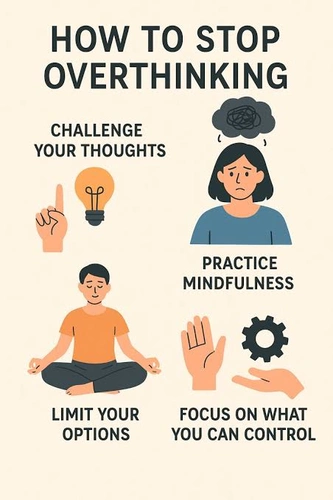
The 3-Minute Mind Reset Ritual
This is the tool I reach for when I am absolutely sick of my own inner monologue. It works best when you feel the spiral ramping up, before it’s 10 layers deep. Here’s the sequence:
- Minute 1: Say aloud, “I am overthinking right now. This is not an emergency.” Speak it in a calm, steady voice. The act of hearing your own words interrupts the internal volume.
- Minute 2: Change your physical position. If you’re lying down, sit up. If you’re sitting, stand. Take three slow exhales, each longer than your inhale. Focus only on the cool air at your nostrils.
- Minute 3: Pick one tiny real-world task and do it: water a plant, wipe a counter, reply to one text—something that has a beginning and an end. When the task finishes, you’ve proven to your brain that reality is still here, and you are still in charge.
What to Do When Overthinking Strikes at Night
Nighttime is its favorite playground. The house is quiet, obligations are gone, and your brain fills the vacuum. First, keep a small lamp and a notepad by the bed. If a worry pops up, write one word that captures it. “Door.” “Fever.” “Work.” Then say, “I’ll take care of this tomorrow at 8 a.m.” It sounds silly. But your mind often just wants acknowledgment. Second, try a story. I mentally re-read a favorite children’s book page by page. Reciting The Very Hungry Caterpillar in my head, in order, silences the loop faster than any relaxation app.
Helping a Friend or Partner Who Can’t Control Overthinking
When it’s someone you love, resist the urge to fix. Ask, “What’s the thought that’s looping most right now?” Let them talk. Then ask, “Is that a fact, or is it a story your brain is telling you?” Don’t answer for them. Just hold the question. If they need a physical shift, offer your hand or suggest a walk to the kitchen to get an ice cube to hold. The cold is a genuine neurological reset. And remember: no jokes, no dismissals. A person deep in the spiral just wants to know you’re not laughing at their fear.
Frequently Asked Questions
Q: How can someone control overthinking when it feels completely automatic?
A: Acknowledge that the automatic part is just a brain habit, not a character flaw. Start with the body: slow your breathing first. Then write the thought exactly as it sounds, no editing. That creates a tiny pause—and in that pause, you can choose a different move.
Q: Can controlling overthinking really work with just simple daily habits?
A: Yes. Habits like naming the thought, moving your hands, and doing a quick reset ritual train your brain over time. It’s like building a muscle. One good redirection today makes tomorrow’s spiral a little shorter.
Q: How can someone control overthinking without talking to a professional?
A: Many people find relief through the steps above, plus consistent meditation or rhythmic exercise. If the overthinking starts to block your daily life—keeping you from sleeping for weeks, eating, or enjoying time with your kids—that’s the signal to reach out for extra support.
Q: What if I try to control overthinking but it comes back worse later?
A: That’s normal. Overthinking has flare-ups, just like any habit. Each time it returns, you’ll catch it a little sooner. Be patient with yourself. One hard night doesn’t erase all the progress you’ve made.
One last thing: next time you’re lying awake at midnight, heart tapping, remember—you’re not crazy, you’re not weak. You’re just a person whose brain loves hard, and sometimes that love spills into worry. You can let the thought play out. Or you can get up, pour a glass of water, take three slow breaths, and remind yourself: I’ve done everything I needed to do today. The rest can wait until morning.
