I still remember the look on the other moms’ faces at pickup. My daughter, almost five, was red-faced and screaming. Her buddy had chosen a different playmate, and her whole world crumbled right there on the kindergarten sidewalk. I felt every stare. That wasn’t the first time. The outbursts had been escalating for months—big, loud, thrashing storms over tiny disappointments. At home, we could contain it. At school, I felt helpless.
Our house runs on high emotion. Both my husband and I have ADHD, and our daughter almost certainly does too. She’s not diagnosed yet—just barely five—but the signs are all there. She feels everything deeply. And lately, minor letdowns at school were triggering meltdowns that didn’t look like any “normal” tantrum.
What finally shifted things wasn’t a perfect system. It was a handful of small, specific strategies that respected her brain—and kept me from losing mine.
Quick Help for School Outbursts Today
If your child is melting down at school right now, start here:
- Breathe out longer than you breathe in when you walk toward her.
- Say one short phrase: “I’m here. I’m not going anywhere.”
- Don’t ask “what happened?” yet. Just sit nearby quietly.
- After she’s quiet, whisper: “Was that hard for your body?”

Why Does My Child Have Emotional Outbursts at School?
Why does a five-year-old lose it over a crayon color? It’s not defiance. It’s an overwhelmed brain. At school, kids face a constant stream of transitions, social negotiations, and heavy expectations. For a child with a sensitive nervous system—especially one with ADHD traits—that pressure builds up like steam.
My daughter’s triggers were predictable. She wanted a specific snack and I said no. A friend didn’t follow her pretend-play script. A drawing wasn’t “perfect.” And at school, the same patterns played out in a louder, more public way. Teachers told me she’d crumble when the schedule changed or when she couldn’t sit next to her best friend.
What I now understand: these outbursts aren’t manipulative. They’re a stress response. Her brain’s frontal lobe—the part that manages impulse control—gets hijacked. She’s not choosing to scream. She’s caught in a neurological traffic jam. The more we punished, the worse it got. The more we explained logic, the more she raged. She needed something else entirely.
How to Respond When Your Child Has Emotional Outbursts at School
My first instinct used to be to talk. I’d bend down and say, “Sweetie, we can’t have the cookie because…” Big mistake. Words were gasoline. I learned the hard way: when she’s in full meltdown, my calm presence is the only thing that reaches her.
A doctor in an ADDitude video described being a pace car. A race car has spun off the track. Debris everywhere. If you speed up, you crash. You have to stay annoyingly slow, right ahead of your child, until the track clears. I started breathing like that pace car at pickup: slow exhales, shoulders dropped, no questions.
The dialogue changed. Instead of “Why are you crying?” I’d say, “You really wanted that. That felt unfair.” Just that. No fixing. No lesson. She’d sob into my leg for three minutes, then look up and ask for a snack. The storm passed faster when I didn’t get sucked in.
Another parent told me about Parent-Child Interaction Therapy, or PCIT. She said it helped her son with similar outbursts. I looked it up. The core idea: learn to stay neutral and “boring” during big feelings. Don’t react with big energy. Don’t escalate. Just be the solid, quiet anchor. I started practicing that at home first so I could bring it to school moments.
The Pace Car Approach for School Meltdowns
I named it the Pace Car Approach because that image stuck. Here’s how it works in real life when you get that dreaded call or see the meltdown at the classroom door.
Step one: Before you interact, take one long, slow breath. Your nervous system sets the speed limit. If you’re racing, she’ll race.
Step two: Get on her level, but not in her face. Sit sideways, slightly turned away. Less threatening.
Step three: Use a calm, boring voice. Say, “I see you. I’m right here.” Nothing else. Count to thirty in your head.
Step four: Offer a quiet, physical anchor. For my daughter, that’s holding my wrist. For some kids, it’s a heavy backpack or a cold water bottle pressed to their cheek.
Why does this work? Because a dysregulated child can’t process language. Logic launches from the prefrontal cortex, which is offline during a meltdown. Calm co-regulation—your steady nervous system next to hers—teaches her brain that it’s safe to come back. The pace car slows the whole moment down.
At school, I taught her teacher a shortened version. She’d say, “I’m going to sit here. You’re okay.” And she’d breathe audibly. The meltdowns didn’t vanish overnight, but they ended sooner. And my daughter started to trust that someone would hold the space without judgment.
Practicing the Pause at Home, Before School
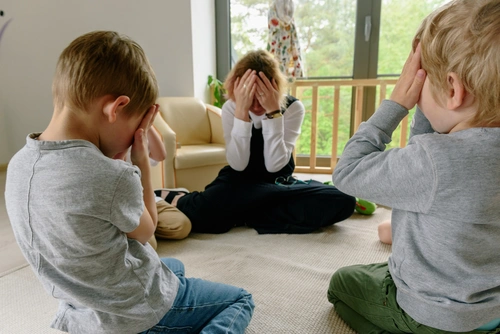
A meltdown at school is harder to navigate if we haven’t practiced the skill in easier moments. I started “pausing practice” on calm Sunday mornings. We’d role-play. I’d pretend to get really frustrated, and she’d be the pace car for me. She’d say, “Breathe, Mama.” It made the dynamic playful. Then before school, I’d whisper: “If something feels wobbly today, remember I’m your pace car, even when I’m not there.”
Tips for home practice:
- Use a two-minute timer after a demand to build tolerance (wait for a tiny thing before getting juice).
- Name feelings without forcing a conversation: “Your face looks like a scrunched-up napkin. Maybe inside you feel tight?”
- After a small frustration, say: “We hit a bump. Let’s slow down together.”
What to Say to the Teacher (and What Not to Say)
I used to apologize profusely. That didn’t help. Now I send a single, human email: “My daughter had a rough afternoon. She’s working on letting feelings pass safely, and we’re using a ‘pace car’ strategy. If you see her start to spin, just sitting nearby with slow breaths helps her reset.” Teachers want tools, not guilt. I share what we do at home, ask what they notice, and keep it collaborative.
A phrase that didn’t work: “Just ignore her.” That made her panic harder. What did work: “I’m not going anywhere. You’re safe.” A teacher told me that line calmed her down in under two minutes last week. I almost cried.
FAQ: Child Emotional Outbursts at School
Q: Why does my child have emotional outbursts at school but not at home?
A: School demands more self-regulation. Transitions, social dynamics, and sensory input all pile up. Some kids hold it together all day and then melt down at pickup—or they melt down at school because they can’t hold it together any longer. The environment is simply harder for their nervous system.
Q: How do I respond to a school meltdown without making it worse?
A: Don’t talk. Don’t ask questions. Don’t try to explain. Get on their level, breathe slowly, and say something calm like “I’m here. I’m not going anywhere.” Your calm presence is the only thing that reaches them when their brain is flooded.
Q: What is the Pace Car Approach?
A: It’s a strategy based on the idea of staying “annoyingly slow” when your child is spinning out. You don’t speed up or match their energy. You stay calm, breathe deeply, and model regulation. Over time, their nervous system learns to follow your lead. (The term comes from an ADDitude article on ADHD parenting.)
Q: Should I talk to my child’s teacher about these outbursts?
A: Yes. Share what works at home and ask what they’re seeing. Offer a simple strategy—like sitting nearby with slow breaths—and keep the conversation collaborative. Teachers appreciate tools, not guilt.
Q: When should I consider professional support for emotional outbursts?
A: If outbursts are frequent, intense, interfering with learning or friendships, or happening across multiple settings, it’s worth exploring. Parent-Child Interaction Therapy (PCIT) and occupational therapy are two options that help many families. Talk to your pediatrician.
One Last Thing
A few months ago, I watched my daughter at the playground. A boy took her shovel. Her face got hot. I braced. But she stood there, not screaming. She looked at me, took this enormous, shaky breath, and said, “I feel really, really mad.” Then she walked over and asked if she could use a different shovel. I didn’t solve it. She found her own slow pace. That’s all we can hope for, really—little moments where they borrow our calm until they can steer on their own.
References
- Greene, R. W. (2014). The Explosive Child: A New Approach for Understanding and Parenting Easily Frustrated, Chronically Inflexible Children. Harper Paperbacks.
- ADDitude Magazine. (n.d.). ADHD and the “pace car” parenting analogy. Retrieved from https://www.additudemag.com
- Porges, S. W. (2011). The Polyvagal Theory: Neurophysiological Foundations of Emotions, Attachment, Communication, and Self-Regulation. W. W. Norton & Company.
