The last time I said a simple “no” before dinner, the sound that came out of my son wasn’t a whine. It was a full-body scream. His face went red. He lunged at me, fists swinging toward my stomach. I caught his wrists and he bit down on my arm hard enough to leave a purple ring for days. That was the moment I realized we weren’t just dealing with a strong-willed kid—we were drowning.
I remember scrolling through a late-night parenting forum and finding a post that could have been my own diary. A parent wrote: “We’re at our limit … He hits. He bites. He screams. We’ve tried so many techniques. Time outs. Offering choices. Being calm. Being loud. We’ve even recently tried spanking.” I cried reading it. It described exactly what we were living with our four-year-old every single day. And it was the first time I could ask, without shame: why does my child react aggressively when told no—and is there a way through this that doesn’t break our family?
Quick Help for Aggressive Reactions Today
If you’re in the middle of a meltdown right now, start here:
- Get down on his level before you even open your mouth.
- Say “no” in a voice as steady and flat as you can, not loud, not sorry.
- Name the feeling immediately: “You’re really angry that I said no.”
- Give his body a safe place to release the big energy—a couch cushion to punch, a stomping spot.
- Stay close without talking until the storm passes. You can whisper once: “I’m right here.”
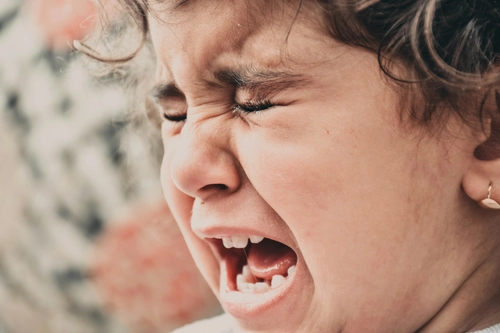
Why Does My Child React Aggressively When Told No?
I used to think it was something I had done wrong. Was I too lenient? Too strict? Did I not hold enough boundaries in the toddler years? But once I stopped blaming myself, I started to see it for what it often is: a four-year-old brain with a fully developed emotional gas pedal and barely any brakes. At this age, the part of the brain that handles impulse control isn’t wired yet. So when a strong-willed child hears “no,” it lands like a punch. They don’t think “I’m disappointed.” They feel the word in their whole body, and they react with whatever tool is closest—hitting, biting, throwing, screaming.
I remember one mother in that online thread wondering about sensory processing challenges. She noticed her son wasn’t clumsy or late with speech, but any limit felt unbearable to him, almost physically painful. I saw my own kid in that description. Some children are so sensitive to the feeling of “no” that their nervous system fires up before they even know what’s happening. This isn’t an excuse for aggression. It’s a roadmap. When I started looking at his outbursts as a stress response and not a personal attack, I could finally stop reacting like a cornered animal myself.
What Finally Helped Our Child Stop Hitting When Told No
I wish I could say one strategy fixed it. The truth is messier. We had to change almost everything. The first real shift came when we stopped seeing his aggression as something to punish out of him. Punishment just made him dig in harder—that defiant stare, the extra shove toward his little brother after we’d said stop. I know that look. It’s not badness. It’s a child trying to reclaim some control in a world that feels overwhelming.
One evening after a particularly awful day, I knelt down while he was still screaming and said very softly, “I see how mad you are. It’s okay to be mad. But I won’t let you hit me. Here’s a pillow you can hit.” He paused. He didn’t take the pillow. But he heard me stop fighting back. That was the moment the connection door cracked open.
We leaned heavily on advice from our pediatrician, who told us to pick one approach and stick with it for weeks. We chose to pair firm limits with deep empathy. “I know you want the toy. And I can’t let you take it from your brother. Let’s find something else.” Repetition after repetition. Preschool became the other lifeline. His teachers were experienced with intense kids. They mirrored the same calm “I can’t let you” language we used at home. Being around peers who didn’t tiptoe around his moods gave him a social mirror we could never provide. Slowly, the reaction to “no” softened from rage to anger to frustration, and sometimes, to an actual negotiation. Not perfect. But human.
A Calm Spot That Stopped the Screaming
I needed a tool with a name, something he could understand and we could both rely on. We created what we now call the “Calm Body Spot.” It’s not a time-out corner. It’s a small area in our living room with a soft mat, a basket of sensory toys, and a timer he can flip over himself.
When I see his fists clench or hear that first guttural growl after a “no,” I say, “Your body needs a calm break. Please go to your spot until you’re ready to use gentle hands.” At first he refused. I’d gently walk him there and sit nearby without looking at him directly. After a few days, he’d stomp there on his own and scream into a pillow. A month in, he started going there without being asked. Last week, after I said no to a second show before bath, he yelled “FINE” and flung himself onto the mat. Two minutes later he called out, “I’m ready to try again.”
The tool worked because it gave his out-of-control body a predictable, safe container—one that wasn’t about shame, but about resetting. It also taught us, his parents, to breathe instead of escalate.

What to Do When the Aggression Is Aimed at a Younger Sibling
The two-year-old became a target. Any time his brother grabbed a toy or needed attention, my four-year-old would push, smack, or scream right in his face. I felt sick trying to protect one child while not demonizing the other. I started using a script that felt stiff at first but eventually saved my sanity: “I won’t let you hurt your brother. I’m moving him to a safe spot, and then I’m staying with you.”
I’d physically place myself between them. Then I’d stay with the older one, not to lecture, but to be present. “That was really hard. You wanted the toy all to yourself.” Naming the want, not the deed, stopped the cycle of blame. Later, when everyone was calm, I’d teach a better substitute: “Next time you want the toy, say ‘My turn next.’ Tap my arm if you need help.” It didn’t work the first ten times. But the eleventh time he stomped, then shuffled to me and said, “My turn next.” Almost a whisper. I almost missed it.
When Should You Worry and Seek Help?
A question that rattled in my head for months: Is this just a phase, or does he need some kind of evaluation? I remember the parent in that forum wondering if their son had behavioral issues or mental health problems. Their pediatrician became the first stop, and ours did too. After a thorough conversation, our doctor explained that while intense temperaments are common at four, a few red flags might mean extra support is worth exploring: aggression that happens almost every hour, self-harm, hurting animals, or any loss of developmental skills.
In our case, preschool teachers gave us the most honest feedback—yes, he’s harder than most, but he’s also capable of empathy and learning. That matched what his grandparents started to notice once we all got on the same page with language. If you’re losing your marriage, your friendships, and your sense of safety, reaching out to a professional is not failure. It’s wisdom. Some parents find that an evaluation uncovers sensory needs or anxiety that can be addressed without medication. For us, the combination of pediatrician guidance, preschool partnership, and home consistency slowly pulled us back from the brink.
FAQ: Child Reacts Aggressively When Told No
Q: Is it normal for a 4-year-old to hit or bite when told no?
A: Physical aggression is common at this age because impulse control is still developing. But if it’s frequent, intense, or causing harm, it’s worth paying close attention. The behavior is normal in the sense of being age-typical—but that doesn’t mean you should ignore it. It means you need tools to address it.
Q: Why does my child only react aggressively to “no” and not other limits?
A: For some kids, the word “no” itself carries extra weight. It might feel like a total shutdown of their desire, not just a limit. They react to the word, not just the rule. Some families find success using alternative phrasing like “not right now” or “let’s do this instead.”
Q: How do I stop my child from hitting me when I say no?
A: Stay calm and state the limit firmly: “I won’t let you hit me.” Then physically block the hit if needed and redirect to a safe outlet—a pillow, a stomping spot. The teaching happens after the storm, not during. Your calm presence is the most powerful tool.
Q: Should I punish my child for aggressive reactions?
A: Punishment often backfires with aggressive kids because it adds fuel to an already overwhelmed nervous system. Focus on safety first, then connection, then teaching a better response. The skill develops over time with repetition and practice.
Q: When should I seek professional help for my child’s aggression?
A: If the aggression is happening daily, if your child is hurting themselves or others, if they seem unable to calm down after a meltdown, or if you’re feeling unsafe in your own home, it’s time to talk to a professional. Start with your pediatrician—they can guide you.
One Last Thing
I think about that bite mark on my arm now, long since healed. And I think about the parent I was back then, hollow-eyed and wondering if my child would ever be okay or if I had already ruined everything. The truth is, the aggression didn’t vanish. He still flares. But yesterday, when I said no to candy before lunch, he growled, kicked the cabinet, and then stomped to his Calm Body Spot without a word. I stood in the kitchen and felt tears on my face—not from fear, but from a quiet, wobbly hope that we might just make it through.
References
- Cline, F., & Fay, J. (2011). Parenting with Love and Logic: Teaching Children Responsibility. NavPress.
- American Academy of Pediatrics. (2021). What’s the best way to discipline my child? HealthyChildren.org. Retrieved from https://www.healthychildren.org
- Siegel, D. J., & Bryson, T. P. (2012). The Whole-Brain Child: 12 Revolutionary Strategies to Nurture Your Child’s Developing Mind. Bantam.
