I’m standing in the hallway at 9:45 p.m., hearing giggles and thumping from the kids’ room. My 6-year-old and 4-year-old share a room, and bedtime has turned into a party. We’ve limited screen time, cut food dyes, spent hours outside. We’ve tried charts, rewards, consequences. We’ve begged, pleaded, yelled. Nothing sticks. They’re not napping anymore, they wake at 7:30, and still they refuse to settle.
I have friends whose kids just put on pajamas and drift off. Mine go crazy until 10 p.m. We have an infant and we’re dangerously tired. My mom brags she never did bedtimes, and I spent school years falling asleep in class. I don’t want that for my kids. I’m not even sure I’m looking for advice anymore—just solidarity. Because when your child refuses bedtime routine, you feel like the only one.
Quick Bedtime Reset Today
If you’re in the middle of a bedtime battle right now, start here:
- Stop the battle—declare a “quiet time” instead of “sleep time.”
- Give the older child a “Stay Up Quietly” pass that expires at a set time.
- Use a podcast or audiobook to anchor their body in bed.
- Set a firm parental boundary: no parent entertainment after 8:30 p.m.
- Observe whether your child genuinely needs less sleep, and adjust the wake-up routine gradually.
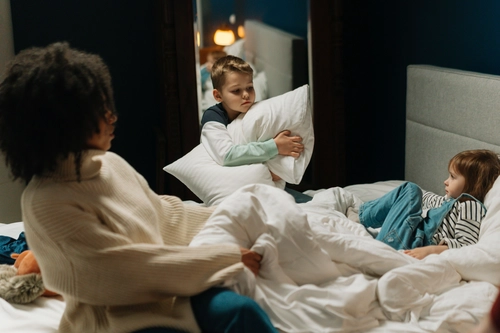
Why Does My Child Refuse the Bedtime Routine Every Night?
It isn’t always about defiance. Some kids simply build sleep pressure slower. My older daughter, the 6-year-old, could keep her eyes open through a hurricane. Her brain didn’t power down until close to 10:30, no matter when we started the bath. When kids share a room, the dynamic multiplies—one gets silly, the other feeds it, and soon no one remembers why we’re lying down. Add a parent who is desperate for adult time, and the routine becomes a nightly tug-of-war.
The truth is that many bedtime struggles aren’t about a broken routine; they’re about a mismatch between the child’s biology and our expectations. Some kids truly need less total sleep than the charts say. Others need more control over transitions. When every suggestion fails, it might mean your child isn’t trying to ruin your evening—she’s telling you she can’t just switch off.
How to Help a Child Who Refuses the Bedtime Routine Without a Fight
The change that saved us was embarrassingly simple: I stopped fighting sleep and started granting permission for quiet wakefulness. The bedtime routine itself stays the same every night—bath, pajamas, books, a song, lights low. Then my youngest goes to bed at 8:15. But my oldest gets an official “quiet play time” until 9:30. She knows these rules: she stays in her bed, she plays with silent toys or listens to a podcast, and Mom and Dad are off duty. No one will come to play or talk. We don’t get upset if she makes a little noise. We just go about our own evenings.
Why does this work? It removes the power struggle entirely. She isn’t defying a “go to sleep” command; she’s following a “you may stay awake quietly” permission. The fight evaporated the first night. By 9:30 I pop in and say, “Time to put things away. You can keep listening if you’re still awake.” She’s usually asleep by 10, but sometimes it’s 10:30. The key is that she wakes up happy and pleasant. I’d rather have a later bedtime and a peaceful house than a 7:30 bedtime and a nightly war.
The Quiet Night Pass Ritual
We made it tangible. I printed a little card with a moon and the words “Quiet Night Pass.” Every evening after her sibling is asleep, I hand her the card. She can use it to listen to a children’s podcast, draw in a notebook with a dim headlamp, or read picture books. It’s hers. She feels in control. When I come to collect the card at 9:30, it’s a soft signal that quiet time is over and real rest begins.
Some families use a token system, others a verbal check-in. The magic isn’t the card—it’s the message: “I see you. I trust you to know your body. I’m not going to force you to sleep, but I am going to protect my own need for downtime.” That respect diffuses the battle.
When Your 6- and 4-Year-Old Share a Room and Bedtime Becomes Chaos
Room-sharing adds jet fuel to bedtime refusal. The older child wants to entertain; the younger doesn’t want to miss out. Our fix had two parts. First, we staggered bedtimes by 45 minutes—the 4-year-old down first with a short sleep podcast while the older one stayed in the living room for final quiet reading. Once the younger was asleep, the older moved to her bed. Second, we used a white noise machine that masked giggles and shuffling. If they did get giggly, I’d say, “Remember, quiet voices so your sister can rest.” The boundary was clear but kind. No threats, no loss of pass.
What If the Younger Child Wants the Same Privilege?
He did ask. I explained, “Your body feels tired earlier. Getting enough sleep helps you run fast and be happy tomorrow. When you’re a little older, you’ll get a pass too.” Short and matter-of-fact. He accepted it because the pass wasn’t a reward for staying up—it was a tool the older needed, like glasses. I also gave him a tiny flashlight to “check on his stuffed animals” before sleep, which felt special without extending wake time.

How Podcasts and Audiobooks Anchor the Bedtime
A kid-friendly podcast is a parent’s secret weapon. We use one that tells calm, sleepy stories. She puts on child-safe headphones or a small speaker set low. The voice gives her mind something safe to latch onto, so she’s not lying there restless, inventing reasons to call us. It’s like an off-ramp from the busy highway of her brain. Within 20 minutes, even if she isn’t asleep, she’s still and quiet. That alone let my husband and me breathe again.
FAQ: When Your Child Refuses the Bedtime Routine
Q: Why does my child refuse the bedtime routine even when we do everything right?
A: Some children build sleep pressure slowly—their brains don’t power down until later. It’s often a biological mismatch, not defiance. Your child may need less sleep than the charts suggest, or they may need more control over the transition to sleep.
Q: How do I stop the bedtime battle without staying up too late myself?
A: Try swapping “sleep time” for “quiet time.” Let your child stay awake quietly in bed with a podcast or silent activity while you go about your evening. Set a clear boundary that parents are off duty after a certain time.
Q: What if my child refuses to stay in bed during quiet time?
A: Start with small, clear rules: stay in bed, quiet voice, no leaving the room. If they get up, calmly walk them back without lectures. The first few nights may be bumpy, but consistency pays off.
Q: My kids share a room and keep each other awake—how do I handle that?
A: Stagger bedtimes so the younger one falls asleep first. Use a white noise machine to mask sounds. Give the older child a quiet activity in a different room until the younger is asleep. Clear boundaries with a kind tone work better than threats.
Q: Is it okay to let my child stay up later if they wake up okay the next morning?
A: Yes. Some children genuinely need less sleep. If they wake up happy, focused, and not overtired, you might be fighting a sleep need that isn’t there. Adjust your expectations to your child’s biology, not the charts.
One Last Thing
Last night I crept past their door at 9:47. I heard the soft hum of a podcast narrator talking about whales. No thumps, no giggles. Just one small lamp outlining my daughter’s hand as she turned a page. I stood there for a minute, not fixing anything. When I got into bed later, I didn’t feel that familiar twist of resentment. I just felt grateful we’d stopped fighting a routine that was never meant for her.
References
- West, K. (n.d.). Good Night, Sleep Tight: The Sleep Lady’s Gentle Guide to Helping Your Child Go to Sleep, Stay Asleep, and Wake Up Happy.
- Markham, L. (2012). Peaceful Parent, Happy Kids: How to Stop Yelling and Start Connecting. Perigee Books.
- Faber, A., & Mazlish, E. (2012). How to Talk So Kids Will Listen & Listen So Kids Will Talk. Scribner.
