I was at a friend’s house last month, and she put on an old record. The sound was strange and beautiful. Harp strings floating over electronic drones. A voice chanting in a language I didn’t recognize. She told me it was Alice Coltrane. I knew the name, vaguely. John Coltrane’s wife, right? The pianist who played on some of his later records. But this music felt like it came from another planet entirely. Who was this woman, really? And why had I never heard her story before?
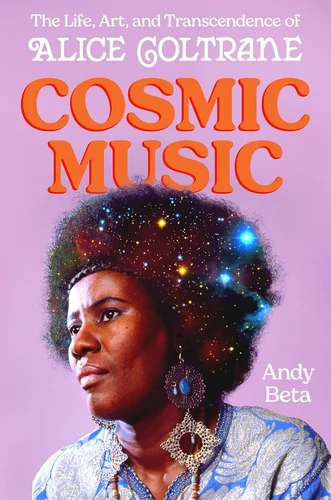
Andy Beta’s Cosmic Music: The Life, Art, and Transcendence of Alice Coltrane arrived in the mail the next week. I’ll be honest: I almost didn’t open it. Another biography of a musician’s spouse? But Beta does something surprising. He doesn’t spend the first hundred pages explaining who John Coltrane was. He starts with Alice as a young girl in Detroit, playing piano in church. A woman who composed before she married. Who had a vision before she became a widow. The book asks a question that stayed with me long after I finished it: What does it mean to create when the world insists on seeing you as an afterthought?
Character and Plot: The Woman Unseen
Alice Coltrane emerges in Beta’s pages as someone who was never quite where people expected her to be. She grew up playing gospel and bebop. She moved to Paris and played with vibraphonist Terry Gibbs. She met John at a club in New York. For years, she was his sideman, his support, his muse. But the book makes clear that she was always composing, always searching for something beyond the standard jazz vocabulary.
The core conflict arrives after John’s death in 1967. Everyone expected her to become a keeper of his legacy. To play his songs. To talk about him in interviews. Instead, she did something that confused critics and alienated audiences. She walked away from jazz entirely. She started playing the harp, an instrument almost nobody in jazz was using. She recorded albums with titles like Universal Consciousness and Journey in Satchidananda. She founded an ashram in California. She stopped performing in clubs and started making music for meditation.
Beta doesn’t judge her choices. He lets the tension sit there. Why would someone abandon a successful career? Why would a brilliant musician choose obscurity? The suspense isn’t about whether she succeeds. It’s about whether she can keep her soul intact while the world keeps trying to shrink her. I found myself holding my breath during the chapters about her ashram years. You want her to find peace. But you also wonder if she’s running from something. The book never gives you a neat answer. It just shows you a woman who kept moving forward, even when nobody followed.
Theme and Imagery: The Sound of Spiritual Hunger
The central image in Beta’s book is the harp. Not as an instrument, but as a symbol. Alice Coltrane picked up the harp because it was impractical. It was hard to transport. It didn’t fit into standard jazz ensembles. Critics called it a gimmick. But Beta shows how the harp became her voice. The strings allowed her to create sustained notes, floating harmonies, a sound that felt less like music and more like prayer. She wasn’t trying to impress anyone. She was trying to reach something beyond the room.
The book’s core theme is transcendence through limitation. Alice didn’t have the freedom that male musicians had. She was a Black woman in a white-dominated industry. She was a mother of four. She was grieving. But Beta argues that these constraints didn’t hold her back. They forced her to find a different path. The ashram wasn’t an escape. It was a laboratory. She experimented with tape loops and synthesizers. She combined Indian devotional music with jazz harmonies. She created a sound that belonged to no genre.
Beta’s writing style mirrors this theme. He doesn’t overwhelm you with technical music analysis. He describes the feeling of her music. The way it makes you feel unmoored, suspended, like you’re floating in deep water. He writes about her chanting and says it sounds like “a voice coming from somewhere behind you.” You can hear it on the page. The imagery stays with you. A woman alone in a room with a harp, recording for hours, knowing that most people will never understand what she’s doing. But doing it anyway.
Elevation and Call to Action
What surprised me most about Cosmic Music is how little it feels like a music biography. Beta isn’t interested in discographies or chart positions. He’s interested in the question of belonging. Alice Coltrane never quite fit into any category. She was too spiritual for jazz critics. Too experimental for gospel audiences. Too Black for the white psychedelic scene. Too female for the male-dominated world of jazz. She spent her entire life in the margins.
But here’s the thing. Beta shows that the margins were where she found her freedom. She didn’t need mainstream approval. She needed her own truth. There’s a moment in the book where she describes her music as “a vehicle for the soul.” She wasn’t making albums. She was making invitations. Come sit with me. Listen to this sound. Let it carry you somewhere else.
I think about this book whenever I feel invisible. Whenever someone reduces me to a role. A parent. A partner. An employee. The world wants to put you in a box. Alice Coltrane refused. She built her own world instead. Beta’s book is a reminder that you don’t have to be famous to be significant. You just have to keep making the thing only you can make.
“I didn’t choose this path,” she once said. “It chose me. I just had the courage to follow it.”
