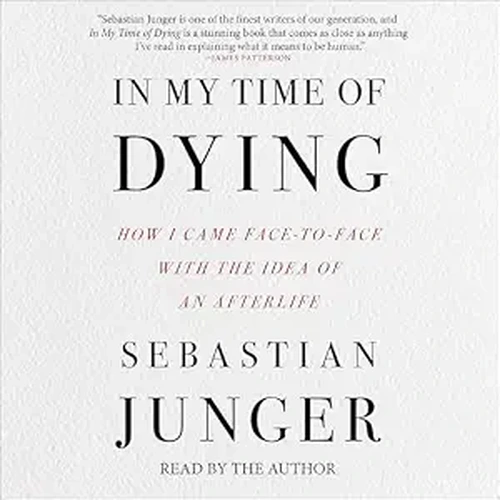
I have a friend who, after a bad car accident, told me she saw her grandmother standing in a field of wheat. She was not religious. She did not believe in ghosts. She looked at me, half embarrassed, and said, “I know it sounds crazy.” That conversation came back to me as I read Sebastian Junger’s In My Time of Dying. Because Junger, a man who has reported from war zones and survived the most violent storms, had the exact same problem. He saw a light. He felt a presence. And his rational, science-trained brain could not make it go away. The book asks a simple, terrifying question: what if the thing we call “the soul” isn’t just a metaphor?
The Man Who Should Have Died, and the Question He Couldn’t Escape
Junger is not a soft man. He has written about the brutality of combat, the indifference of the ocean, the loneliness of men under fire. He has seen death up close, many times. But in June 2020, death came for him personally. A ruptured abdominal aortic aneurysm. He was bleeding internally, dying on the floor of his Cape Cod home. What he describes next is the heart of the book. He felt a profound sense of peace. He saw a warm, golden light. He felt the presence of his long-dead father, who seemed to be waiting for him. Then the paramedics arrived, and he was dragged back. The experience shattered him. Not because it was frightening, but because it was beautiful. He writes, “I had never felt so loved in my entire life.” The conflict here is not between life and death. It is between what he knows and what he felt. Junger is a journalist. He believes in data, in neuroscience, in the material world. But the light did not care about his beliefs. It just stayed. This tension, between the man of science and the man who glimpsed something else, drives the entire book. What do you do when your own body betrays your worldview?
The Science of the Sacred, or Why We Need a Story for the End
Junger does not pretend to have answers. He is too honest for that. He walks us through the neuroscience of near-death experiences: the flood of DMT in the dying brain, the effects of oxygen deprivation, the temporal lobe’s tendency to hallucinate under stress. All of that is true, he admits. But then he adds a twist. He points out that these explanations only describe the mechanism, not the meaning. The core theme here is that we, as a species, have always needed a story for death. Junger draws on his background in anthropology. He reminds us that for most of human history, the boundary between the living and the dead was porous. Our ancestors felt the presence of ancestors. They built rituals around dying. They did not suffer from our modern, clinical loneliness in the face of the end. The key imagery is the light itself. Junger describes it not as a bright, blinding flash, but as a warm, welcoming presence. A light that seemed to have intention. A light that felt like home. He is careful not to claim proof. But he is also careful not to dismiss it. The craft here is in the restraint. He could have written a New Age manifesto. Instead, he writes like a man holding a piece of glass up to the sun, wondering if it is a jewel or just a shard.
What We Do With a Question That Has No Answer
You might pick up this book hoping for a definitive answer. Is there an afterlife? I will tell you now: you will not find one here. Junger does not conclude. He does not convert. He ends with a kind of humble uncertainty. And I found that more valuable than any certainty. Because the real gift of this book is not the light. It is the permission to talk about the light without pretending to understand it. Junger argues that our fear of death is not just fear of pain or nothingness. It is fear of being alone. The near-death experience, for him, was an experience of being held. Of being met. Core insight: Maybe the afterlife is not a place we go. Maybe it is a presence we have always been inside of, and death is just the moment we finally notice it.
