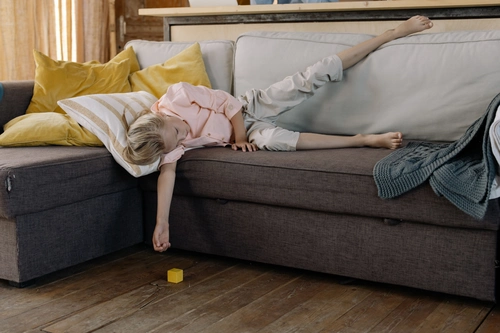
I remember the exact moment. My daughter spilled three drops of milk, and her whole world came crashing down. She threw herself on the kitchen floor, wailing like someone had broken her favorite toy. I stood there, sponge in hand, thinking it would take two seconds to wipe up. But for her, it felt like the end of days. That’s when I knew this was bigger than spilled milk.
Quick Ways to Respond When Your Child Overreacts
If you’re in the middle of a dramatic meltdown right now, start here:
- Pause before reacting. Count to five in your head.
- Kneel to their eye level without saying a word.
- Offer a single nod to show you see them.
- Wait for the storm to pass before teaching anything.
- Later, practice a “calm voice” phrase together.
These quick steps open the door to a deeper conversation about why these big reactions happen and what you can do to gently shift them. They are just a starting point, not the entire solution.

Why Does My Child Overreact to Everything?
I used to think my son was just being difficult. Every small disappointment became a meltdown. The wrong color cup, a broken cracker, saying “hi” too loudly. I asked myself constantly: why does my child overreact to everything? Is it my fault? Did I spoil him?
Then I watched him one afternoon. He was tired, hungry, and I had just told him we couldn’t go to the park because it started raining. He screamed, “I’m the worst kid ever! I’m going to go in the trashcan and throw myself away!” My heart stopped. Where did he learn that? What did I do? I scooped him up and said, “No, honey, you are the most wonderful boy. Don’t ever say that.” The next day, he said it again. And again the day after that. He had found a phrase that stopped me in my tracks. He got a huge hug and my full attention. So he kept using it, not because he believed it, but because I had accidentally taught him that those words were magic for getting mom’s full focus.
Many parents on the r/parenting subreddit have shared similar stories. One parent noticed their daughter saying dramatic things like “I’m so stupid” after being disciplined. Another user pointed out something crucial: “Is it possible, that when she first displayed this behavior, it was ‘rewarded’ with attention?” That comment was a lightbulb moment for me. A child overreacts to everything not always because the feeling isn’t real, but because the reaction got them something they needed. Attention, a release from a punishment, or connection when they felt alone.
Think about your own life. Have you ever caught yourself saying something dramatic under your breath when you burned dinner? “I’m the worst cook in the world.” You didn’t mean it. You were just frustrated. Kids do this too, but their emotional brakes aren’t fully built yet. They say the extreme thing because it matches the intensity they feel inside. And if we respond with our own intensity, we accidentally confirm that this is how you communicate big feelings.
What Do I Do When My Child Overreacts to Everything?
What worked for us started with a conversation from another Reddit parent. They said, “Of course when he first started saying that stuff, we were like, ‘No, honey, you’re awesome and smart!’ And then he relished in that and kept on saying it more. Now when he makes those comments, we ignore it, and it seems to be phasing itself out pretty quickly.” It felt wrong at first. Ignore my child when he says he wants to throw himself away? But then I tried it. I didn’t ignore him. I ignored the specific dramatic phrase. Instead, I looked at him and said, “You’re really upset about the rain.” No big hug for the trashcan line. Just a calm acknowledgment of the real feeling.
The shift happened slowly. He tested it a few times, saying the phrase louder. I stayed steady. I’d say, “I hear you’re frustrated. Let’s talk about that.” Within a week, the trashcan talk faded. He mostly seems to joke about it now, like another user whose son says, “I’m going to throw myself away, mom,” and she playfully replies, “Should I call the garbage man?” He laughs. “Haha, no mama. It is just a bad joke.” Humor only works once the attention-seeking cycle is broken. Before that, it can feel like you’re making fun of their pain. Now, we can joke. But we had to walk through the calm ignoring phase first.
One afternoon, my daughter spilled her entire juice box. Before the wail could start, I said, “Juice is on the floor. Let’s get a towel.” She paused. Her mouth was open, ready to scream. But my voice was so boring, so flat. She followed me to get the towel. Later, during a calm moment, I brought up what happened. Not the spilling, but the almost-scream. I said, “You know, sometimes we feel like screaming. What is another word for that feeling?” She said, “Ragey?” I smiled. “Yep. Ragey. Next time you feel ragey, you can say, ‘Mom, I’m ragey.'” It gave her a tool instead of a tantrum.
The Calm Corner Reset
We created something called “The Calm Corner Reset.” It’s not a time out. Nobody gets sent there. It’s a small pillow in the corner of the living room with a few soft books and a squishy ball. The rule is: anyone can go there if their feelings get too big. Even me. I started using it myself. “Mom is feeling really frustrated right now. I’m going to the calm corner for two minutes.” Seeing me use it made it safe for them.
One evening, my son lost a board game. He stood up, hands in fists, face red. I said, “Looks like you need the calm corner.” He stomped over, sat down hard, and squeezed the squishy ball for about thirty seconds. Then he took a deep breath that I didn’t teach him. He just did it. He walked back and said, “I wish I had won.” That was it. No screaming, no “I’m the worst.” Just an honest feeling, spoken plainly. The calm corner gave him a script to follow when his brain was too noisy to think. It’s a simple tool that many parents can create with just a cushion and a few quiet items.
What About When There Are Consequences?
Sometimes the overreaction comes right when they need to face a consequence. My son hit his sister, and I told him he needed to sit on the step for four minutes. He immediately screamed, “I’m horrible! I’m just a bad kid!” My instinct was to say, “No, you’re not!” But I remembered what one parent suggested: “require her to be still in time out for the allotted time and, if in the last 30 seconds, she is not quiet and still, when her time out is over, add another 10 seconds.” I stayed quiet about the dramatic words. I said, “You hit your sister. Four minutes. Starting now.” When he kept yelling, I said nothing. When he was quiet for the last ten seconds, the timer ended. A few days in, he realized the dramatic phrases didn’t shorten the consequence. They didn’t even distract me. So he stopped using them.
It’s hard. You want to reassure them. But reinforcing the positive, calm moments works so much better than rushing to soothe the false crisis. Another parent offered a great idea: “prompt her to use an appropriate replacement phrase, like ‘I didn’t mean to upset you.’ Or ‘I feel bad for hitting.'” Another wisely noted to do this teaching later, not in the heat of the moment. Trying to teach during the outburst is like trying to give swimming lessons in a hurricane. Wait for calm waters.
What If The Words Keep Coming?
Some kids stay stuck longer. If your child repeatedly says alarming things and you are concerned, please reach out to a doctor. That is important to say, as many reasonable parents worry about self harm. But for most kids, these are just the biggest words they have for everyday frustration. Another parent offered this: “Maybe tell her you want to hear how she feels, however not until the time out/punishment is over.” That sets a boundary. You are not ignoring them. You are delaying the discussion until their brain can actually listen.
How To Teach Replacement Phrases (Ages 3-7)
With my three year old, I keep it very simple. Two words: “I’m mad.” That’s it. When she screams because her sock feels funny, I say, “Try ‘I’m mad.'” She says it, sometimes yelling “I’m mad!” which is honestly fine. She’s naming her feeling instead of throwing the sock across the room. With my five year old, I give him more. “I feel frustrated because…” He doesn’t always finish the sentence, but the beginning frames the problem correctly. Now at seven, my oldest can be playful with it. We invented silly feeling words together. “I’m feeling pickle-ish today, mom.” It makes me laugh, and the laughter disarms the drama before it starts. Age matters here, and giving them a small step up the communication ladder is often enough to stop the spiral.
FAQ: When Your Child Overreacts to Everything
Q: Why does my child overreact to everything?
A: Kids often overreact because their emotional brakes aren’t fully developed. They feel things intensely and don’t yet have the language or skills to express it. Sometimes they’ve learned that dramatic words get attention or delay consequences. It’s not personal—it’s development.
Q: Should I ignore my child when they say dramatic things?
A: Ignore the dramatic phrase, not the child. Acknowledge the real feeling underneath. If they say “I’m the worst,” say “You’re really frustrated right now.” This validates the emotion without reinforcing the dramatic language.
Q: How do I handle overreactions during a consequence?
A: Stay neutral. Don’t engage with the dramatic words. Keep the consequence simple and consistent. When the dramatic phrase doesn’t shorten the consequence, they’ll stop using it. Teaching happens after, not during.
Q: What if my child’s dramatic words sound like self-harm?
A: If you’re genuinely concerned about self-harm, contact your pediatrician or a professional. For most kids, dramatic phrases like “I’m going to throw myself away” are just expressions of frustration, not literal threats. But trust your gut and get support if you’re worried.
Q: How do I teach my child to use calmer language?
A: Practice replacement phrases during calm moments. With younger kids, keep it simple: “I’m mad.” With older kids, give more words: “I feel frustrated.” Model calm language yourself, and use the “calm corner” or similar reset tools.
One Last Thing
It’s been a year since the trashcan words filled our house. Yesterday, my son lost his favorite Lego piece. He looked at me, eyes welling up a little, and said, “Mom, I’m so, so, so frustrated.” I knelt down. “I know. That’s the worst.” He nodded, took a shaky breath, and we looked for it together. No one got thrown away. Not even the moment.
References
- American Academy of Pediatrics. (n.d.). Help your child deal with strong feelings. HealthyChildren.org. Retrieved from https://www.healthychildren.org
- Faber, A., & Mazlish, E. (2012). How to Talk So Kids Will Listen & Listen So Kids Will Talk. Scribner.
- Siegel, D. J., & Bryson, T. P. (2011). The Whole-Brain Child: 12 Revolutionary Strategies to Nurture Your Child’s Developing Mind. Delacorte Press.
