I was at a dinner party last month when a friend leaned in and whispered a piece of news about a mutual acquaintance. The room went quiet. I felt that familiar thrill, that tiny electric jolt of being let in on a secret. And then I felt guilty. Why do we love this so much? And why does it feel so wrong?
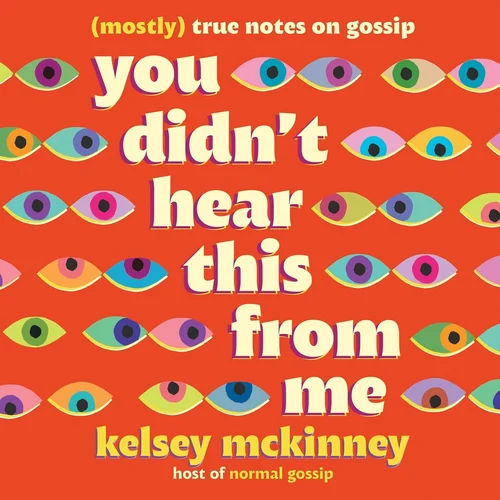
Kelsey McKinney, the host of the podcast “Normal Gossip,” has spent years thinking about this contradiction. Her new book, You Didn’t Hear This From Me: (Mostly) True Notes on Gossip, proposes a radical idea. What if gossip isn’t a character flaw? What if it is one of our most fundamental tools for survival, connection, and even justice? She asks a question that haunts every page: What if the thing we are most ashamed of is actually the thing that makes us most human?
A Protagonist Who Embodies the Shame and Joy of Gossip
McKinney positions herself not as a detached academic but as the book’s main character. She is a gossip. She admits it freely, with a kind of wry, self-aware humor. I found myself nodding along as she described the almost physical pleasure of a good story. She traces our love of gossip back to the schoolyard, to the office water cooler, to the family dinner table. But she also shows us the damage.
The core conflict of the book isn’t between McKinney and an outside critic. It’s an internal war. She loves gossip, but she has seen it ruin lives. She dedicates a whole chapter to the rumor that almost destroyed her friend’s marriage. She describes the feeling of watching a story mutate, of realizing you contributed to something cruel. This doesn’t feel like a lecture. It feels like a confession. She is trying to find a line, a place where gossip can be good and not evil. I’m not sure she ever finds a perfect answer. But the search itself is the point.
The Real Work of Gossip as a Social Glue
McKinney’s central argument is that gossip is not about information. It’s about intimacy. When you tell me a secret, you are giving me a gift. You are saying, “I trust you enough to share this.” The book’s key imagery is the “backstage” versus the “front stage.” We all perform a public version of ourselves. Gossip is the language of the backstage, the place where we drop the act and talk about what is really happening.
This is where the book’s craft shines. McKinney weaves together personal memoir, pop culture analysis, and a little bit of anthropology without ever sounding like a textbook. She shows how gossip builds community in marginalized groups, how it can be a form of resistance. Think about it. Before the internet, how did queer people find each other? Through whispers, through coded language, through gossip. She also admits the dark side. Gossip can be a weapon. It can destroy reputations and enforce social norms. But she refuses to let us simply label it as “bad.” This character’s struggle reveals a universal pattern. We are all gossips. The question is not whether we do it, but how we do it and why.
The Dignity of Our Small, Messy Stories
McKinney completes her argument by pulling back to a wider lens. She looks at the rise of “stan culture” and online call-outs. She argues that the modern internet is just gossip at an industrial scale. We are still telling stories about other people. We are still building tribes around shared secrets. The only difference is the volume and the speed.
There is a humility to this book that I did not expect. McKinney never claims to have the moral high ground. She is in the mud with us. She struggles. She backtracks. She changes her mind. The book’s only real weakness is that it sometimes tries to cover too much ground. A chapter on celebrity gossip feels a little thin compared to the rich personal stories. But that is a small complaint.
Reading this, I started to think about my own gossip. The little stories I tell my wife at the end of the day. The jokes I share with coworkers. The truth is, I don’t want to stop. And McKinney makes me realize I don’t have to. The real sin is not the gossip itself. It is the cruelty. It is the lack of empathy. It is telling a story someone trusted you with to someone who has no right to hear it.
She leaves us with a question, not an answer. If gossip is how we build our world, how do we build a kinder one? Maybe it starts with being a better listener. Or maybe it starts with remembering that the person you are gossiping about is just as real as the person you are gossiping to.
