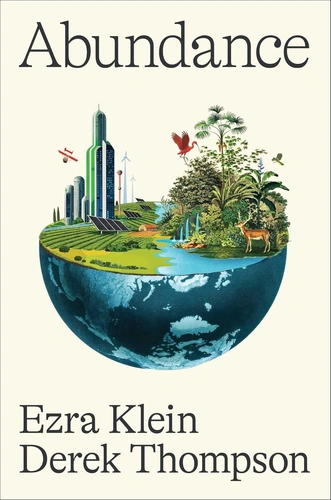
I chatted with a friend recently about her six-year-old son. He has a closet full of toys, a tablet with endless games, and a pantry packed with snacks. Yet every afternoon, he tells her he is bored. He tells her he wants more. She laughed when she told me this, but there was something uneasy in her voice. Am I raising a child who will never feel satisfied? I nodded. I recognized the feeling. So did Ezra Klein and Derek Thompson, I realize now, when I read their book Abundance.
The book asks a quiet but devastating question. It isn’t about economics, exactly. It is about why we feel scarce when we are swimming in plenty. Why do we live in the richest era in human history and still feel like we are running out? The book is a kind of diagnosis of a modern sickness. But it is also, I think, a love letter to the people who refuse to let that sickness win.
Character: The Economy We Built, and the One We Need
Klein and Thompson do not write about a single protagonist. Their main character is something bigger. It is the system. The economy. The way we have organized our collective lives. They show how we built a world of astonishing abundance: more food, more medicine, more information, more entertainment than any generation before us. I felt dizzy reading the statistics. We have solved so many problems. And yet.
And yet we feel squeezed. Housing costs more. Time feels thinner. The future seems less certain. The authors call this a paradox. But I think it is something sharper. It is a betrayal. We were promised that more would feel like more. Instead, more feels like a treadmill that keeps speeding up. The book traces how our systems for producing abundance have broken down: zoning laws that prevent building, regulatory mazes that block innovation, a political culture that rewards obstruction. The core conflict is not between rich and poor, exactly. It is between the world we could have and the world we have settled for. I will not spoil how they propose we fix it. But I will say this: the solution is not less. It is better.
Theme: The Scarcity Inside Us
The most powerful idea in Abundance is not about economics. It is about psychology. Klein and Thompson argue that scarcity is not just a condition of the world. It is a condition of the mind. We have been trained to expect more. We have been trained to fear that what we have will be taken away. The authors call this a learned scarcity. And they show how it shapes everything: our politics, our relationships, our sense of self.
But there is a subtle light in this book. It is not a dark diagnosis. It is an invitation. The authors suggest that abundance is not just about having more things. It is about having more room. More room to breathe. More room to be generous. More room to imagine a different kind of life. I found myself underlining passages about the importance of play, of rest, of building things for the sheer joy of building them. The book is a quiet argument that we have confused wealth with well-being. And the imagery that stays with me is of a garden: not a perfectly manicured lawn, but a messy, fruitful, overgrown place where things grow because they are allowed to.
Elevation: What We Do With What We Have
Abundance is a book for this moment, but it speaks across eras. I kept thinking about the 1950s, when my grandparents worried about running out of food. And I thought about my own children, who will worry about running out of something else: clean air, stable climate, affordable homes. The authors do not pretend the future is easy. But they argue that the problem is not scarcity. The problem is our inability to build.
The book has one real weakness. It can feel too optimistic at times, too confident that better policy can solve deep cultural wounds. I wanted them to sit longer with the grief of what we have lost. But that is a small complaint. This is a book that made me want to act. It made me want to call my city council. It made me want to ask harder questions about why we accept so little.
I recommend Abundance to anyone who has ever felt that strange, hollow feeling of having enough and yet not enough. It will not give you a magic solution. But it will give you a new way to see the problem. And that, I think, is where change begins.
