I was sitting at my kitchen table last Tuesday, trying to reply to an email, when a single phrase hijacked my brain. “She just said that.” Over and over. Not the meaning. Just the words. Like a scratched record spinning in silence. I couldn’t finish the email. I couldn’t hear my partner ask what I wanted for dinner. The loop was louder than real sound.
It’s not the first time. Maybe you know the feeling. A song lyric, a random sentence, a word you mispronounced in a conversation three days ago. And the moment you try to force it out, your brain pushes back. It almost hurts. You go back to the loop without meaning to. And that’s constant thought looping in a nutshell. Frustrating. Exhausting. But not unbeatable.
I’ve found a few things that help. Not cures. Not medical advice. Just ideas that worked for one person who has spent way too many nights staring at the ceiling while her mind chanted nonsense.
Quick Constant Thought Looping Fixes Today
If your brain is stuck on repeat, try these:
- Take three slow belly breaths and name the loop out loud.
- Replace the stuck words with a neutral, silly phrase like “purple giraffe toast.”
- Engage a different sense—smell a strong candle or hold ice in your hand.
- Visualize a big red button that you slam to cut the audio.
- Move your body in a completely different rhythm, like marching while humming.
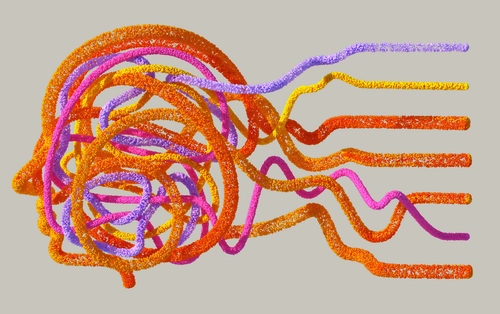
Why Does Constant Thought Looping Happen?
It feels like your brain is broken, but it’s not. Many people with a tendency to hyperfocus experience constant thought looping. Not just those with ADHD, though it’s common there. Anyone can get stuck when their brain’s default mode network gets a little too chatty. Some research suggests that stress, fatigue, and lack of sleep make it worse. For me, it’s almost guaranteed after a long, overstimulating day.
The loop isn’t random, exactly. It often grabs something incomplete. A half-remembered tune, a sentence you never said aloud, a mental argument you’re still editing. The brain wants closure. It loops because it’s searching for the “right” version. And so you rephrase the thought again. And again. Even though you know what you mean.
Physical loops work the same way. Tapping fingers in a sequence. Twirling a strand of hair until it knots. My own thing is rubbing my thumb against each fingertip in a pattern, over and over, until the skin feels hot. Breaking out feels wrong. Almost physically uncomfortable. But understanding that this is just a brain stuck in a hyperfocus loop, not a personal failing, helped me stop panicking.
How Can I Stop Constant Thought Looping When It Starts?
I won’t pretend there’s a magic switch. But there is a kind of mental jujitsu you can learn. The trick is not to fight the loop head-on. That makes it louder. Instead, redirect it.
One method that works for me is engaging a different sensory channel. If I’m looping a sentence, I’ll hold a frozen orange in my hand. The cold and the texture pull my brain’s attention elsewhere. I’ll count the bumps on the peel. For those few seconds, the loop fades. It might spike again, but I do it again. Eventually, the brain lets go.
Another approach is to use sound disruption. Play a song you know by heart at medium volume and sing along. Not passively. Really sing. Your auditory system gets hijacked by something external, and the internal loop loses fuel. This is why some people find that listening to the full version of a stuck song lyric can stop the mental repetition.
Dialogue example:
Me, out loud: “Okay, brain. You’ve said ‘the blue umbrella’ seventeen times. We’re done now.” Then I’ll hum a completely different melody. It feels silly. It works more often than not.
A Simple Visualization for Thought Loops
After months of frustration, I started using a mental tool I think of as a control panel reset. I imagine myself standing in a dim room with a big, old-fashioned soundboard. Every stuck phrase plays from one channel. The loop glows red. I picture myself walking to the board, placing my hand on a large silver slider, and pulling it all the way down. The sound cuts out. Then I flip a switch labeled “New Input” and mentally hear a calm, low hum instead.
Sometimes I have to repeat it. But over time, my brain started cooperating faster. Now it flips that switch even before I consciously choose to. It’s not sophisticated. But it works because it gives the hyperfocus something visual and physical to latch onto, replacing the loop.
This isn’t therapy. It’s just a trick I stumbled upon after reading about how visualizations can retrain automatic thoughts. If Beyoncé stomping down a hallway in your mind works better for you, use that. The point is to give your brain a competing story.
When Loops Strike at 2 a.m.
Nighttime looping is the worst kind. I’m lying there, my toes twitching, my brain repeating “remember to buy white vinegar” until I’m furious. What helps me is the 5-4-3-2-1 grounding technique. You name five things you see, four you feel, three you hear, two you smell, one you taste. By the end, the loop weakens. I combine it with slow breathing. Not perfect, but enough to break the cycle.
Taming Physical Loops at the Same Root
The thumb-to-fingertip tapping. The toe-curling pattern under the desk. Physical loops and mental loops are twins. When I catch myself tapping, I deliberately change the pattern. Instead of index-middle-ring-pinky, I’ll go pinky-ring-middle-index. It disrupts the automatic sequence. It satisfies the urge for movement without reinforcing the loop. Some days I just press my palms flat on my thighs and hold them there, counting heartbeats.
FAQ: Constant Thought Looping
Q: Is constant thought looping a sign of ADHD?
A: Many people with ADHD traits experience it, but anyone can have them. It’s more about how your brain processes unfinished thoughts. If it’s frequent and disruptive, consider talking to a doctor.
Q: Can constant thought looping happen with physical movements too?
A: Absolutely. It can feel like a need to complete a motion sequence. It’s the same underlying loop, just expressed in your body instead of your mind.
Q: Why does forcing myself to stop make it worse?
A: Because you’re feeding the loop attention, and attention is fuel. The brain registers the resistance as importance and replays it louder.
Q: Does meditation help with constant thought looping?
A: Some people find that just five minutes a day of focusing on breath reduces the frequency. It’s not about emptying your mind. It’s about practicing noticing a thought and letting it pass.
Q: When should I seek professional help for constant thought looping?
A: If the loops are interfering with your daily functioning, sleep, or relationships, it’s worth talking to a professional. A therapist or psychiatrist can help you understand whether it’s connected to anxiety, ADHD, OCD, or another condition.
One Last Thing
That night at the kitchen table, I finally gave up fighting. I opened my notes app and typed the silly loop aloud: “She just said that. She just said that. She just said that.” I looked at it. I laughed. And then I closed the app. The loop didn’t vanish, but it got quieter. And sometimes, quieter is enough.
References
- Hallowell, E. M., & Ratey, J. J. (2011). Driven to Distraction: Recognizing and Coping with Attention Deficit Disorder from Childhood Through Adulthood (Rev. ed.). Anchor Books.
- Harris, R. (2008). The Happiness Trap: How to Stop Struggling and Start Living. Shambhala Publications.
- Wells, A. (2009). Metacognitive Therapy for Anxiety and Depression. Guilford Press.
