I still remember the sound of my pencil hitting the wall. It was 11 p.m., and I’d been rewriting the same confrontation scene for two hours. My antagonist was supposed to be simmering with rage, but all I could produce was another clenched fist, a furrowed brow. I’d already used gritted teeth three times in the last chapter. The pencil left a tiny gray scar on the paint. I stared at it and realized something. I didn’t really know how to read anger in body language. Not the real, messy, surprising version. Just the cartoon one. And that was why my writing fell flat. Maybe that’s your struggle too, whether you’re a writer, a manager, or just someone trying to understand a loved one. How do you spot the anger that hides in plain sight?
Quick Anger-Reading Cues Today
If you’re trying to spot hidden anger, look for these:
- Notice breathing changes: rapid, shallow, or suspiciously forced-slow.
- Watch for sudden stillness, the kind that feels too controlled.
- Look for micro-expressions around the mouth: a quick lip compression or one-sided smirk.
- Pay attention to voice pitch. A drop can signal controlled fury, a rise signals loss of control.
- Observe the person’s baseline first, then spot deviations.
Why Is Anger So Hard to Read Accurately?
A colleague once told me she was “fine” after a tense project review. Her voice was calm, her posture relaxed. I believed her. Later I learned she’d spent the entire lunch break crying in her car. I had misread her anger so completely it felt like a betrayal of friendship. Why did I miss it? Because anger is not always a fire. Sometimes it’s ice. The body’s fight-or-flight response dumps adrenaline, which can produce trembling, flushed skin, rapid breathing. But social conditioning often forces us to suppress those signs. So the energy goes inward. The person becomes unnervingly still. Their breathing gets shallow. Their face might go pale instead of red. Have you ever mistaken quiet fury for boredom? Guilty. Me too.
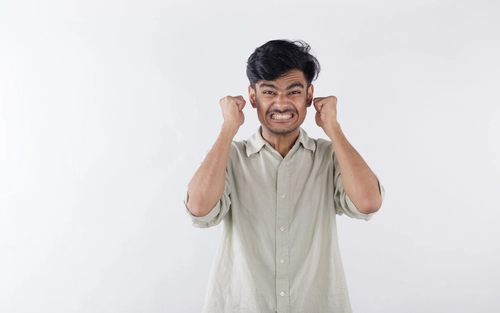
Many of us rely on the classic trio: clenched jaw, fists, furrowed brows. I was cycling through them like a broken record in that novel draft. But real anger has a much larger vocabulary. To read it, we need a better method.
How to Read Anger in Body Language: The Cluster Method
One afternoon in a crowded coffee shop, I started watching a couple at a corner table. The woman’s arms were crossed, her chin tucked low. The man leaned forward, his voice just above a whisper. Nothing too obvious. But then I noticed her hand. It rested on the table, fingers tapping lightly. Then they stopped. She froze them mid-tap. I saw his knee jiggling under the table, then his foot hooked around the chair leg and went rigid. These weren’t isolated signs. They clustered. The conversation ended with her walking out. He sat there, jaw working side to side, but his hands perfectly still on his coffee cup. I had witnessed anger encoded in a dozen small signals.
This cluster approach changed everything for me. Instead of hunting for one dramatic tell, I look for three categories:
- Facial cues beyond the brow. A nostril flare, a quick press of the lips into a thin line, eyes that narrow for a split second before widening again. When someone is truly angry, their eye contact often becomes too direct or too avoidant. A blank stare can hold more threat than a glare.
- Postural shifts. Shoulders that ride up toward the ears. A slight lean forward, as if ready to spring. Or the opposite: a rigid uprightness that screams control. I once saw a department head lean back in his chair and lace his fingers behind his head during a heated budget talk. He smiled. But his knuckles were white. That’s a cluster: relaxed pose, white knuckles, tight smile.
- Behavioral breaks in pattern. A person who normally talks with their hands might go statue-still. Someone who is usually reserved might start gesturing sharply, poking the air. The key is knowing their baseline. Without that, you’re guessing.
The Emotion Thesaurus Framework: Mapping Anger Inside and Out
After the pencil incident, a fellow writer mentioned a book called The Emotion Thesaurus by Angela Ackerman and Becca Puglisi. I bought it the next day. It doesn’t just list body language cues. It breaks down physical signals, internal sensations, mental responses, and even signs of long-term suppression. That framework helped me move past the surface. Anger isn’t just a set of visible poses. It’s a full-body event. What I needed was to understand what my character felt on the inside, then show it leaking out.
Here’s a tiny piece of what the framework teaches. Take anger and split it:
Physical Signals: rapid heartbeat, heat rising to the face (or draining from it), tightness in the chest, jaw ache from clenching, veins visible on the neck or forehead. One overlooked signal is what I call the anger tremor. A hand that shakes when lighting a match. A voice that quivers not with sadness but with the effort to stay calm.
Internal Sensations: a burning pit in the stomach, a feeling of pressure behind the eyes, a sudden clarity that narrows focus until everything else blurs. I’ve felt a hot cord tighten along my spine when truly angry. My character could too.
Suppression Cues: the forced smile that doesn’t reach the eyes, the deliberate slow breathing, the person who suddenly becomes very, very gentle with objects because they’re afraid they’ll throw them. Think of an executive who places a pen down with exaggerated care. That’s not calm. That’s a volcano with a lid on.
This internal-to-external mapping gave me variety. I could show anger through a character suddenly cleaning their desk furiously or speaking in a quieter-than-normal voice. The book became my cheat sheet, but I adapted it to real life. Now when someone tells me they’re not angry while stacking coasters into a perfect tower, I pay attention.
The Exploders vs. The Freezers: Personality Changes Everything
One of my biggest mistakes was writing every angry person as explosive. Then I remembered my aunt Liz. She never raises her voice. When she’s upset, she goes very, very still. She might pour a cup of tea and set the pot down with a delicate click that somehow sounds like a gunshot. Her anger is a freezer, not an explosion. That insight helped me see anger in the quiet ones. Have you ever stood next to someone who radiated such stillness that the air felt thicker? That’s anger, too.
Explosive types show their anger through volume, gesture, door slamming, throwing cushions. Freezers hold it in their muscles. A freezer might sit on the sofa, hands gripping their own knees, staring at a fixed point on the wall. Their breathing is controlled but shallow. Sometimes a fine tremor runs through their arms. The contrast between their usual animated self and this statue version is the biggest clue.

What about tears? I used to think crying meant sadness. But watch closely. Angry tears come with a different face: jaw set, eyes glaring even as they water. The crying is almost an overflow of pressure. I’ve cried when I was so mad I couldn’t speak. Now I recognize that in others. If you see tears plus clenched teeth, don’t reach for the tissues just yet. What you’re witnessing might be pure rage in disguise.
How to Practice Reading Anger in Everyday Life
I started practicing at home, with my own family. One evening, my husband came in from work and said, “Rough day.” He smiled, kissed my forehead, and began unpacking his laptop bag. His movements were too precise. The bag zipper pulled open with a sharp, angry sound. I asked if he was okay. “Fine,” he said, then arranged his chargers in a perfectly straight line. That was my cue. I didn’t push. I made him a cup of tea and left it beside the meticulous charger row. Five minutes later, he talked.
You can practice anywhere. At the grocery store, watch how a person in a hurry stands in line. A genuine hurry looks frustrated: shifting weight, checking phone. But an angry hurry? The person might grip the cart handle so tightly their knuckles blanch. They might not shift at all, just stand utterly rigid, eyes drilling into the back of the person ahead. It’s a quiet menace.
The biggest lesson? Never assume. Anger wears a hundred costumes. Could it be the sudden, excessive politeness of a customer service agent? Could it be the way a kid slams their bedroom door? Could it be the way your partner says, “It’s fine,” while breaking eye contact? Yes, yes, and yes. Learning how to read anger in body language is less about memorizing a list and more about noticing what’s different. What’s missing. What’s too controlled.
FAQ: How to Read Anger in Body Language
Q: What are the most reliable signs of hidden anger?
A: The most reliable signs are changes from a person’s baseline: sudden stillness, overly controlled movements (like placing objects down with exaggerated care), shallow breathing, lip compression, and a voice that drops in pitch or becomes unnervingly flat. Clusters of these cues are more telling than any single sign.
Q: Why do some people go still when they’re angry?
A: Stillness is often a suppression response. When social conditioning or personal temperament makes outward expression unsafe, the body contains the energy. The person freezes to avoid exploding. This “ice” anger can be more intense than explosive anger because all the energy is held inside.
Q: Is it possible to hide anger completely?
A: Not completely. Even with perfect control, small leaks happen: a micro-expression, a change in breathing, a momentary tension in the hands or jaw. The key is knowing where to look. A person who claims to be calm while gripping their own knee with white knuckles is telling two different stories.
Q: How can I get better at reading anger in real time?
A: Practice observing people in low-stakes settings—coffee shops, grocery stores, meetings. Watch for deviations from baseline. Notice clusters. Then check in with the person gently: “You seem a little tense. Everything okay?” The feedback loop helps you calibrate.
Q: Are explosive anger and frozen anger signs of different personalities?
A: Yes. Explosive anger often comes from people who externalize stress—they discharge it through action and sound. Frozen anger comes from people who internalize stress—they contain it. Both are valid expressions of the same emotion. Understanding which type someone is helps you read them more accurately.
One Last Thing
The other day, I noticed that tiny pencil scar on my office wall. I didn’t paint over it. Now when I write anger, I think of the woman in the coffee shop, freezing mid-tap. I think of my aunt’s death-grip on a teacup. I think of my husband’s straight line of chargers. The body speaks. Sometimes it whispers. My job is just to listen. And that pencil mark? It reminds me that even frustration leaves its own quiet signal.
References
- Ackerman, A., & Puglisi, B. (2012). The Emotion Thesaurus: A Writer’s Guide to Character Expression. Write Great Fiction.
- Navarro, J. (2008). What Every Body Is Saying: An Ex-FBI Agent’s Guide to Speed-Reading People. William Morrow Paperbacks.
- Ekman, P. (2004). Emotions Revealed: Recognizing Faces and Feelings to Improve Communication and Emotional Life (2nd ed.). Holt Paperbacks.
