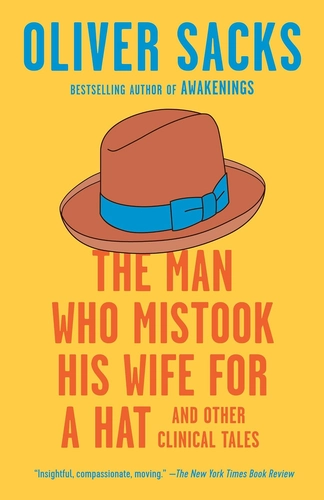
A few weeks ago, I found myself staring at my own reflection in a dark window. I did this thing where I tried to see myself as a stranger. Just a face. A collection of features. And for a split second, it worked. That face felt unfamiliar. It was unsettling, that tiny flicker of doubt. Is this what it feels like, I wondered, to slowly lose the map of yourself? That is the question at the heart of Oliver Sacks’s strange and beautiful book.
The Character and Plot: A Man Who Lost His Head but Found His Way
The book is not a novel. It is a collection of case histories. But the main character is not one patient. It is the human brain itself. We meet Dr. P., a music professor who mistakes his wife’s head for his hat. He reaches for her face, tries to lift it. He does not recognize her. Not really. His eyes see a shape, and his brain fills in the wrong label. Sacks describes him as cheerful, articulate, and utterly lost.
Then there is Christina, a young woman who loses her proprioception. She cannot feel her own body in space. She describes it as being a ghost. She has to watch her hands to know where they are. She cannot walk, cannot hold a cup. She uses her eyes to replace the missing sense. It is exhausting. Sacks writes about her with a tenderness that makes you ache. He does not just list her symptoms. He shows her trying to live. The suspense here is not about a plot twist. It is about the terrifying fragility of the ordinary. You close the book and suddenly feel grateful for the simple act of standing up. What happens to our sense of self when the very ground beneath our feet becomes untrustworthy?
The Core Theme and Imagery: The Music That Holds Us Together
The central argument of this book, I think, is about the stories we tell ourselves to stay whole. Sacks shows us that the brain is not a machine of perfect logic. It is a storyteller. It makes up stories to fill the gaps. When a patient loses the ability to see the left side of the world, the brain simply pretends that side does not exist. It creates a coherent universe, even if half of it is missing. That is a survival mechanism.
The key image for me is music. Dr. P. could not recognize faces, but he could recognize music. His brain had rewired itself. He used melody to navigate the world. Sacks himself was a neurologist with a deep love for music. He saw it as a kind of scaffolding. When the logical parts of the brain crumble, the rhythmic parts often remain. Music becomes a thread. You hold on to it, you follow it, and it keeps you from falling into the void. The truth is, we are all just holding on to something. Some of us hold on to words. Some hold on to songs. Some hold on to the feel of a hand in our own. Sacks makes you see these threads everywhere.
The Elevation and the Unanswered Question
This book was written in 1985. It still feels urgent. In an age of algorithms and artificial intelligence, we talk about consciousness as if it were a code to be cracked. Sacks reminds us that consciousness is not clean. It is messy, embodied, and deeply personal. The book has a quiet flaw, though. It is sometimes too kind. Sacks is so gentle with his patients that he sometimes glosses over the sheer horror of their conditions. He wraps the tragedy in a blanket of clinical poetry. You want him to scream sometimes. But maybe that is the point. He chooses to see the person, not the disease.
So what does this book give you? It gives you a new kind of respect for the fragile machinery inside your skull. It gives you a strange comfort. You learn that even when the brain breaks, the self does not always disappear. It just takes a different shape. You learn that a man who mistakes his wife for a hat is still a man who loves his wife. He just cannot show it in the way we expect. Sacks leaves us with a question that sits in the back of your mind long after you close the cover. If the self is only a story our brain tells itself, what happens when the storyteller goes silent?
