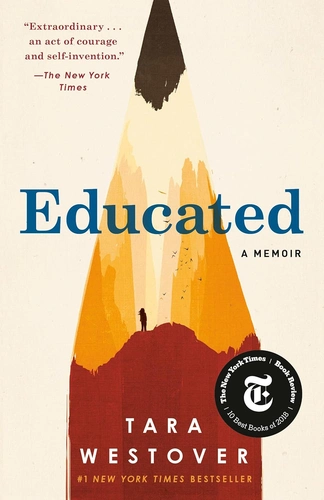
I was at a family dinner recently. My cousin, the one who stayed in our hometown, told a joke about our childhood. Everyone laughed. I laughed too, but I felt something cold in my stomach. The joke relied on a shared memory of a person who had hurt us. We all agreed, silently, that the memory was funny now because the pain was gone. But I have been thinking about that dinner ever since. It made me wonder about the stories we tell ourselves to survive. And it made me pick up Tara Westover’s memoir, Educated, again.
What is the real cost of leaving?
The book’s central question is not how Tara got her PhD. It is something harder. She grew up in a radical survivalist home in the mountains of Idaho. Her father did not believe in doctors, schools, or the government. She worked in his junkyard, her body bruised and her mind untouched by textbooks. When she finally stepped into a classroom at seventeen, she was illiterate. She did not know about the Holocaust. She had never heard of the Civil Rights Movement. Later, she went to Cambridge and Harvard. But the real story is not there. The real story is in the phone calls she did not make home. In the letters her mother stopped sending. In the moment she realized that to be fully educated, she would have to stop being the daughter her father wanted. Is that a victory? Or is it a kind of death?
The protagonist who must break herself
Tara is not a hero on a clear path. She is a young woman who loves her father fiercely, even as he tells her that her education is the devil’s work. She loves her brother Shawn, who hurts her and then hugs her. The tension in the book is not about getting into Cambridge. It is about the moment she has to look at her brother and say: You hurt me. And then watch her family choose him over her. I will not spoil the ending, but I will say this: the hardest scenes are not the physical abuse. They are the silences afterward. The way her mother looks away. The way her father prays for her soul instead of protecting her body. Tara Westover writes with a kind of careful, almost surgical distance. She does not scream. She just tells you what happened, and lets the weight of it sit on your chest.
The violence of a new world
The core theme here is the cost of knowledge. Not the monetary cost, but the emotional one. Tara’s journey is not from ignorance to wisdom. It is from one set of beliefs to another, and each step forward feels like a betrayal of the people who raised her. The imagery that sticks with me is the mountain itself. Buck’s Peak. It is both a home and a prison. She describes its shape, its silence, its permanence. It is a place that holds her past. Later, when she is at Cambridge, she looks at a painting of a mountain in a museum. She realizes that the mountain she left is no longer hers. She has become someone who sees it through a frame. That image captures the whole book for me. You can leave a place, but you cannot keep it the same. The moment you leave, you change it. And it changes you. Westover’s writing is plain and unadorned. She does not use fancy metaphors. She lets the facts speak. And the facts are devastating.
Maybe leaving is not the point
I read this book a few years ago, and I came back to it recently. I think I needed to understand something about my own choices. Tara’s story is extreme, but the feeling is universal. Most of us have, at some point, chosen a path that our family did not understand. Maybe you moved to a city they thought was too dangerous. Maybe you married someone they did not approve of. Maybe you just started thinking thoughts they could not accept. The question Educated asks is this: Is it worth it? And the book does not give a simple answer. Tara ends up with a PhD and a life far from the junkyard. But she also ends up without a family. She has a kind of freedom, but it is a lonely one. She writes about her father with love and pain. She does not forgive him completely, but she does not hate him either. She lives in the gray space.
Who should read this book and what you will get
This book is for anyone who has ever felt torn between two worlds. It is for the first-generation college student, the person who left a religious community, or anyone who has ever had to choose between their own sanity and their family’s love. It is not a feel-good story. It is a messy, honest account of what it means to be educated. The main concept Westover offers is simple but profound: education is not just about learning facts. It is about learning to see the world from a different perspective. And that can be violent. The book’s weakness, if I am honest, is that it sometimes feels too controlled. I wanted her to break down more on the page. But maybe that control is the point. She had to hold herself together to survive the telling. After reading, you will not feel inspired in the typical sense. You will feel something deeper. A quiet grief. A strange kind of hope. Maybe that is what education really is. Not a ladder to success. But a door that, once opened, you cannot close. And you have to live with what you see on the other side. I recommend this book to anyone brave enough to ask themselves: What am I willing to lose to become who I am?
