I went to visit my grandmother last month. She is ninety-four and lives in a facility that smells like lemon disinfectant and regret. We sat in the common room while a television played a game show no one was watching. She told me the same story three times. I smiled each time. Later, driving home, I felt something heavy in my chest. Not sadness exactly. More like a question I had been avoiding.
What does it mean to truly care for someone when we cannot fix them?
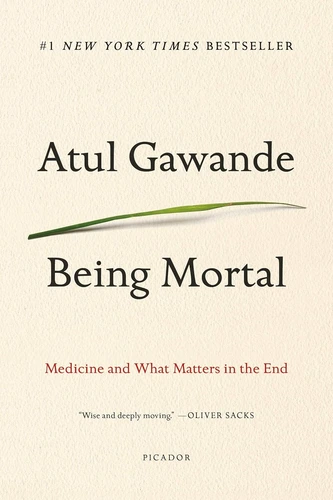
That is the question Atul Gawande asks in Being Mortal. He is a surgeon. He has saved lives. But he has also watched patients suffer through treatments that did nothing but extend their pain. The book is not really about medicine. It is about what we want when we cannot have more time.
The Protagonist and His Awkward Truth
Gawande does not present himself as a hero. He is a man who learned slowly. He opens with a story about a patient named Bella who had cancer. He offered her surgery, then chemotherapy, then more surgery. She died anyway. And in the process, she lost her ability to walk, to eat, to enjoy her last months. He admits he failed her. Not because he did the wrong medical thing. He did not see her as a person with a life to live, only as a disease to fight.
The book follows Gawande as he meets nursing home residents, hospice workers, and families making hard choices. There is a woman named Alice who moves into assisted living. She hates it at first. The rules, the schedule, the loss of her kitchen. Later she finds a small community. She starts a book club. She dies with people who knew her name. That stuck with me. The difference between dying alone in a hospital room and dying with someone who has seen your face.
Gawande also talks about his own father, a surgeon who gets a spinal tumor. His father chooses to stop treatment at a certain point. He wants to play golf and read books and eat dinner with his wife. He dies at home. Gawande writes about this with a kind of awe, like he is watching something he cannot fully understand.
The conflict here is not between life and death. It is between the medical instinct to fight and the human need for peace. Gawande never tells us the right answer. He just shows us the cost of not asking the question.
The Craft of Facing the Inevitable
The core theme of Being Mortal is dignity. What does it mean to die with dignity when your body fails you? Gawande argues that modern medicine has stolen this from us. We have traded a human death for a clinical one. We die in hospitals, surrounded by machines, isolated from the people we love.
The key imagery in the book is the nursing home. Gawande visits one that feels like a hospital ward. Residents sit in rows. They are clean but vacant. Then he visits a place called the NewBridge on the Charles, which has a different philosophy. It has a garden, a dog, a pub. Residents can drink beer if they want. They can stay up late. They can take risks. The difference is not in the building. It is in the permission to still be alive.
Gawande writes with the precision of a surgeon but the heart of a son. His sentences are short when they need to be. He lets the stories breathe. There is a moment when he describes a woman named Sara Monopoli, who has lung cancer. She fights hard. She goes through rounds of chemo. She ends up in the ICU with tubes everywhere. Her husband says, “She would have hated this.” That line hit me like a stone. I thought of my grandmother. I thought of what she would hate.
This character’s struggle reveals something universal. We all want to control how our story ends. But we avoid the conversation. We pretend it will not happen to us. Gawande forces us to look.
What We Do With This Knowledge
The book was published in 2014, but it feels more urgent now than ever. We live in a culture that worships youth and efficiency. We push the elderly to the edges. We call it “retirement communities” and “skilled nursing facilities.” We pretend we are being kind. But Gawande shows us that kindness is not the same as presence.
The most important concept in Being Mortal is “the hard conversation.” Gawande argues that doctors, families, and patients must ask three questions: What do you understand about your condition? What are your fears? What are your hopes? He shows that when we skip these questions, we default to aggressive treatment. We fight death until the last breath. And we lose the chance to say goodbye.
Who is this book for? Anyone who has a parent, a grandparent, or a body that will one day fail. That is everyone. It is not a pleasant read. There were moments I had to put it down and stare at the wall. But that is the point. We need to feel the weight before we can carry it.
The book has a limitation. Gawande is a doctor, and he writes from a position of privilege. His father had resources. His family could afford hospice care at home. The reality for many is different. But the core insight still holds.
What I will carry with me is not a lesson or a technique. It is a sentence Gawande wrote near the end. He said, “Our most cruel failure is that we can see the end but choose not to see it.” I think about that when I visit my grandmother. I think about what she might want that I have not asked. I think about the stories she tells three times and wonder if she is trying to tell me something I have not heard.
Maybe that is what this book really is. A permission to ask. A reminder that love does not always mean fighting. Sometimes it means staying.
