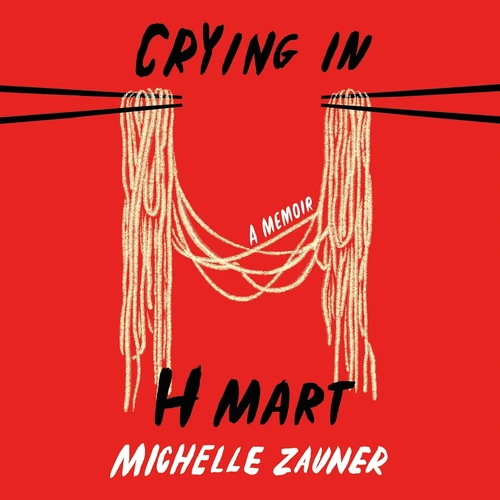
I was standing in my own kitchen the other night, stirring a pot of soup my mother used to make. I don’t know why I started. The recipe was half-forgotten. The smell hit me, and suddenly I was crying over onions. That’s when I picked up Michelle Zauner’s Crying in H Mart. I had heard about it, the memoir about a Korean-American woman who loses her mother and finds her way back through food. But I wasn’t prepared for how it would grab me. The book opens with a scene in H Mart, the Korean grocery chain. Zauner is standing in the aisle, sobbing over a jar of gochujang. It sounds dramatic, but it isn’t. It’s just honest. She asks a question that I think many of us carry quietly: What connects a mother and daughter when words fail?
Character and Plot: The Daughter Who Learned to Cook Her Grief
The protagonist here is Michelle herself, and she is not a perfect narrator. She is prickly, ambitious, sometimes selfish. She grew up in Oregon, the only Asian kid in a white town. Her mother, Chongmi, is fierce and exacting. Strict about grades, critical of Michelle’s weight, obsessed with appearances. They fight. A lot. The core conflict is simple and brutal: Chongmi gets cancer, and Michelle becomes her caregiver. I won’t tell you the ending, but I will say this. The story does not follow a neat arc of reconciliation. Instead, it moves through hospitals, hospital food, failed treatments, and small moments of grace. The most powerful parts are when Michelle cooks. She learns to make japchae, kimchi jjigae, tteokbokki. She burns things. She cries over burned rice. She calls her aunt in Seoul for recipes. Zauner writes these scenes with a kind of reverence, like she is watching a ritual unfold. And she is. Cooking becomes a language that Michelle and her mother never quite mastered in English or Korean. It wasn’t a perfect bridge. More like a shaky plank over a deep ravine. But it held.
Theme and Imagery: What Food Carries When Words Cannot
The core theme here is inheritance. Not just genetic inheritance, but cultural, emotional, culinary. Zauner asks what we pass down and what we lose. The key imagery is, of course, food. But not in a glossy cookbook way. The food in this book is messy, specific, emotional. There is a scene where Michelle describes her mother’s hands making dumplings. The way she pleated the edges, the sound of the knife on the cutting board. These details matter because they are the only things that survive. When Chongmi dies, Michelle realizes she never learned how to make her mother’s kimchi. She has to piece it together from memory, from YouTube videos, from phone calls with relatives. The act of cooking becomes an act of excavation. You dig through taste and smell to find the person. Zauner does not romanticize this. She admits that sometimes the food tastes wrong, that the memory is unreliable. But she keeps trying. That is the heart of the book. Not the perfect reunion, but the imperfect attempt. The struggle to hold onto something that is slipping away.
Elevation and CTA: The Love That Survives the Mess
This book stays with you because it refuses to be neat. It is not a tidy story of a daughter who learned to forgive or a mother who revealed a hidden softness. It is messier than that. Chongmi remains difficult even in memory. Michelle remains wounded. But there is something profound in that rawness. I think about the moment when Zauner writes about her mother’s funeral. She is handed a bag of her mother’s ashes. She doesn’t know what to do with them. Later, she scatters some in the ocean. She keeps a small vial. She puts some in the kimchi she makes. It sounds strange, maybe even grotesque. But it also sounds true. Grief doesn’t follow rules. It finds its own containers. The book resonates across eras because it speaks to a universal experience: losing a parent and realizing you never asked enough questions. You never learned the recipe. You were too busy fighting or too busy living your own life. And then the person is gone, and all you have is a jar of gochujang and a broken heart. What do you do? You cook. You cry. You try again. The core insight is this: Love is not the absence of mess. It is the willingness to stay in the mess, to keep cooking even when the recipe is lost.
