I still remember the afternoon my six-year-old stood in the kitchen, face red, fists clenched, yelling at the top of his lungs because I said no to ice cream before dinner. I was running on four hours of sleep. The baby had been up three times. My coffee was cold. And something inside me just snapped. I yelled right back. He flinched. My heart cracked a little. That night, I sat in the dark and wondered: Is this who I am now? How do I stop this cycle?
Quick Ways to Stop Your Child From Yelling Today
If your child is screaming right now, try these:
- Pause and take three slow breaths before you say a single word.
- Whisper your response. It’s almost impossible for a child to stay loud when you’re quiet.
- Say: “I hear you. Tell me again with a calm voice so I can really listen.”
- Offer physical connection—a hand on the shoulder, open arms, a gentle back rub.
- Model the exact tone you want. Your voice is their mirror.
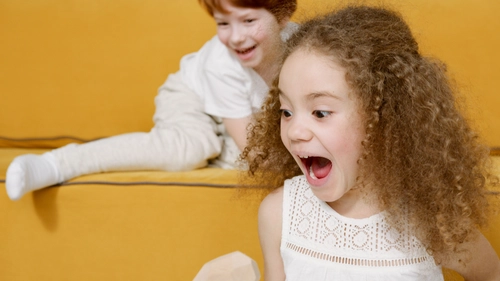
Why Do Kids Start Yelling in the First Place?
Young children yell for one simple reason. They feel something huge, and they don’t have the words yet. I read somewhere that the part of the brain that handles impulse control isn’t fully developed until well into our twenties. So when my son wants something right now, and he hears “no,” his little brain floods with frustration. Yelling is just a pressure valve. It’s not defiance. It’s a signal.
I tried to remember that during the hard moments. Was he yelling because he’s naughty? No. He was yelling because he needed help navigating a big emotion. Once I saw it that way, I stopped taking it personally. And that changed everything.
How to Stop Child From Yelling by Connecting Before Correcting
Here’s the thing most parenting advice misses: you can’t teach a screaming child anything. Logic doesn’t land when ears are full of their own noise. What finally worked for me was a practice I now call the Quiet-Calm Reset. After a yelling episode, I’d pull my son onto my lap. No words about what happened. Just three minutes of solid, silent connection. I’d smooth his hair. He’d melt into me. Then, when his breathing steadied, I’d say, “That was really loud. I wonder if you were feeling angry or sad?”
Sometimes he’d talk. Sometimes he’d just nod. But the yelling never lasted after that. The reset wasn’t about the behavior. It was about the bond underneath. I learned that connection is the real mute button.
The Whisper Technique That Defuses Yelling Instantly
I stumbled on this by accident. One morning my daughter, age four, started shrieking because her sock wasn’t on “right.” I felt the familiar rise in my chest. Instead of raising my voice, I crouched down and whispered, “I can see this sock is making you really frustrated.” She stopped mid-scream. She actually leaned in to hear me. Then she whispered back, “It feels scratchy.” We fixed the sock. No tears.
This works because a whisper forces closeness. It signals safety. It also gives the child an invitation to calm down without losing face. I use it now every single time. It’s my favorite tool.
What If You’re the One Who Snapped? Repairing After Parental Yelling
I’m not perfect. Last week, I yelled at my son when he spilled milk all over the couch. His face crumpled. That guilt was instant. But here’s what I did differently this time: I sat down right next to him and said, “I shouldn’t have yelled. I was tired and frustrated, but that’s not your fault. I love you. Can we try again?”
He crawled into my lap and cried a little. I cried too. That repair moment taught him something big: yelling doesn’t last forever. We can reconnect. We can forgive. And honestly, modeling that kind of apology has helped him learn to apologize after his own outbursts, too. It’s not just about stopping their yelling. It’s about showing them how to come back from it.
FAQ: How to Stop Child From Yelling
Q: How do I stop my 3-year-old from yelling at me?
A: Three-year-olds lack emotional vocabulary. Name the feeling for them: “You’re mad because we have to leave the park.” Then offer a quiet alternative like a deep breath or a stomping game. Often, they just need to know you understand.
Q: What should I do when my child yells and hits at the same time?
A: First, create safety. Gently block the hit without anger. Say, “I won’t let you hit, but I’m here to help you calm down.” When the yelling stops, talk about what else they can do with mad hands: hit a pillow, squeeze a toy.
Q: How can I stop my child from yelling at siblings?
A: This is often about competition for attention or toys. Intervene with connection first: “You’re both feeling really upset. Let’s take a break and come back to this together.” Then teach them to use an “I statement”: “I don’t like when you grab my toy.”
Q: Why does my child only yell at me and not at school?
A: You’re their safe person. Children hold it together all day and then release big feelings where they feel most secure. It’s exhausting, but it’s actually a sign of a strong attachment. Comforting, right?
Q: Is it ever okay to just ignore the yelling?
A: Sometimes, yes. If a child is yelling for attention in a non-dangerous situation, you can say calmly, “I’ll talk with you when your voice is as quiet as mine,” and then model calmness. Don’t ignore genuine distress, though—use judgment.
One Last Thing
Last night, my son got upset about putting away his toys. I felt the old tension rise. But I knelt down, whispered his name, and opened my arms. He stopped. He walked over and buried his face in my shoulder. No yelling. Just a shaky breath and a small voice saying, “I need help, Mama.” That moment was everything I’d been working toward. Not perfect. Just human. And so much better.
References
- Siegel, D. J., & Bryson, T. P. (2011). The Whole-Brain Child: 12 Revolutionary Strategies to Nurture Your Child’s Developing Mind. Delacorte Press.
- Faber, A., & Mazlish, E. (2012). How to Talk So Kids Will Listen & Listen So Kids Will Talk (Rev. ed.). Scribner.
- American Academy of Pediatrics. (2018). Effective discipline to raise healthy children. Pediatrics, 142(6). Retrieved from https://publications.aap.org
