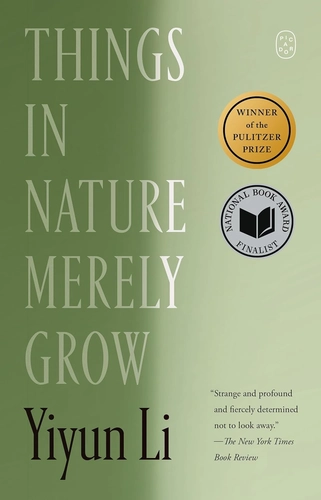
I sat on my porch last fall, watching a neighbor methodically prune a dying apple tree. She knew the tree would not survive the winter. She trimmed it anyway. I thought of Yiyun Li’s new memoir, Things in Nature Merely Grow, and that strange, stubborn act of tending to something already gone.
Li’s book arrives in the world carrying an unbearable weight. She lost both of her teenage sons to suicide, years apart. This is not a story of overcoming. It is not a story of finding meaning in tragedy. It is something rawer and more honest. Li asks a question most of us never dare to face: When life breaks you in a way that cannot be fixed, what does it actually mean to go on living?
Character and Plot: A Woman Who Refuses to Grieve Correctly
Yiyun Li does not write about grief the way we expect. She refuses the easy language of healing, of closure, of moving forward. The memoir opens with her sitting in a garden, watching things grow. Plants do not grieve, she notes. They simply continue.
The book is not a linear story. It moves through fragments. A memory of her oldest son teaching her the names of flowers. A philosophical passage from Simone Weil underlined in an old notebook. The precise, clinical details of a hospital phone call. Li structures her narrative like a mind trying to make sense of chaos by holding onto small, solid objects.
Her core conflict is quiet but devastating. She cannot mourn the way the world expects her to mourn. People offer condolences, and she feels nothing. She attends therapy, and the therapist suggests she is “stuck.” But Li insists that some losses do not have a path forward. They are not obstacles to be overcome. They are permanent alterations to the landscape of a life.
I found myself holding my breath while reading. Not because of suspense in the traditional sense. Because Li’s honesty is so uncompromising that it feels dangerous. She admits to feeling relief when her second son died, because the waiting was over. She admits to envying her sons for escaping a world she finds exhausting. These are confessions most people would take to their graves. She writes them down.
Theme and Imagery: The Radical Acceptance of Unfixable Pain
Things in Nature Merely Grow centers on one core theme: the refusal to seek redemption through suffering. This is not a Christian narrative of trial and reward. It is not a self-help story of post-traumatic growth. Li rejects all of that.
Instead, she offers something called “radical acceptance.” Borrowed from Buddhist thought, this is not passive resignation. It is an active, daily choice to acknowledge reality without insisting it change. The garden becomes her central metaphor. A plant does not question why it rains or why it withers. It simply grows toward the light it has.
There is a subtle light in this book, but it is not hopeful. It is more like the pale winter sun that warms nothing but still illuminates. Li finds comfort in music, specifically in Bach’s cello suites. She writes about how the notes do not resolve into harmony. They simply exist, one after another, creating a structure that holds without promising meaning.
Her prose is deliberately spare. She avoids the language of “grief” or “loss” because those words suggest something that can be processed and finished. Instead, she uses words like “accompaniment” and “continuation.” She is not healing. She is going on.
Elevation and CTA: What This Book Offers the Rest of Us
I think about Li’s book often, weeks after finishing it. It haunts me not because it is sad but because it is true. We live in a culture obsessed with fixing things. We want the five stages of grief. We want the timeline for recovery. We want assurance that pain has a purpose.
Li offers none of that. She offers something harder to accept. She suggests that some wounds do not heal. Some losses do not teach us anything. Some lives are permanently broken, and we have to find a way to live inside that brokenness anyway.
This is not a book for everyone. It will not comfort you if you are looking for comfort. It will not inspire you if you are looking for inspiration. But for anyone who has ever felt that their grief was too strange or too deep for the normal scripts, it offers something rare. Permission not to get better.
I would recommend Things in Nature Merely Grow to people who have lost someone and felt frustrated by platitudes. To people who distrust easy answers. To people who understand that sometimes the bravest thing you can do is simply continue, without hope, without meaning, without any guarantee that it will get easier.
Li ends her book not with resolution but with a simple observation. She looks at a plant in her garden. It has grown taller than it was the year before. She does not know why. She does not need to know. It merely grows.
Maybe that is enough.
