I went to a friend’s housewarming party recently. Everyone was talking about their jobs, their kids, their renovations. Then someone mentioned she’d started a moon altar in her backyard. She laughed, a little embarrassed, like she’d confessed to owning a pet snake. But I saw something shift in the room. A quiet flicker of curiosity, quickly suppressed.
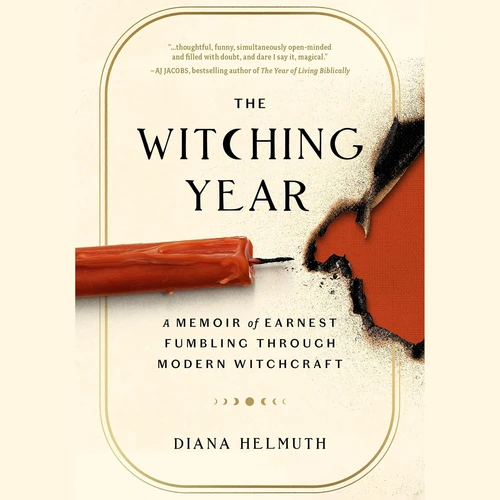
That’s the space Diana Helmuth steps into with The Witching Year. She’s a 33-year-old skeptic, tired of the old religions but equally tired of the hollow feeling that comes with “God is dead.” So she makes a decision: for one year, she will try to become a modern witch. Not the cauldron-and-toad kind. The kind who lights candles, talks to the moon, and tries to believe in something, anything, that feels real.
But here’s the question that stuck with me long after I finished the book: What does it mean to seek meaning when you don’t even trust the seeker?
Character and Plot: A Skeptic Who Wants to Believe, But Can’t Quite
Helmuth is the protagonist I didn’t expect to root for. She’s honest about her cynicism, almost painfully so. She doesn’t pretend to have mystical experiences. She tries a spell and nothing happens. She reads about the Goddess and feels silly. She goes to a pagan gathering and spends most of it trying not to roll her eyes.
And yet she keeps going. She buys the candles. She learns the history. She joins online covens and meets women who are dead serious about their craft. The tension isn’t about whether magic is real. It’s about whether she can allow herself to need it. Her core conflict is internal: the battle between her rational mind and her aching heart.
I won’t spoil the ending, but I will say this: by the final chapter, I realized I wasn’t reading about witchcraft anymore. I was reading about the human cost of refusing to hope. Helmuth’s journey is messy, funny, and sometimes deeply uncomfortable. She makes mistakes. She judges people. She judges herself harder.
The bridge to the next layer is this: her struggle is not about magic at all. It’s about belonging.
Theme and Imagery: The Loneliness of a Modern Believer
The core theme of The Witching Year is the search for community in a world that has privatized faith. Helmuth doesn’t just want to believe in something. She wants to believe with someone. She wants a ritual that isn’t just a personal wellness practice but a shared act of meaning-making.
The key imagery is the circle. Witches cast circles before rituals. They stand inside them, facing each other, holding space. Helmuth keeps coming back to this image, and I found myself thinking about it too. Because a circle has no leader. No hierarchy. Everyone is equal inside it. That’s what she’s really looking for.
The author’s craft is quiet but deliberate. She doesn’t overexplain the history or the spells. She shows them through her own fumbling attempts. She confesses when she fails, when she feels foolish, when she secretly wishes she could believe more. The writing is self-deprecating without being cruel. It trusts the reader to understand that this is serious, even if it looks ridiculous from the outside.
This character’s struggle reveals a universal pattern: the modern person’s loneliness is not about being alone. It’s about having no shared ritual to belong to.
Elevation and CTA: Why This Book Matters Outside the Pagan World
I’ll be honest. I picked up The Witching Year because I thought it would be funny. A skeptic tries witchcraft for a year. You can imagine the jokes. And yes, there are jokes. Helmuth is genuinely funny. But the humor is a door, not the house.
What I found inside was a serious meditation on the crisis of meaning in secular life. We have rejected the old gods, but we have not replaced them with anything that holds us together. We go to yoga. We journal. We take psychedelics in retreats. But these are individual pursuits. They don’t create community.
Helmuth doesn’t offer a solution. She doesn’t convert. She doesn’t become a high priestess. What she offers is something rarer: permission to be honest about wanting more, even if you don’t know what “more” looks like. The book is not a guide to witchcraft. It’s a guide to the struggle of a sincere person trying to find a home.
Who is this for? It’s for anyone who has ever felt foolish for wanting meaning. For anyone who has tried to believe and failed. For anyone who has sat in a church or a temple or a circle and felt both drawn and skeptical. You will not find answers here. You will find a companion.
The real emotion I felt at the end was not hope. It was recognition. I have stood where Helmuth stands. I have wanted to believe and couldn’t. I have longed for a circle and stood outside it, watching.
Maybe that is what she means by magic. Not the power to change the world. The courage to keep looking for a place where you are welcome, even when you don’t believe you deserve it.
