I recently had drinks with an old friend who works in corporate communications. He told me a story about spinning a client’s pollution scandal into a “green initiative.” He laughed. I laughed too, nervously. Then I picked up Phil Elwood’s memoir, All the Worst Humans, and realized I was laughing at the wrong thing. The book asks a question that stuck with me: when you spend your days defending the indefensible, at what point do you stop being the messenger and start being the message?
A Portrait of the Man in the Middle
Elwood introduces himself not as a villain, but as a guy who fell into a strange job. He was a young journalist turned PR man. His clients included dictators, arms dealers, and oligarchs. People who, he admits, did genuinely terrible things. He describes the work with a kind of weary precision: the late nights drafting press releases, the careful phrasing of denials, the martinis with men who joked about death squads. What makes his portrait compelling is that he never claims to be innocent. He just says he was good at his job. Very good.
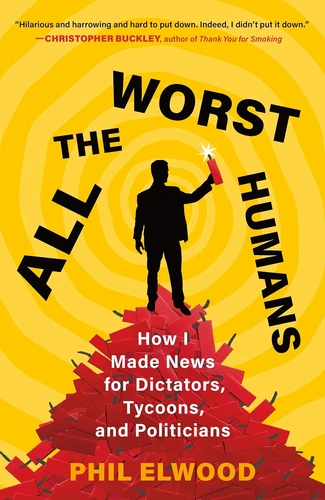
The core conflict builds slowly. He lands a big account. A wealthy, corrupt politician from a troubled country. The money is enormous. The moral cost is invisible at first. Elwood arranges interviews, softens the man’s image, gets him on friendly talk shows. He watches the politician charm the room. And he feels a strange pride. Then a journalist calls him out. “You know he tortures people, right?” Elwood doesn’t answer. He just hangs up. I won’t spoil what happens next, but the suspense isn’t about whether he quits. It’s about whether he even wants to.
The Light Through the Fog
The central theme here is not corruption in the obvious sense. It’s something more subtle. Elwood calls it “the fog.” A mental space where you stop seeing your clients as people who do harm and start seeing them as problems to solve. The craft of the book shines in how he renders this fog. He doesn’t lecture. He just shows you the small moments. A dictator’s wife asks him for help with her son’s homework. A tycoon sends him a birthday card. These tiny human gestures make the monsters feel real. And that is the trap.
There is a subtle light here too. It appears in Elwood’s rare moments of self-awareness. He describes a night in a hotel room, staring at the ceiling, asking himself: “Who am I helping?” The answer is never clean. But the fact that he asks the question at all suggests a crack in the armor. The imagery he uses is telling. He talks about “polishing a turd,” a crude but honest phrase. He also describes his work as “painting a smile on a skull.” The author’s craft is not in big revelations. It is in the accumulation of these small, ugly truths. This character’s struggle reveals a universal pattern: we all make compromises. The book asks how many we can make before we lose ourselves.
What We Carry Home
I finished the book feeling unsettled. Not because Elwood is a bad person. He seems like a decent guy who made a series of bad choices, each one small enough to rationalize. The book’s real power is in its cross-era resonance. In a world of spin doctors, social media managers, and brand consultants, almost everyone has a version of Elwood’s job. We all sell something. Maybe it’s a product. Maybe it’s an idea. Maybe it’s just ourselves.
The book has weaknesses. Some sections feel rushed. Elwood skips over certain personal relationships that might have added depth. He also avoids taking full responsibility in places, preferring to blame the industry. But that might be the point. The memoir is not a confession. It is a warning.
What you get from reading it is not a solution. It is a mirror. You see the moments where you, too, looked the other way. The friend you didn’t call out. The lie you let slide in a meeting. The client you knew was wrong but paid the bills. In the end, Elwood writes: “I told myself I was just doing a job. But the job was doing me.” I think that is the real emotion here. Not anger. Not guilt. Just the quiet, horrifying realization that you might have become the person you once swore you’d never be.
