A Mirror, Not a Manual
I picked this book up on a Tuesday night, sitting on the floor of my apartment with a mug of tea that went cold. I had just quit a job I hated, and I was terrified. I wanted a quick fix. A ten-step plan. Something that would tell me exactly what to do.
Instead, I got Stephen R. Covey. And he didn’t offer me a fix at all. He offered me a mirror.
The 7 Habits of Highly Effective People is not a self-help book in the usual sense. It’s a book about principles. About the idea that effectiveness isn’t a technique you learn. It’s a character you build. Covey argues that we’ve become obsessed with personality—with looking good, saying the right things, managing impressions. But real change, he says, comes from something deeper. From integrity. From aligning your actions with your values.
The question that stuck with me: what if the problem isn’t that you’re not trying hard enough, but that you’re trying to be the wrong person?
Covey doesn’t write a protagonist, exactly. He writes a framework. But the framework has a kind of character to it. It’s the person you could become if you did the work.
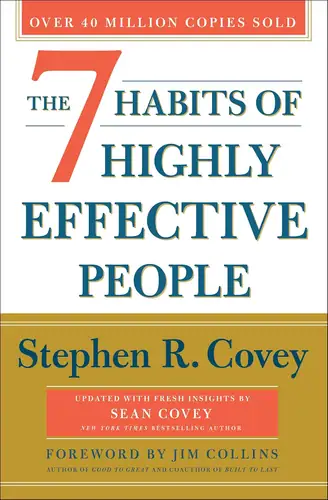
The habits themselves: Be Proactive. Begin with the End in Mind. Put First Things First. Think Win-Win. Seek First to Understand, Then to Be Understood. Synergize. Sharpen the Saw.
I know. It sounds like corporate poster language. I rolled my eyes too.
But here’s the thing. Covey doesn’t just list them. He builds them into a sequence. The first three are about private victory—getting your own house in order before you try to influence anyone else. The next three are about public victory—how you relate to others. The last one is about renewal. It’s a system, not a checklist.
What struck me most was his insistence that you can’t skip steps. You can’t learn to “think win-win” if you haven’t first learned to be proactive. You can’t understand others if you haven’t understood yourself. It’s humbling. It’s also the most honest thing I’ve read in a long time.
There’s a moment where he talks about a man who came to him, frustrated with his marriage. The man said, “My wife and I just don’t have the same feelings for each other we used to. I guess I don’t love her anymore.” Covey’s response: “Love is a verb. Love the feeling is the fruit of love the verb.” That stayed with me.
The Paradigm Shift That Hits Like a Punch
The core theme of the book is paradigm shift. The idea that how you see a problem is often the problem itself.
Covey tells a story about a man on a subway. The man’s kids are running wild, screaming, throwing things. The man just sits there, staring into space. Finally, another passenger says, “Excuse me, but your children are disturbing everyone. Could you please control them?” The man looks up, dazed, and says, “Oh, I’m sorry. We just came from the hospital. Their mother died an hour ago. I don’t know what to think.”
The paradigm shifts. The passenger’s anger vanishes. He sees the situation completely differently.
That’s the book’s key imagery. The lens. The frame. Covey argues that we live our lives through the lens of our own conditioning, and we don’t even know it. We think we’re seeing reality. But we’re seeing our own story.
What made me uncomfortable was how much I saw myself in that subway story. I’ve been the angry passenger a thousand times. I’ve judged people without knowing their story. And I’ve been the man on the subway too, carrying my own invisible weight, wondering why no one understood.
The book made me realize something I didn’t want to admit. That my effectiveness in life isn’t about having more skills. It’s about having a better view.
The Quiet Power of Showing Up
I’ll be honest. The book has problems. It’s long. It’s repetitive. Some of the language feels dated. And there’s a certain middle-class American optimism to it that can feel naive. If you’re looking for a critique of systemic injustice, this isn’t it. Covey assumes a world where individuals have agency, and that’s a privilege in itself.
But that’s also the book’s power. It doesn’t tell you the world is fair. It tells you that your response to the world is your responsibility. That sounds like a hard truth. And it is.
I finished the book feeling less anxious. Not because I had a plan. But because I understood something about myself. I had been waiting for someone else to fix my life. Covey made me realize I was the only one who could.
This book is for people who are tired of blaming circumstances. It’s for people who want to stop feeling like a victim of their own story. It’s for people who are willing to look in the mirror and see, honestly, what’s there.
It’s not for people who want a quick fix. It’s not for people who want to be told they’re fine as they are. And it’s not for people who think the problem is always someone else.
What I took away? Not a set of habits. But a question I keep asking myself: “Am I being proactive, or am I just reacting?” It’s a small shift. But it changes everything.
