I was waiting for a train last week. A woman sat on a suitcase near the escalator, wearing a polo shirt with a corporate logo. She had a badge clipped to her collar. She looked tired, not crazy, not dangerous. Just tired.
I looked at my phone.
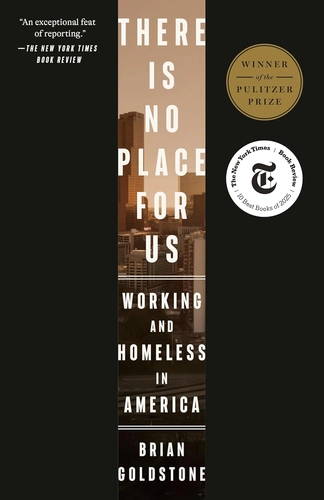
Here is the question Brian Goldstone asks in There Is No Place for Us: Working and Homeless in America: What does it mean to have a job, to do everything right, and still have nowhere to sleep tonight?
The People Who Work and Still Fall Through
Goldstone does not write about the stereotypical homeless person you might imagine. He writes about people like Maria, who works forty hours a week at a fast-food restaurant and sleeps in her car behind the strip mall because rent ate her whole paycheck. He writes about James, a security guard who watches over a downtown office building at night and then walks the streets until dawn because shelters are full and his van got towed.
These are not stories about addiction or mental illness, though those things exist too. These are stories about math. Rent goes up. Wages do not. A medical bill arrives. A car breaks down. One bad month and the floor disappears.
I found myself holding the book tighter as I read. Goldstone follows his subjects for months, not days. He sits with them in parking lots and emergency rooms. He watches them try to keep their uniforms clean using public bathroom sinks. The detail that broke me: a man named Derrick wipes his work boots with a wet paper towel before every shift. He does this because he knows his boss judges homeless people. He does not want to be judged.
Goldstone does not preach. He just shows you the math. And the math does not lie.
The Light We Refuse to Turn On
The core theme here is not housing policy. It is visibility. Goldstone argues that the working homeless are invisible because we need them to be. If we saw them clearly, if we admitted that a person can work full-time and still be homeless, then we would have to ask harder questions about the system we live in.
He writes about a subtle kind of light. Not the harsh glare of a news camera, but the quiet glow of recognition. The moment when a coworker finally asks, “Where do you live?” and the homeless worker has to decide whether to lie or tell the truth. Most lie. The shame is too heavy.
There is a scene where a woman named Tanya brings a change of clothes in a plastic bag to work every day. She hides it in a janitor’s closet. She tells her colleagues she lives with her sister. She does not live with her sister. She lives in a storage unit with no heat.
Goldstone’s craft is careful here. He never sensationalizes. He lets the details do the work. A plastic bag. A janitor’s closet. A lie that protects dignity. The pattern he reveals is universal: we are all one bad month away from something we cannot control. The difference between us and them is luck, not virtue.
What We Owe Each Other
I finished this book on a Sunday evening. The next morning I walked past three people on my way to the train. One slept on a grate. One held a cardboard sign. One wore a clean polo shirt and sat on a suitcase.
I knew her now. I had read her story. And I still did not know what to do.
Goldstone does not offer easy solutions. He does not pretend that a few donations or a kind word will fix a broken system. But he does something harder. He makes you sit with the discomfort of your own looking away. He makes you ask: If I see someone who works and still has no place, what does that say about the world I am building?
Maybe that is the real emotion of this book. Not anger, though there is plenty to be angry about. Not pity, because these people do not need your pity. It is something closer to recognition. The recognition that every person you walk past has a story, a uniform, a plastic bag in a janitor’s closet.
The woman on the suitcase? I looked at her again. She was folding a paper towel into a neat square. She was preparing for her shift. She was working.
I put my phone away.
