Quick Answer: Toddler whining is so annoying because it is hard for your brain to ignore. The sound pulls your attention, triggers stress, and often traps you in a loop where nothing you do seems to work. You are not a bad parent for feeling irritated. Your nervous system is reacting to a sound designed to get adult attention.
You are heating up food in the kitchen.
Your three-year-old is at your feet, tugging at your pant leg, using that voice.
“Mommy, I want that. Right now. Mommy. Mommy. Mommy.”
It is not a full cry. It is not a normal request. It is that thin, stretched-out sound that seems to slip straight under your skin.
Or you are waiting in line at the grocery store. Your child is sitting in the cart and starts whining:
“I want to go home. I want to get out. I don’t want to wait.”
The voice is not loud enough to look like an emergency, but it is loud enough for the person in front of you to turn around.
Or you are driving. Your child is in the car seat saying:
“Why aren’t we there yet? I’m bored. I want music.”
You turn on music.
“Not this song.”
You change it.
“I don’t like this one either.”
And suddenly, you are gripping the steering wheel like you are trying to hold your entire personality together.
Why is toddler whining so annoying?
The answer is not simply that you are impatient. It is hiding inside your brain.
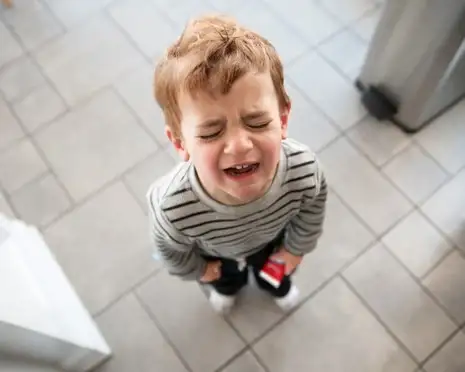
Reason 1: Your Brain Cannot Fully Ignore That Sound
Toddler whining is designed to get attention.
That does not mean your child is being manipulative in some adult, calculated way. It means their young brain has discovered a sound that works when they are tired, hungry, bored, frustrated, or unable to explain what they need.
For adults, that sound can feel almost impossible to tune out.
Your brain is built to notice child distress. A young child’s cry or whine cuts through background noise because, from a survival point of view, adults needed to respond when children signaled discomfort or danger.
So when your toddler whines, your body may react before your calm parenting brain has a chance to speak.
Your shoulders tighten.
Your jaw locks.
Your patience disappears faster than you expected.
You are not choosing to be annoyed. Your nervous system is being pulled into alert mode.
That is why whining can feel so much worse than ordinary talking. Your brain does not file it as “background noise.” It files it as “something needs my attention now.”
Reason 2: Whining Feels Like a Problem With No Button
When a child cries hard, the situation is often clearer.
They fell.
They are hurt.
They are scared.
They need comfort.
You may still feel stressed, but at least you know what direction to move in.
Whining is different.
If you give in, your toddler may start whining about the next thing.
If you ignore it, they may follow you around and whine louder.
If you snap, they may stop for thirty seconds, then begin again with a new complaint.
If you kneel down and explain calmly, they may not hear a word because they are already too tired or frustrated to process logic.
That is what wears parents down.
Not just the sound.
The helpless feeling underneath it.
Nothing I do works.
I cannot make this stop.
I am losing control.
That feeling is often what makes you angry. Your anger is not only about the snack, the song, or the checkout line. It is about being trapped in a loop you cannot quickly fix.
Reason 3: Whining Usually Happens When You Are Already Loaded
Toddler whining rarely happens at a peaceful moment when you are sitting in a quiet room with endless emotional capacity.
It happens when dinner is burning.
When you are late.
When you are carrying groceries.
When the baby is crying.
When you have answered the same question twelve times.
When you have not had a private thought since breakfast.
So the whine lands on top of everything else.
It is not just one sound. It is the final drop in a cup that was already full.
This is why you might handle whining calmly at 9 a.m. and completely lose patience at 6 p.m.
The child is not necessarily worse.
Your nervous system is more tired.
Reason 4: Your Toddler Is Asking, But Not in a Voice You Can Handle
Most whining is a request in a hard-to-hear form.
Under the whine, your toddler may be saying:
“I need help.”
“I am tired.”
“I want control.”
“I do not know how to wait.”
“I want connection.”
“I am frustrated and I do not have better words yet.”
That does not mean you should give them everything they ask for.
It means the goal is not only to stop the sound. The goal is to teach a better way to ask.
What to Do When Toddler Whining Starts
Next time your toddler whines, try one simple response.
Put your finger gently near your lips, then point to your ear.
Say calmly:
“I’m listening. Use your normal voice.”
That sentence does two things.
First, it tells your child you are not ignoring them.
Second, it sets a clear condition: I can help when I can understand you.
You can repeat it without adding a lecture.
“I’m listening. Normal voice.”
If they try again in a calmer voice, respond immediately.
“Thank you. Now I can hear you. You want water.”
This teaches your toddler that whining is not the most effective path, but clear communication is.
Do Not Reward the Whine, Reward the Repair
If your toddler whines, “I want juice,” and you immediately give juice, the brain learns:
Whining works.
But if you say, “Normal voice,” wait for even a tiny improvement, and then respond, the brain learns something different:
Trying again works.
You do not need a perfect polite sentence from a toddler.
You are looking for a small shift.
A slightly calmer voice.
A clearer word.
A pause.
A point instead of a scream.
Then you name it:
“That voice helps me understand you.”
What If You Are About to Snap?
Sometimes the best parenting move is not a perfect sentence. It is a pause.
If you feel yourself about to yell, lower the demand on yourself.
Take one breath.
Put both feet on the floor.
Say:
“I need one second.”
If your child is safe, turn your body slightly away, sip water, or place your hands on the counter for a moment.
You are not abandoning them. You are stopping your own stress response from taking over the room.
Then come back to the same sentence:
“I’m listening. Use your normal voice.”
Why Understanding This Helps
Once you understand why toddler whining is so annoying, something changes.
You stop thinking:
“I am a terrible parent for being irritated.”
And you start thinking:
“My brain is reacting to a hard-to-ignore sound, and my child still needs help learning a better way to ask.”
That shift matters.
Shame makes you explode faster.
Understanding gives you a little space.
And sometimes a little space is enough to choose your next sentence instead of letting the whine choose it for you.
FAQ: Why Is Toddler Whining So Annoying?
Q: Why is toddler whining so annoying to parents?
A: Toddler whining is annoying because it is hard for the adult brain to ignore. It pulls attention, creates stress, and often happens when parents are already tired or overloaded.
Q: Is my toddler whining on purpose?
A: Not in the adult sense. Toddlers often whine because they are tired, hungry, frustrated, bored, or do not yet have the emotional skills to ask calmly.
Q: Should I ignore toddler whining?
A: Ignoring can sometimes make whining louder. A better approach is to acknowledge your child while setting a clear limit: “I’m listening. Use your normal voice.”
Q: How do I stop losing my temper when my toddler whines?
A: First, pause your own stress response. Take a breath, lower your voice, and use one repeated phrase. The goal is not to feel perfectly calm, but to avoid joining the chaos.
One Last Thing
Now you know why toddler whining is so annoying.
Your brain is not weak. Your ears are not dramatic. Your patience is not broken.
Whining is hard to ignore, and it traps you in a loop where nothing seems to work.
But next time, you do not need a whole parenting strategy.
You need one calm sentence:
“I’m listening. Use your normal voice.”
Say it once.
Say it again.
Then reward the smallest better attempt.
That is how the loop starts to break.