I was watching a crow the other day. It landed on my neighbor’s fence, dropped a walnut on the driveway, and waited for a car to run over it. The nut cracked. The crow ate. I stood there, coffee in hand, feeling a little stupid.
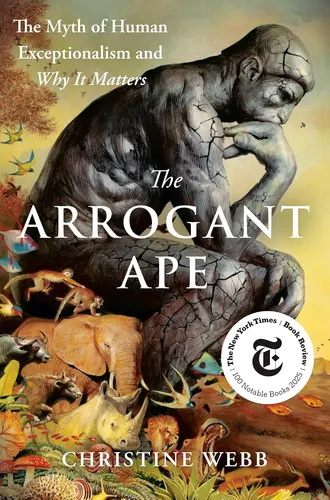
Why do we believe humans are the only ones who plan, who feel, who know? Christine E. Webb asks this question in The Arrogant Ape. It is not an angry book. It is a quiet, patient dismantling of our oldest myth. We are the chosen species. We have language, morality, and self-awareness. But Webb looks at the evidence and says: are you sure?
The book is a mirror. And what I saw in it made me uncomfortable. What if our arrogance is just a story we tell ourselves to feel less alone?
Character and Plot: The Protagonist Is Us, and We Are Not the Hero
Webb does not write about one person. She writes about a species. The protagonist is the arrogant ape itself. Us. We are the ones who built zoos, who study animal cognition with the assumption that we are the baseline. The book’s plot is simple: we meet animal after animal that does something we thought only humans could do.
There is the dolphin who recognizes itself in a mirror. The elephant who grieves her dead calf for days. The octopus who solves a puzzle to get food, then solves it again when the researchers change the rules. Webb describes these moments with a calm, almost surgical precision. She does not romanticize them. She lets the facts sit there.
I found myself holding my breath during the chapter on corvids. Crows remember human faces. They hold grudges. They teach their young which humans are dangerous. One experiment showed that a crow could use a tool to reach a tool to reach a piece of meat. Three steps. That is planning. That is foresight.
The core conflict is not between humans and animals. It is between what we know and what we refuse to admit. Webb builds this tension slowly. She shows us the evidence. She shows us how we dismissed it for decades. She does not shout. She just points.
Theme and Imagery: The Mirror We Never Wanted to Look Into
The core theme is humility. Webb uses one image again and again: the mirror. Not just the mirror test for self-awareness in animals, but the mirror we hold up to ourselves. We look at animals and see what we want to see. We see instincts, reflexes, nothing more. But the mirror cracks when a chimpanzee learns sign language and asks: “Who are you?”
Webb also uses the image of the border. A border between human and animal, between mind and instinct, between culture and nature. She shows how scientists have spent centuries drawing and redrawing this border. Every time an animal crosses it, we move the line. Tool use used to be the border. Then chimps used sticks to fish for termites. So we moved the border to language. Then apes learned sign language. So we moved it to morality. Then we saw rats sharing food with strangers.
It is exhausting, honestly. The border keeps moving because we cannot bear to be ordinary. Webb does not say this directly. She does not need to. The pattern is clear.
What I loved most was her honesty about the limits of science. We cannot know what an animal feels. We can only observe behavior. But that is also true of other humans. I do not know what you are feeling right now. I just guess. Webb suggests that we might be too conservative in our guesses. Maybe we underestimate animals not because of evidence, but because of pride.
Elevation and Call to Action: What Do We Lose by Being Arrogant?
I finished this book feeling smaller. It was not a bad feeling. It was like looking at a photograph of Earth from space. You realize how tiny you are, and somehow that makes you breathe easier.
Webb’s argument has resonance beyond biology. It touches philosophy, ethics, and even religion. If animals think and feel, what does that mean for how we treat them? If they have culture, what does that mean for conservation? If they grieve, what does that mean for the way we kill them for food?
The book has a flaw, though. Webb is too careful. She stays inside the lab, inside the data. I wanted her to push harder. I wanted her to say: look, if we are not special, then our entire moral framework might be wrong. She hints at it. She never quite says it.
But maybe that is the point. Maybe the book is a mirror too. It shows you the evidence, and then it waits. It waits for you to draw your own conclusion.
I have been thinking about that crow ever since. It was not just solving a problem. It was living a life. It had a morning, just like I did. It had a goal, just like I did. The only difference was the shape of the body, the shape of the mind.
Maybe that is the real question of The Arrogant Ape. Not whether animals are like us. But whether we are brave enough to admit that they might be.
