I was sitting on my couch, scrolling through Netflix, when my friend texted me a photo. It was a girl, maybe twelve, sleeping on a subway grate in midtown Manhattan. A coat over her face. My friend wrote, “I walked past her. I didn’t know what to do.” I didn’t either. That’s the thing about poverty in America. We see it, but we don’t see it. We look away because looking feels like a commitment we can’t make. Then I picked up Andrea Elliott’s Invisible Child, and I realized: I had been asking the wrong question. It’s not “What can I do?” The real question is harder: What does it mean to truly see someone, and what happens when we refuse to?
A Girl Who Carries the World on Her Shoulders
Dasani Coates is eleven when we meet her. She lives with her parents and seven siblings in a Brooklyn homeless shelter. The shelter smells like mildew and stale urine. The ceilings leak. Roaches crawl over her baby sister’s face. I’ll be honest: reading the first hundred pages, I wanted to put the book down. Not because it was bad, but because it was too much. Dasani has a mother who loves her but is drowning in addiction. A father who tried but failed. School administrators who see her as trouble. And yet.
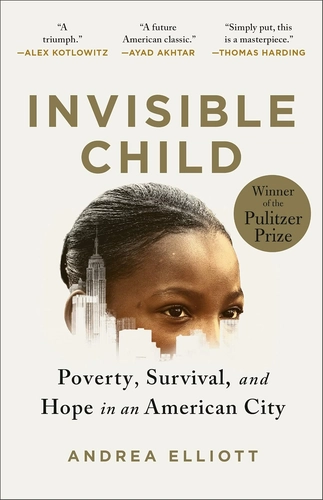
And yet she walks into her fifth-grade classroom every morning, head high, shoulders back. She recites poetry. She dreams of becoming a lawyer. She protects her little brother, a boy with a speech impediment who gets bullied. She does all of this while her stomach is empty and her shoes have holes. Elliott never sentimentalizes her. Dasani is not a saint. She fights, she lies, she steals a bag of chips from the corner store. She is a child acting like a child in a world that punishes children for being children. The core conflict is simple and brutal: Dasani wants to be seen as someone, but the system only sees a case number. Elliott traces this tension through eight years. She follows Dasani from the shelter to a foster home, from school suspensions to moments of unexpected grace. I won’t tell you how it ends, because you need to live through it yourself. But I will say this: the book does not offer rescue. It offers something more rare. Presence.
The Light That Finds a Crack in the Floor
Elliott’s craft is quiet and surgical. The key imagery in Invisible Child is light. Or rather, the absence of it. The shelter has no windows in the stairwells. The family’s room gets sunlight only for an hour in the afternoon. Dasani’s mother, Chanel, talks about being “in the dark” constantly. It’s not just literal. It’s the darkness of not knowing where your next meal comes from. The darkness of a mother who can’t protect her children. The darkness of a society that looks away.
But here’s the subtle light Elliott finds. It comes in small moments. Dasani’s teacher, Miss H., who stays after school to help her with math. A social worker who brings her a new pair of sneakers without being asked. The way Dasani’s father, Supreme, tells her she is “the one who will break the cycle.” These moments are not heroic. They are not enough. But they are real. Elliott shows how hope lives in the cracks. It doesn’t erase the darkness. It just reminds you the darkness isn’t total. The universal pattern here is hard to stomach: we reward resilience, but we rarely ask why resilience is necessary in the first place. We praise the girl who overcomes, but we don’t fix the system that made her have to overcome.
What We Owe Each Other
I finished Invisible Child three days ago. I haven’t stopped thinking about it. The book is not just about Dasani. It’s about every invisible child in every American city. It’s about the lie we tell ourselves, that hard work alone is enough. Dasani works harder than anyone I’ve ever met. She is still poor. The book’s resonance across eras is devastating. In the 1990s, we had the same conversations about welfare reform. In the 2000s, we had Hurricane Katrina. In the 2020s, we have the pandemic. The faces change. The story stays the same. We build shelters, but we don’t build homes. We fund programs, but we don’t fund dignity.
There is a moment near the end where Dasani says, “I’m tired of being a statistic.” It broke me. Because she is not a statistic. She is a girl who loves hip-hop, who writes poetry about her grandmother, who wants to be a mother one day. She is a person. The core insight of Invisible Child is this: we don’t need more pity. We need more presence. We need to stop looking away. We need to ask not “How can I save you?” but “How can I stand beside you?” Dasani taught me that seeing someone is not a passive act. It is a commitment. And it might be the only thing that saves us.
