I found an old ring in my grandmother’s drawer last year. No story came with it. Just a tarnished band and the sense that someone had worn it for decades. I never asked. Now I wonder what I lost by not asking.
Tiya Miles’s All That She Carried starts with a similar question. In the 1850s, a woman named Rose, enslaved in South Carolina, gave her nine-year-old daughter Ashley a cotton sack. Inside: a few pecans, a braid of hair, a worn dress. That is almost all we know. The sack survived. The women did not. How do you write a history when the people themselves left no letters, no diaries, no names on a census? How do you honor a love that had no witnesses?
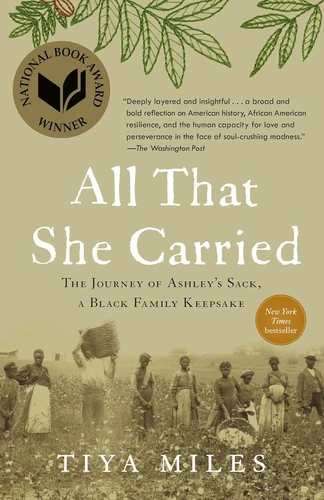
The Protagonist Who Never Speaks
Ashley is the center of this book. She never says a word. No diary entry. No recorded voice. She exists only through the sack her mother gave her and the line her granddaughter Ruth embroidered on it in 1921: “My mother gave me this sack.” That is the whole archive.
Miles does something careful here. She does not pretend to know what Ashley felt when a trader took her away. She does not invent dialogue or fill in emotional gaps with fiction. Instead, she reads the object itself. The fabric. The stitches. The type of pecan that would have grown in that region. She builds a world around what remains.
The core conflict is obvious but brutal: a mother tried to save her daughter with a handful of nuts and a piece of cloth. That was all she had. That was everything. Miles traces the sack through five generations, from Ashley to her descendants who made it to freedom, to the family who kept it for over a century. The suspense is not about what happens. It is about whether the evidence will hold. Whether a single object can carry enough meaning to make a life visible.
I will not tell you how the story ends. But I will say this: the sack does not provide closure. It provides presence. That is different.
A Braid, A Nut, A Nation
The core theme here is erasure. Not just the erasure of enslaved people from official records, but the quieter erasure inside families. The things we do not say. The questions we never ask until it is too late.
Miles uses the sack as an anchor. Every chapter circles back to it. She describes the pecans as “food, but also a prayer.” The braid of hair becomes a kind of archive: DNA before DNA existed. The dress is the mother’s own body, given away. The imagery is never decorative. Each object carries weight because the people who owned them had no other way to speak.
This is where Miles’s craft shines. She is a historian, but she writes like a poet who trusts her reader to sit with ambiguity. She admits when she does not know. She speculates, but she marks her speculation. “Perhaps Rose tore a strip from her own skirt,” she writes. “Perhaps Ashley held the braid at night.” The language stays humble. It stays human.
What I found most moving was how the book refuses to turn suffering into inspiration. There is no triumphant arc here. Just survival. Just a sack that was carried from one century to the next by women who could not write their names but who knew exactly what they were saving.
What This Book Asks of Us
I finished All That She Carried on a Sunday afternoon. I sat in my kitchen and looked at the objects around me. A ceramic bowl I bought at a flea market. A photograph of my great-grandfather I cannot identify. I realized I had been treating these things as decoration. The book asked me to treat them as evidence.
This is the core insight: objects do not just hold memory. They hold love that could not be expressed any other way. Rose could not write a letter. She could not make a phone call. She could not hold her daughter’s hand for more than a few minutes. So she gave her a sack with pecans and a braid and a dress. That was her I love you. That was her I will find you. That was her you will not be forgotten.
The book has one limitation. It is slow in the middle. Miles spends pages on the history of cotton cultivation, the legal status of enslaved property, the details of a single seed. I felt the pace drag. But later I understood: she was building a scaffold for the small, fragile story at the center. Without that scaffold, the sack would just be a curiosity. With it, the sack becomes a monument.
Who should read this? Anyone who has ever held an object they did not understand and felt it matter. Anyone who has lost a story before they could save it. Anyone who wants to see what scholarship looks like when it is humble and fierce at the same time.
What you get from reading it is not a neat answer. It is a better question: what am I carrying that I do not yet know how to read?
