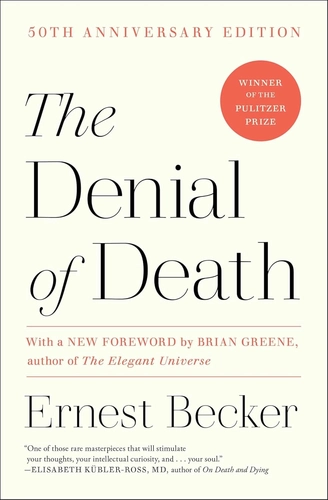
I woke up at 3 AM last Tuesday. Not from a nightmare, exactly. More like a low-grade panic about a project deadline that felt, in that dark hour, like a matter of life or death. I got up, made tea, and found myself staring at my bookshelf. My copy of The Denial of Death by Ernest Becker sat there, spine unbroken, a prize-winning book I’d been avoiding for years. I pulled it down. I thought I was reading about psychology. I was actually reading about myself.
What if my entire life was just a performance? Not for an audience of people, but for something much bigger and more terrifying. What if every ambition I have, every goal I set, every fear of being “ordinary” is just a very elaborate way of saying, “Please don’t let me disappear”? That is the question Becker asks, and it is the question this review must answer.
The Hero Who Fights Against Nothingness
Becker’s central character isn’t a person. It is every person. He calls it the “hero.” The human hero. We are all, he argues, trying to create a “heroic project.” We want to be significant. We want our life to mean something. I think about my friend who works 80-hour weeks in finance. He says it’s for his family. But I wonder. I really do. Is it for his family, or is it for the feeling of being indispensable? Becker says the latter.
The core conflict here is not between good and evil. It is between life and the awareness of death. We are the only animals who know we are going to die. This knowledge is unbearable. So we build a “character armor.” We create a personality, a career, a reputation. All of it is a lie, a beautiful lie, that protects us from the raw terror of non-existence. You don’t need me to reveal the ending of this book. There is no happy ending. There is only understanding. And that understanding, I found, is both devastating and liberating.
The Stage, The Costume, and The Shadow
The core theme of The Denial of Death is this: we are all in denial. But it is not a simple denial. It is a creative, desperate, and tragic denial. Becker uses the imagery of a stage. We are actors in a play. The play is our life. We wear costumes of success, of love, of knowledge. But behind the curtain? The void. The quiet, waiting emptiness.
The key imagery for me was that of the “immortality project.” We do not just want to live. We want to live forever. So we build things. Companies. Books. Families. Reputations. These are our monuments against the shadow. We pour our life force into them, hoping that when our body is gone, our name will remain. It is a beautiful, fragile thing. I look at my own writing. I want it to matter. But Becker whispers a hard truth. The monument will also crumble. The only honest response, he suggests, is not to give up the project. It is to understand why we have it. To be less cruel to ourselves for having it.
A Heavy Glass of Water, and a New Kind of Freedom
Here is what I finally understood, sitting in my kitchen at dawn. Becker’s argument is not a call to despair. It is a call to humility. It isn’t about giving up ambition. It is about seeing it for what it is. A shield. A very human shield. The book’s weakness, I think, is that it is relentlessly dark. It gives you the diagnosis but leaves you alone with the medicine. There is no simple prescription for how to live after you know this.
Who is this book for? Anyone who has ever felt a strange, hollow ache at the peak of success. Anyone who has wondered why they care so much about what strangers think. It is for the restless. The driven. The secretly terrified. What you get from it is not peace. It is a clearer, more honest view of the battlefield. You see your own fear. And maybe, just maybe, seeing it makes it a little less powerful.
I closed the book. I did not feel better. I felt seen. I felt the weight of my own performance, and I felt a flicker of something else. Maybe it was permission. Permission to be small. Permission to be temporary. Because that is what we all are, really. Temporary actors on a temporary stage. And maybe that is enough. It has to be. It is all we get.
