The first time my debit card got declined buying oatmeal, I wanted to disappear. Oatmeal. Generic oats in a cardboard tub that cost maybe $3. That was four years ago, standing in a fluorescent-lit grocery aisle, hoping the woman behind me hadn’t seen. I had a job, worked overtime, and still ran out of money 10 days before payday every single month. How was that even possible?
I kept asking myself: what am I doing wrong? Other people seem to figure this out. They buy coffee without checking their banking app first. They don’t panic at gas station pumps. The stress of living on empty was eating me alive. If that sounds familiar, I want to share what I did—the specific steps that actually moved the needle for me. Some of this might surprise you. It surprised me.
Quick note on me: I’m not a financial advisor. I’m someone who spent years wondering why I was broke even with two jobs. These are the steps that actually got me out.
Quick Living Paycheck to Paycheck Solutions Today
If you’re stuck in the cycle right now, start here:
- Track every dollar spent for exactly one week. Write it down in a notebook.
- Look directly at your car situation, even if it hurts.
- Switch your phone plan immediately. There’s almost certainly a cheaper option.
- Cook a big pot of something cheap this weekend. One pot, three meals.
- Stop using credit cards for anything new, right now.
Why Do I Feel So Broke Even Though I’m Working All the Time?
I worked more hours than anyone else. Two jobs. I was exhausted. And I was still broke. It made no sense.
What I finally had to admit: my car was eating me alive. Not metaphorically. Literally. My payment was $588 a month. My insurance was $164. Gas ran $80 or so. Total: over $830. Before I ate a single meal or paid a single bill. My income at the time was around $1,200 a month, if shifts held steady. Do that math. Over two-thirds of every dollar I earned went to that car.
I didn’t want to see it. That car felt like the one nice thing I owned. Giving it up felt like admitting failure. But the math doesn’t care about your dignity or your feelings or how hard you worked for it. The math just is what it is.
If you’re feeling lost right now, start with one thing: what is your biggest fixed cost? Is it more than 50% of your income? Because if it is, no amount of cutting lattes will fix the problem. You have to deal with that one monster first.
What Is the First Realistic Step I Can Take When I Have Nothing Saved?
Here’s what I did. It sounds too simple to work. But it works.
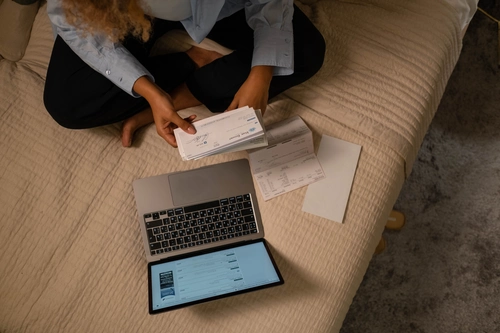
I sat down on a Sunday afternoon with a notebook—not an app, not a spreadsheet. A physical notebook. And I wrote down every single thing I spent money on for the previous week. Not categories. Specific things. The $2.89 at the gas station. The $11.42 fast food lunch. The weird subscription I forgot about.
This exercise took 20 minutes. And I found $87 in spending I had zero memory of. Zero. I couldn’t tell you what I ate or why I spent it. That $87 was almost my electricity bill that month.
The next week, I tracked spending in real time. Every night, three minutes. Just wrote down the day’s spending. This sounds obsessive. But it woke me up. I started pausing before purchases. Asking: do I actually need this, or do I just want it right now?
Some people call this a spending journal. Call it whatever you want. But if you’re serious about living paycheck to paycheck solutions, start here. Just one week of full awareness.
When you review it, ask yourself three questions: Did this purchase move me closer to stability? Did I even remember buying this? Could I have eaten something at home instead?
Picking One Thing to Change First
You can’t change everything at once. You’ll quit by Wednesday. I know because I did that too. Made a huge list of rules, felt virtuous for three days, then ordered pizza at 10 p.m. on a stressful night and gave up entirely. Twice.
What finally worked: pick one thing. One. The biggest, most obvious money leak. And change that one thing for 30 days.
For me, it was food. I ordered delivery constantly. DoorDash knew my address by heart. I was probably spending $300 a month on food I could have made myself for $80.
So I bought a cheap slow cooker from Goodwill for $7. I learned to make three things really well: chili, lentil soup, and chicken thighs with rice. I cooked on Sundays for the whole week. Was it boring eating the same thing? A little. But my food spending dropped by almost $200 that first month. Two hundred dollars I could put toward debt.
A friend of mine who was also struggling chose her car. She sold it to CarMax, paid off most of the loan, and bought a used Honda for $3,500 cash. No payment. Her insurance dropped. She said it felt like a pay raise. She was terrified to do it. But three months later she told me it was the best decision she’d made in years.
What’s your one thing? You know what it is. Everyone knows their biggest leak. Pick it. Change it for 30 days. Then pick the next one.
How Do I Deal With Credit Cards When I’m Barely Surviving?
Credit cards terrified me. Still do, honestly. Mine was at $2,000 and I paid the minimum every month, which meant I was basically paying for the privilege of staying in debt forever.
I stopped using credit cards entirely. Cold turkey. Cut them up, removed them from every app. Used only my debit card or cash. This felt scary but also weirdly freeing. I couldn’t spend what I didn’t have.
Then I called the credit card company. I asked if there was any way to lower my interest rate. The person on the phone said, “Let me check.” Two minutes later, they lowered it. Not a lot. But something. Call yours. The worst they can say is no.
I also learned something I wish I had known earlier: pay more than the minimum. Even if it’s just $20 extra. The minimum payment is designed to keep you paying for years. Adding even a small extra amount each month cuts months off your repayment time.
What worked for me psychologically: I paid my smallest debt first. Not the highest interest rate. The smallest. Mathematically not optimal. But emotionally? Huge. Crossing off that first debt felt so good I wanted to keep going.
Can I Find Living Paycheck to Paycheck Solutions If My Income Is Too Low?
Hard truth: sometimes you can’t cut your way to stability. Sometimes you need more income.
I’m not saying get a second job. You probably already have one, or you’re already exhausted. I was. Maybe what you need is one better job instead of two bad ones.
When I was 23, which wasn’t that long ago, I was making $300 every two weeks. That’s $600 a month. You cannot live on that. You can’t budget your way out of poverty. You need more money coming in.

I want to tell you something that someone told me when I was at my lowest and it stuck with me for years. We were in a break room at some temporary job. I was complaining about the pay. He said, “Your car payment is more than your rent would be in some places. You’re not poor. You’re car-poor.” He was rude about it. But he wasn’t wrong.
Look around at what’s actually available. A full-time warehouse job in my area starts at $18 an hour. A pharmacy technician trainee earns $16 and gets certified for free. Amazon, for all the bad things people say, pays reliably and offers overtime. One job with steady hours and benefits beats patching together two or three jobs that keep cutting your shifts.
Is trade school or certification an option? Becoming a radiology tech changed a friend’s life. Two years of training, then a starting salary that made her car payment irrelevant. I’m not saying it’s easy or fast. But think about where you want to be in two years, not just next month.
Selling Things and Finding Support
What about selling things quickly when bills are due?
Facebook Marketplace saved me more than once. Not a long-term solution. But when I needed $50 for the electric bill, I looked around my apartment and found stuff. Old video games. A lamp I never used. A jacket that was too small.
That first time, I made $65 in one evening. It felt like a miracle. Not because of the amount. Because I realized I had resources I wasn’t using. That gave me a tiny sense of control when everything else felt out of control.
How do I find support when I have no one to ask?
I didn’t have anyone either. My family was in no position to help. My friends were all just as broke. I felt completely alone trying to figure this out.
What helped: I found communities online where people talked honestly about money. Not judging, not showing off. Just sharing what worked. Subreddits, YouTube channels about frugal living. Hearing other people’s stories, especially people who had climbed out of worse holes than mine, gave me hope.
One book someone recommended changed how I thought about money entirely: The Richest Man in Babylon. It’s old. The language is weird. But the principles are so simple and so true that I still follow them.
FAQ: Living Paycheck to Paycheck Solutions
Q: How do I start living paycheck to paycheck solutions when I have nothing left after bills?
A: Start with one week of tracking. Don’t change anything yet—just observe. You’ll almost certainly find leaks you didn’t know existed. Then pick one thing to change for 30 days. The $7 slow cooker changed my entire food budget.
Q: What are the biggest traps that keep people stuck in the paycheck cycle?
A: Car payments that are too high, credit card minimums that never end, and delivery food subscriptions you don’t notice. Attack those first. A $500 car payment on a $2,000 monthly income is a trap. A $30-a-week DoorDash habit is $1,500 a year.
Q: Should I stop paying my credit cards if I can’t afford them?
A: No. Call the company and ask for help. They have hardship programs. A payment plan you can actually afford is better than ignoring the debt and making it worse. I lowered my interest rate by just asking.
Q: Can living paycheck to paycheck solutions work if I have debt?
A: Yes. I had $2,000 in credit card debt when I started. The solutions still worked. Pay your smallest debt first for the emotional win, then keep going. The momentum matters more than the math in the beginning.
Q: What if I’ve tried all this and it still doesn’t work?
A: Then the problem might be on the income side, not the spending side. Look for one better job instead of two bad ones. Trade school, certification, or even a different employer can change your baseline. You can’t budget your way out of $600 a month.
One Last Thing
I was in my kitchen three days ago, making oatmeal, and I wasn’t scared. I had just looked at my bank account and there was money there—money that would still be there next week even after bills. It’s not much. But that feeling, waking up without the knot in my stomach, no longer living paycheck to paycheck, is something I will never take for granted. You can get there. One small honest decision at a time.
References
- Ramsey, D. (2013). The Total Money Makeover. Thomas Nelson.
- Clason, G. S. (1926). The Richest Man in Babylon. Penguin Books.
- Warren, E., & Tyagi, A. W. (2005). All Your Worth: The Ultimate Lifetime Money Plan. Free Press.
