I sat on my kitchen floor, cross-legged, with a mug of tea going cold. My four-year-old nephew had just asked me to name all fifty states. I stalled. I could get maybe thirty. Then I saw this book on my coffee table: Sing the 50 United States! by Dr. Seuss.
The cover was bright, the Cat in the Hat was grinning. I opened it, hoping for a secret weapon. What I found instead was a strange, incomplete feeling. It was like finding a half-finished drawing in a master’s notebook. You admire the lines but you feel the absence. The question I kept asking myself was: does this book actually work as a book, or is it just a piece of fan memorabilia dressed up as one?
What the Cat Does with the States
The Cat in the Hat appears with Thing One and Thing Two. They are putting together a puzzle of the United States. The text is a rhythmic chant of state names, starting with Massachusetts and jumping around. Minnesota. Missouri. Montana. It feels like a list you might sing on a long car ride.
The protagonist here is not a character with a struggle. It is the Cat himself, a familiar guide. He leads us through the states, but there is no real story. No conflict. No problem to solve. One reviewer noted that a state is almost omitted, which creates a tiny bit of suspense. But honestly, the core of the book is a recitation.
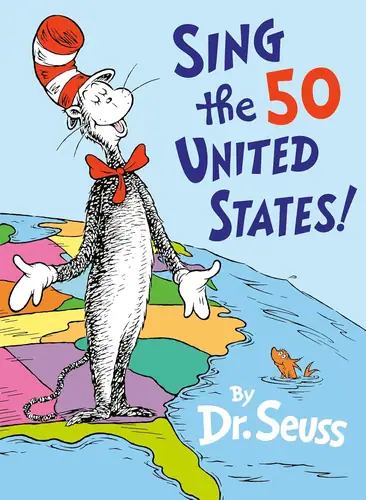
What struck me was the lack of narrative drive. Dr. Seuss always had a story, even in his nonfiction like Oh, the Places You’ll Go! This feels more like a song without a verse. The illustrations by Tom Brannon are faithful to Seuss’s style, but they are too clean. Too uniform. The original sketches, shown in the publisher’s note, have more life. The book is beautiful to look at but it does not pull you forward. It just presents.
A Pattern of Fragments
The core theme here is memory and identity. Knowing the names of the states is a way of knowing where you belong. The key imagery is the puzzle. The states are pieces being fitted together. It is a nice visual for unity.
But the author’s craft feels incomplete. The rhymes are there, but they are not as playful as Seuss at his best. One reviewer complained, “Where’s my damn fun rhyme schemes?” I get it. The rhythm is functional, not magical. The order of states is not alphabetical or geographical. It feels random. Some readers were bothered by this. Others, like me, found it disorienting.
The publisher’s note at the end explains that the manuscript was discovered in Geisel’s archives. It was never finished. This explains everything. The book is a fragment. It shows us Seuss’s process, his early thinking. But it is not his finished work. The strongest cage was never the puzzle itself. It was the expectation that a Seuss book should be a complete, joyful world. This one is a door left ajar.
What This Book Really Gives You
Let me be honest. This book is good for collectors. For fans who want every scrap of Seuss. It is good for children who already love the Cat and want a simple chant to learn state names.
But it has problems. It is not very story-driven. It lacks the zany energy of Green Eggs and Ham or The Cat in the Hat. The illustrations, while pretty, feel generic. They do not surprise you. The book is also not great for teaching geography deeply. It just names states. No terrain, no landmarks, no context.
I read it with my nephew. He liked saying the names aloud. But after five minutes, he asked for a different book. “This one is boring,” he said. He was not wrong.
What I took away was a lesson about unfinished things. Sometimes a manuscript should stay in the drawer. Ted Geisel obviously did not think it was ready. The publisher’s note says he put it aside. Maybe he knew something.
This book won’t teach your child everything about America. But it will make you feel slightly less alone in the moment when you realize even the Cat in the Hat cannot make a list feel like a story. It raises a question: when we love an artist, do we want their best work, or do we want everything they touched?
